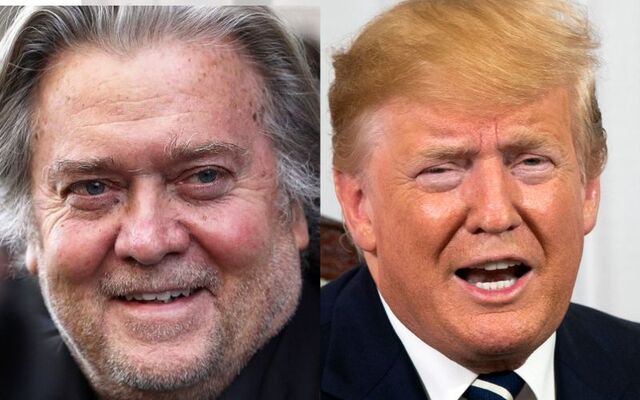
Steve Bannon, who served as the White House's chief strategist during US President Donald Trump's first term, says he is "working behind the scenes" to form a nationalist party in Ireland.
Bannon, 73, mentioned Ireland while discussing the recently published National Security Strategy of the United States of America in an interview with Politico.
The strategy, signed by Trump, claims in part: "The larger issues facing Europe include activities of the European Union and other transnational bodies that undermine political liberty and sovereignty, migration policies that are transforming the continent and creating strife, censorship of free speech and suppression of political opposition, cratering birthrates, and loss of national identities and self-confidence."
It adds: "We want Europe to remain European, to regain its civilizational self-confidence, and to abandon its failed focus on regulatory suffocation."
It later states: "America is, understandably, sentimentally attached to the European continent— and, of course, to Britain and Ireland. The character of these countries is also strategically important because we count upon creative, capable, confident, democratic allies to establish conditions of stability and security. We want to work with aligned countries that want to restore their former greatness."
According to Politico, the strategy "prompted gasps of horror from European capitals," though Bannon is "clearly gleeful" and is "clearly relishing upcoming opportunities to amplify the radical populist message across Europe."
Bannon told Politico: “I think MAGA will be much more aggressive in Europe because President Trump has given a green light with the national security memo, which is very powerful."
According to Politico, Ireland is first up in Bannon's "schemes to smash the [European] bloc’s liberal hegemony and augment the Trump administration’s efforts."
Bannon, who is of Irish and German descent, told Politico: “I’m spending a ton of time behind the scenes on the Irish situation to help form an Irish national party."
He claimed: “They’re going to have an Irish MAGA, and we’re going to have an Irish Trump. That’s all going to come together, no doubt. That country is right on the edge thanks to mass migration."
In 2020, Bannon and three others were indicted by the US Attorney’s Office for the Southern District of New York in connection with an alleged conspiracy to defraud donors to a crowdfunding campaign called “We Build the Wall.” However, on January 20, 2021 - the final day of Trump's first term in office - Bannon received a presidential pardon on the federal matter; his co-defendants received no pardon.
In September 2022, Bannon was charged in a New York State Supreme Court indictment with two counts of Money Laundering in the Second Degree, two counts of Conspiracy in the Fourth Degree, one count of Scheme to Defraud in the First Degree, and one count of Conspiracy in the Fifth Degree.
In October 2022, Bannon was sentenced to four months in prison after being convicted on two counts of contempt of Congress stemming from his failure to comply with a subpoena issued by the House Select Committee investigating the January 6, 2021, breach of the US Capitol.
Earlier this year, as part of a plea deal for the September 2022 charges in New York, Bannon pleaded guilty to one count of scheme to defraud. He received a three-year conditional discharge and is barred from fundraising for or serving as “an officer, director, or in any other fiduciary position” for any charitable organization with assets in New York state.
In October, Bannon told The Economist that "there is a plan, and President Trump will be the President in '28," despite the US Constitution's 22nd Amendment dictating that "No person shall be elected to the office of the President more than twice."
While there are MAGA supporters in Ireland, recent voting trends are not indicative of a widespread shift toward the right, raising doubts about Bannon's claims that there will be an "Irish MAGA."
In Ireland's most recent general election in November 2024, Fianna Fáil emerged as the largest party, followed by Fine Gael and Sinn Féin. Both Fianna Fáil and Fine Gael are considered centre or centre-right - certainly not as far right as MAGA - while Sinn Féin is considered left to centre-left.
More recently, Ireland elected Catherine Connolly to become the country's tenth President, succeeding Michael D Higgins. The left-wing Independent soundly defeated Fine Gael's Heather Humphreys and Fianna Fáil's Jim Gavin, though Gavin had announced before election day that he was abandoning his run.
Notably, Irish sports star Conor McGregor, who met with US President Donald Trump in the White House on St. Patrick's Day this year, attempted to get on the ballot for this year's Presidential election after being found liable for sexual assault in 2024. Despite earning the backing of Elon Musk, a major Trump 2024 donor, McGregor was ultimately not able to garner enough support to get on the ballot.



Comments