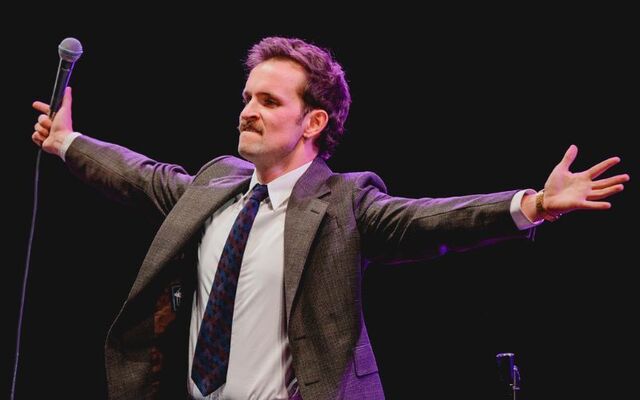
It’s not even been six years since Vittorio Angelone debuted the Socially Distant Social Club, a Covid-era comedy night, in his parents’ back garden in Belfast.
Since then, he’s toured two critically-acclaimed shows, "Translations" (2022) and "Who Do You Think You Are? I Am!" (2024), selling out countless venues around Ireland, the UK, and Europe.
His current show, "you can’t Say Nothing any more"—the cover of which is a tongue-in-cheek nod to the TV adaptation of Patrick Radden Keefe's book about The Troubles, "Say Nothing"—was the toast of last year’s Edinburgh Fringe.
Now, a few weeks shy of his 30th birthday, he’s taking it on the road again, this time to America.
View this post on Instagram
“I’m still trying to figure out Los Angeles,” he tells me when we speak over Zoom, three days after arriving stateside. “It’s a strange place.”
It’s the day before his eight-city US and Canada tour kicks off. And while he is, he admits, bewildered by the size and layout of the city, he is excited to be here and kick the "you can’t Say Nothing any more" tour off at the Netflix Is A Joke Festival.
If you haven’t yet heard of Vittorio Angelone—or are wondering how a Belfast boy got the name Vittorio (more on that soon)—he’s part of a generation of young Irish comedians who have exploded in popularity since the pandemic. While many of these comedians, like Killian Sundermann, Peter McGann, Justine Stafford, and Michael Fry, rose to prominence making hilarious front-facing camera comedy, Angelone has mostly made his name through standup and having clips from his gigs go viral.
More recent fans of Angelone might know from his podcast with Kilkenny-born, London-based comedian Mike Rice, "Mike & Vittorio’s Guide to Parenting"—which, just to be clear, has nothing to do with parenting.
And, if you’ve only heard his name in the past two months, there’s a good chance it’s because of a clip in which he humiliated Tory MP Penny Mordaunt on an English talk show for her support of Saudi arms fairs.
Angelone was born in Belfast in 1996. His paternal grandparents were emigrants from Italy who fled the violence and bombing of Italy during World War II only to settle in Belfast—a city which was, ironically, to soon become synonymous with the very things his family had fled. He is named after his great-grandfather, also Vittorio Angelone, who ran Victor’s Café, a beloved ice cream shop in the center of Belfast for many years. Angelone had grown up believing that his great-grandfather’s ice cream shop had simply closed down in the 70s until, when doing some family research, he found a New York Times article from 1975 which detailed how it had been bombed by a loyalist paramilitary organisation. A customer had found a purse that they assumed someone had forgotten and brought it to the counter, which was being staffed by a relative of Angelone’s. When he glanced inside the purse, he noticed wires and immediately threw the purse across the room. It exploded right after he’d thrown it, blowing his ear off, and injuring 38 other people.
The Troubles feature prominently in Angelone’s comedy. He is part of a generation of young people in the North known as the ceasefire babies—those born at the tail end of The Troubles but whose lives remain marked by them in countless ways. His new show, "you can’t Say Nothing any more," grapples with this head-on, asking what it means to have your identity shaped by a 30-year-long sectarian conflict in which you didn’t participate. A palpable silence stifled his parents’ generation from talking about The Troubles. Whether out of a fear of recrimination, a fear of stoking further violence, or simply out of sadness, that generation chose to say nothing. Angelone’s generation, on the other hand, often talks about the period with a sense of ironic detachment afforded by the passage of time.
“It seems silly, but I think 'Derry Girls' taught a global audience more about the Troubles than the 7,000 documentaries about The Troubles that have been on BBC,” Angelone told me, noting the increased interest in The Troubles, and Ireland more broadly.
“Between that and 'Say Nothing' and 'Normal People,' Fontaines DC, Kneecap and CMAT, and Sally Rooney—we’re very in vogue at the minute. I think it’s cool to know about Ireland, so I’m cashing in on the cultural cache.”
While there’s a lot more awareness now about it, Angelone doesn’t assume any prior knowledge and builds funny, educational segments into his latest show through crowd work to ensure that even those with little knowledge of the history or politics can follow along.
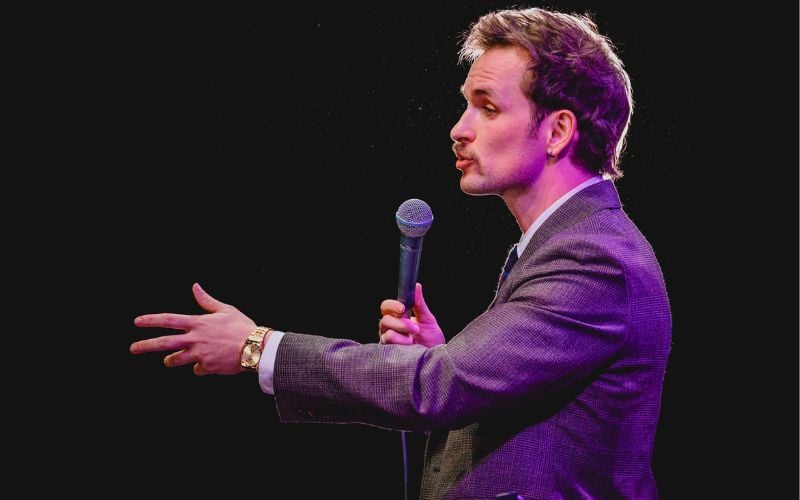

Vittorio Angelone on stage. (Ruben Navarro)
Angelone credits his parents encouraging him to take part in extracurricular activities that had both Catholics and Protestants with helping open his mind and challenge some of the binary, us-versus-them narratives that were still floating around in the post-Belfast Agreement years. After finishing school, he moved to London to study classical percussion at the Guildhall School of Music and Drama. While living there, he became interested in acting and started attending standup nights. When Covid hit, he moved back to his parents in Belfast and started the Socially Distant Social Club to keep doing what he was quickly starting to realize was his passion—standup comedy. This was not something, he told me, that he had foreseen in his own future.
“I was never funny in school,” Angelone explained. “If you ask anyone I went to school with, they think it’s absolutely mental that I’m a comedian. I was a very quiet and anxious child all the way through, but I think that’s more common. I think people assume comedians are the class clowns—and I think that’s occasionally true—but, more often, when I speak to comedians, they were quite quiet and didn’t really fit into any of the cliques in school. They could exist within them, but they weren't solidly in any of them. I think that ability to slot into different groups, but not properly get stuck in any of them—being slightly on the outside looking in—that’s much more common in my experience of talking to comedians.”
Despite this, Angelone now sees that he is part of several traditions within Irish comedy.
“I do think I’m aware that I come from a sort of lineage of comedians in Belfast, particularly.” He notes how someone like Patrick Kielty—whose father was murdered by a loyalist paramilitary organisation—was seen as a very transgressive and influential comedian, even making his first appearance on The Late Late Show (which he now presents) wearing a balaclava.
“I find it very funny nowadays that you have these comedians on Netflix saying that they’re edgy and controversial and they’re risk takers and they’re pushing the boundaries of whatever—I think that’s all complete bulls--t. There was a generation of comedians who were performing stand-up comedy about The Troubles, in Belfast, during The Troubles. That’s actually risky. That's actually pushing boundaries. That's actually testing the limits of free speech [compared] to whatever these fucking Netflix people want to talk about.”
Just as inspiring to Angelone is the generation of Irish artists coming up around him, earning fans and respect from around the world for making exactly the kind of art they want to make. We discuss the examples of Lankum, the contemporary Irish folk band revered for their heavier, darker take on trad music, and Fontaines DC.
“I think Fontaines are also a very good example of that, where it’s like there’s something intensely Irish about them,” Angelone notes, “but there’s nothing recognisably Irish. You know what I mean? It doesn’t have any of that Guinness-drinking, knee-slapping sort of paddywhackery thing, but it is authentically, modernly Irish.”
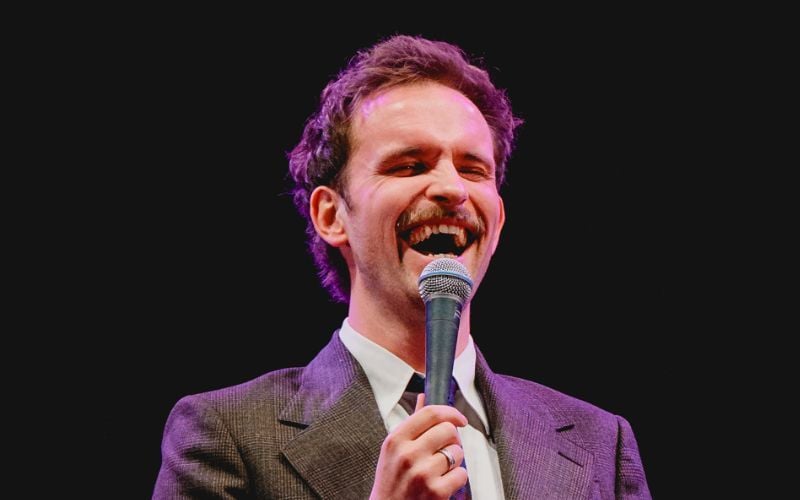
Vittorio Angelone on stage. (Ruben Navarro)
This tour is not Angelone’s first time gigging in the US. Last November, he came over to New York to do a trial run of "you can’t Say Nothing any more" at Union Hall in Brooklyn to take the temperature of American audiences. Within a day of arriving, however, he managed to land an audition slot at one of the most respected comedy clubs in the world—The Comedy Cellar. Landing an audition, never mind a slot, at the much-coveted club is a privilege for which many comedians wait years. Angelone was called into a back room by the venue’s legendary booker, Estee Adoram, who asked for his contact details and said they’d be in touch. "What did that mean?" he asked his comedian friends afterwards. Don’t worry, they assured him—he’d passed.
Over the next few days, not only did Angelone manage to get front row seats next to Method Man at a New York Jets game, he also attended the "Saturday Night Live" afterparty, ended up on a show with Neil Patrick Harris, caught Irish folk band BIIRD at The Dead Rabbit (followed by a surprise gig by Ed Sheeran), caught a Knicks game, and, perhaps most impressively of all, came down with—and recovered from—food poisoning.
“I don't think it's the maddest weekend in New York ever—that feels like a lofty bar to try and hoist myself over—but it was pretty crazy,” Angelone tells me.
While he was hoping to avoid a repeat of some things (food poisoning), he was excited to perform to a sold-out Gramercy Theater and make his debut at the Comedy Cellar.
It’s been a momentous few years for him, and the work put in is starting to pay off in very visible ways for him, with the US tour and more frequent TV appearances. How, I ask him, has he been dealing with all of it? Stay in, read a book, and try to stay off his phone—try to be boring as he can be, essentially, he tells me.
“There’s always a little f--king dopamine treadmill thing that you can get stuck in. Just trying to be super grateful and just crack on with what I’m doing. But there are crazy moments where you’re just like, I can't believe this is happening.”
His partner, he jokes, plays an important role in putting things in perspective. “My partner’s very good at being, like, none of them would be there if you got shot—f--king do the dishes!”
“I try to remember that even if people on the internet think you’re cool, or a dickhead—whatever’s happening on the internet that day—you still need to do the dishes.”
*Tadhg Hoey's writing has appeared in The Irish Times, The Brooklyn Rail, Dublin Review of Books, BOMB, The Stinging Fly, and elsewhere. You can follow him here.


Comments