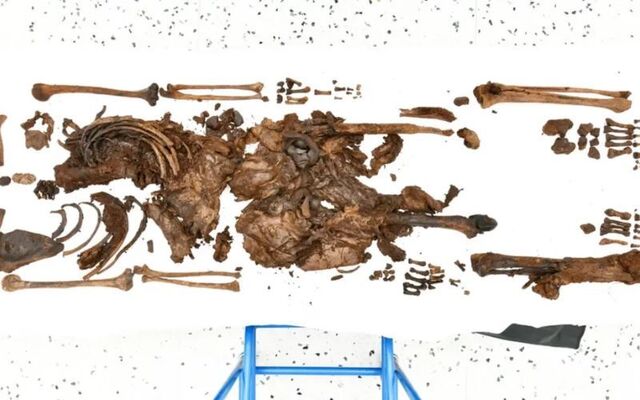
A young woman whose remains were lifted from a County Derry bog in 2023 was deliberately beheaded with a bladed weapon, most likely struck from behind, more than two millennia ago. That finding was delivered on Monday at the Ulster Museum in Belfast, where a serving coroner and experts from across Europe spent the day piecing together her short life and her violent death.
The investigation was the first of its kind held at the museum. It borrowed the structure and the methods of a modern coroner's investigation, though it was not an inquest, and was staged as an educational exercise approved by Lady Chief Justice Dame Siobhan Keegan as part of the judiciary's outreach work.
Belfast coroner Joe McCrisken chaired the day. He put the same core questions a modern inquest would ask, which are who the woman was, where she died, when she died, and how she died.
"The purpose of the exercise is not to impose modern legal conclusions upon the distant past, but to provide a framework through which the available evidence could be assessed and the story of a previously unknown young woman could be told," McCrisken said in his concluding remarks, as reported by The Irish Times.
Found in a Bellaghy bog
The remains were discovered in bogland near Bellaghy in 2023, alongside a woven artifact. Workers with Bulrush Horticulture made the find, and they gave evidence at the hearing along with officers from the Police Service of Northern Ireland.
She is known as Ballymacombs More Woman, after the townland where she came to light, following the convention of pairing the place of discovery with the sex of the person found.
Researchers established that she was female and aged roughly 15 to 22 when she died during the Iron Age. The analysis found she had been deliberately decapitated, most likely from behind, with a bladed weapon.
Read more
The work was led by National Museums NI and drew in partners including Queen's University Belfast, Trinity College Dublin, University College Dublin, the National Museum of Ireland, and the universities of Copenhagen, Glasgow, Bradford, and Manchester.
Specialists used micro-CT scanning, digital mapping, and 3D imaging, and studied her bone, hair, skin, nails, and the textile found with her. Together, those strands revealed details of her diet, her health, her appearance, and the world she lived in.
Professor Susanna Harris of the University of Glasgow and PhD researcher Nysa Loudon examined the fibrous material recovered with the body. It had been made by twining, a technique that leaves a border with a loose, hanging fringe.
Radiocarbon dating placed the plant fiber twining between 363 BC and 160 BC, a span that matches the dating of the body itself. The researchers believe the two are contemporary and possibly connected, and that the cloth may have been a garment, a body adornment, or a decorative piece laid on the ground.
Why she may have been sacrificed
How she came to die remains unknown. The evidence raises the possibility that she belongs to a wider tradition of ritual killing and sacrifice recorded in Iron Age bog bodies across northwestern Europe.
That tradition includes Denmark's Tollund Man and Grauballe Man, and Ireland's own Clonycavan Man and Old Croghan Man.
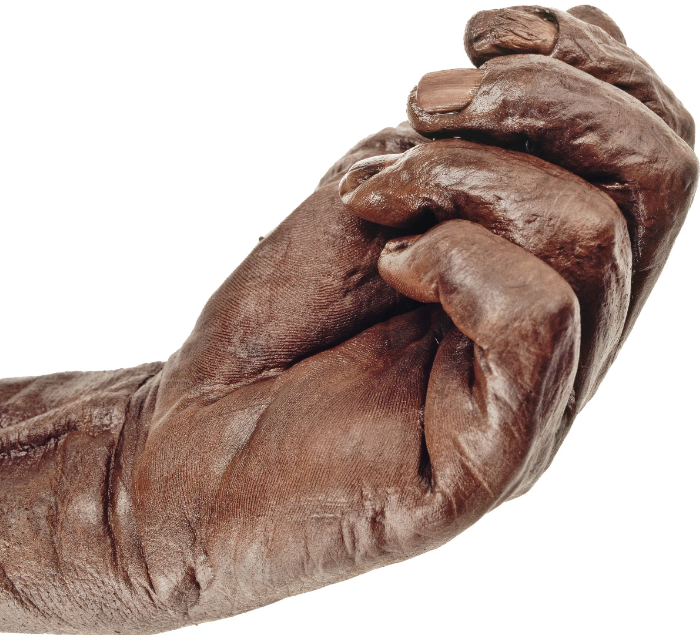

The hand of the Old Croghan Man.
"Although separated from us by more than 20 centuries, she was once a living member of her community," McCrisken told the hearing, according to The Irish Times.
Read more
A place in the Early Peoples gallery
Niamh Baker, curator of archaeology at National Museums NI, has described the woman as one of the most important discoveries made on the island of Ireland, and said the museum put a comprehensive, ethical research process in place to unlock as many details as possible about her.
Hannah Crowdy, head of curatorial at National Museums NI, said the research had allowed the museum to tell her story with clarity and confidence. She added that the discovery also raises questions about the presence and care of human remains in museum collections today.
"Her legacy will provide a crucial resource for research and learning, and an important reminder of how relevant museums are in connecting the past to the present day, not only for our visitors, but across academia too," Crowdy said, in comments carried by the PA news agency.
Ballymacombs More Woman will now help shape a new interpretation being planned for the Early Peoples gallery at the Ulster Museum.
"Though she lived and died over 2,000 years ago, we will ensure that her story resonates long into the future," Crowdy said, as reported by The Irish Times.