Ireland has a rich history of stunning archaeological finds.
From jewelry to people to ancient sites, here are some of the more recent artifacts discovered in and around Ireland.
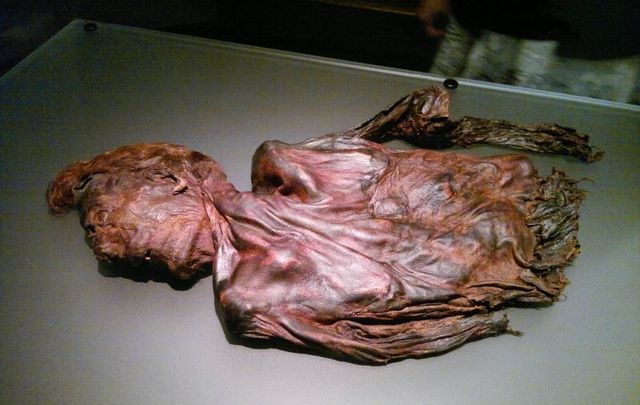
Clonycavan Man
Clonycavan Man was discovered in Meath in February of 2003 after its remains dropped off of a peat cutting machine, reports the BBC.
Most interesting about him is that his hair seemed to have a sort of hair gel in it, slicking it up into a mohawk. The ingredients of the “gel” were traced back to either France or Spain. Judging by the deep wounds in his skull, Clonycavan Man appeared to have been brutally murdered, supposedly by an axe approximately 2300 years ago. Clonycavan Man has found a new home and is on display at the National Museum of Ireland in Dublin.
Oldcroghan Man
Oldcroghan Man was named for the location where he was found, Croghan Hill in Offaly. This mummy had the distinguishing traits of being 6’6, quite tall for the time period in which he lived, as well as neatly manicured nails. National Geographic reports that Oldcroghan’s body was preserved so finely that upon its discovery, a murder investigation was launched.
Later, he was found to have been brutally murdered, which was deduced from his lack of head and lower body. His stomach bore evidence of a wheat-and-buttermilk diet. He, along with Clonycavan Man (who was found only three months earlier and about 25 miles away), is on display at the National Museum of Ireland in Dublin.
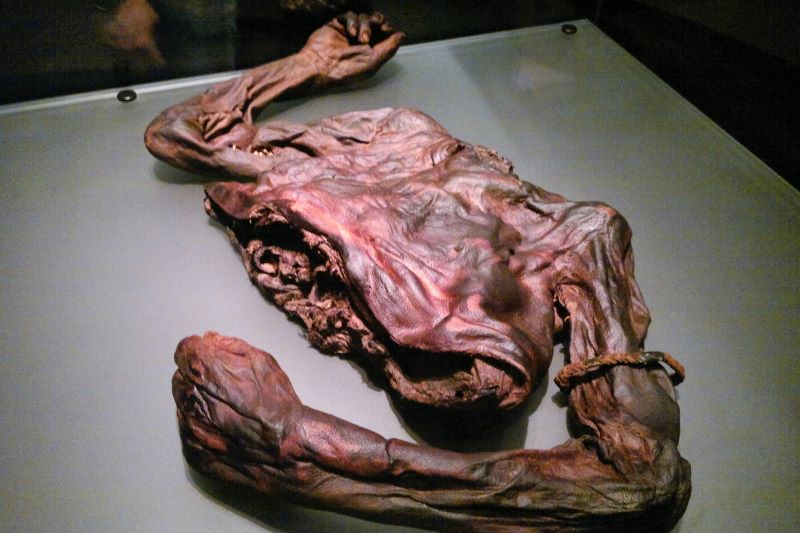

Oldcroghan Man. (Mark Healy, Flickr / CC BY-SA 2.0)
Linn Duachaill
A Viking settlement village was discovered in Annagassan, County Louth. The village is presumed to have been a Viking winter base, one of only two in Ireland. The untouched “virgin” site is said to be a massive discovery. After some testing by Dundalk’s County Museum, it was discovered that the site was, in fact, an area used to repair long ships, a base for inland raids and later, a trading site. Its importance lies in its early period, as it was founded in 841, among the earliest Viking settlements in Ireland.
Bog butter
This batch of butter was dug up in Tullamore and is believed to be a staggering 5,000 years old. The “butter” was discovered by turf cutters who found it seven feet underground it what appeared to be a “keg” or “urn” type capsule. They cut it open with a spade to find the butter inside. Presumably, the butter was buried as a form of refrigeration. Although ‘bog butter’ is a more common discovery around Ireland, the discovery in 2011 was remarkable for its size - 100 pounds! The substance was said to still have a “dairy smell,” though no one is sure exactly what it is.
Images of #bog #butter, #NMI-Archaeology, Kildare Street, pic.twitter.com/E4CmGdydbH
— National Museum of Ireland (@NMIreland) May 21, 2015
4000-year-old Lunala necklace
After two thieves robbed a shop in Strokestown, Roscommon, they discarded the necklace and other documents in a Dublin dumpster. Police, short on time before trash collection, luckily found the precious artifact, believed to be 4,000 years old and belonging to an early king of Ireland.
The necklace, called a lunala, was originally found in 1945 during excavations in Roscommon. It was given to the Strokestown shopkeeper, who kept it locked away in a safe until the robbery.
Ancient Latin Psalter
In 2006, a mechanical digger unearthed a 1,200-year-old manuscript in Faddan More, near Riverstown, in Tipperary. The manuscript consisted of 60 vellum pages and had covers made of animal skin. It was found undisturbed and open to the Latin version of Psalm 83. The discovery was said to be of staggering impact and changed the understanding of how old Irish manuscripts were created.
Images of the Faddan More Psalter before & after conservation #NMI-Archaeology, http://t.co/416opNhUMS, #discovery pic.twitter.com/rcEaEK8PmC
— National Museum of Ireland (@NMIreland) September 8, 2015
Sacrificed king in Laois
A mummified body found in Co Laois became a particular interest to archaeologists when it was discovered on the boundary between two ancient Irish kingdoms, suggesting it may have been that of a king. The 3000-year-old remains were found just moments before a Bord na Mona worker almost drove over them. In addition to its location, the body discovered had various cuts on it, suggesting a ritual sacrifice.
Mabel Bagenal, Ireland’s ‘Helen of Troy’
The remains of what is believed to be Ireland’s ‘Helen of Troy’ were discovered at Castle Hill in Dungannon, Tyrone, this past July. Evidence suggests that the body could be that of Mabel Bagenal, who died in 1596 and was the third wife of the Earl of Tyrone, Hugh O’Neill. Ornate details in her burial point to her high societal status during her life, befitting the wife of an Earl.
Burial Ground in North Dublin
In June 2011, workers in North Dublin unearthed what appears to be a pre-Viking burial site. Scientists from Queen's University conducted tests at the site and concluded that it was created in the seventh century AD. With this information, it was deduced that the site dates to the pre-Viking era, placing it in the period of Christian conversion.
“Zombie” Graveyard
The Independent reports that a so-called “zombie” graveyard was discovered in September 2011, just in time for Halloween, at a site overlooking Lough Key in Roscommon. The skeletal remains found there were discovered to have large rocks placed in their mouths, supposedly in hopes of preventing the souls from rising up to terrorize the living.
* Originally published in August 2016. Updated in July 2026.


Comments