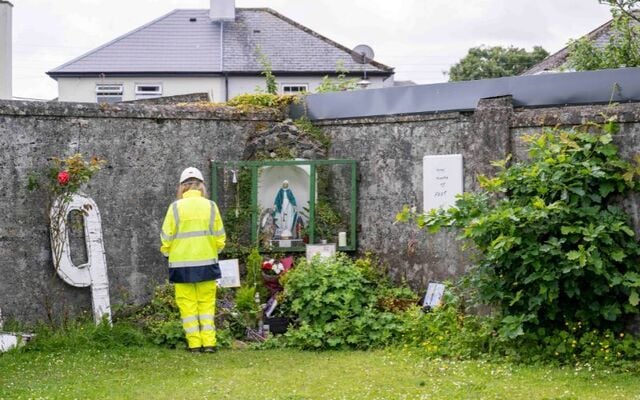
An additional eight sets of infant remains were recovered during the most recent reporting period of the ongoing forensic excavation at the site of the former Mother and Baby Institution in Tuam, Co Galway.
The eight sets of infant remains were all buried in coffins, the Office of the Director of Authorised Intervention, Tuam (ODAIT) said in its latest update, issued on Friday, June 5.
There have now been 77 sets of infant human remains recovered from the area of the site, which has been identified in historical documents as a "burial ground," ODAIT said.
There are no surface markers that indicated the presence of burials at this location, ODAIT said.
The evidence that ODAIT has recovered from this area during the forensic excavation is consistent with the location being a burial ground from the time of the operation of the Mother and Baby Institution.
Excavation of the layers beneath the infant remains in this area has revealed anomalies consistent with earlier historic burials, ODAIT said.
These earlier historic burials are similar to those reported in October in ODAIT's second technical update, where ODAIT expert osteoarchaeologists confirmed that seven sets of historic, skeletal human remains were consistent with the Workhouse era (1841 to 1918) of this site. ODAIT is engaging with the National Museum of Ireland for advice on these earlier burials.
In another tented area during this latest reporting period of April 1 through May 31, ODAIT completed the mechanical removal of modern layers of material above the burials, and the area has been further excavated by hand. These excavations have shown evidence of additional potential graves of child or infant size.
ODAIT further said on Friday that in the course of its excavations, it has recovered some separate or ‘disarticulated’ bones, not found associated with burials already recovered. These include human adult and infant bones. ODAIT said it is not possible to confirm if these bones form part of remains from the institutional era or workhouse era remains until it completes the excavation and conducts its forensic analysis.
"The recovery of individual skeletal elements is not unexpected in a site of this nature, and all human remains recovered are treated with respect and dignity," ODAIT said.
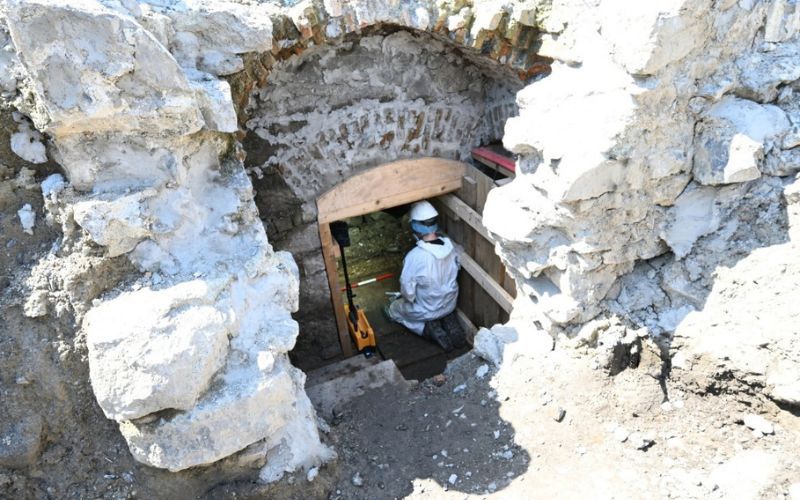

A member of the Forensic excavation team working in the subterranean vaulted structure. (ODAIT)
Artefacts
Artefacts from various historic periods continue to be recovered, ODAIT said on Friday.
Items of note include a metal finger-loop candle holder found in the subterranean chamber.
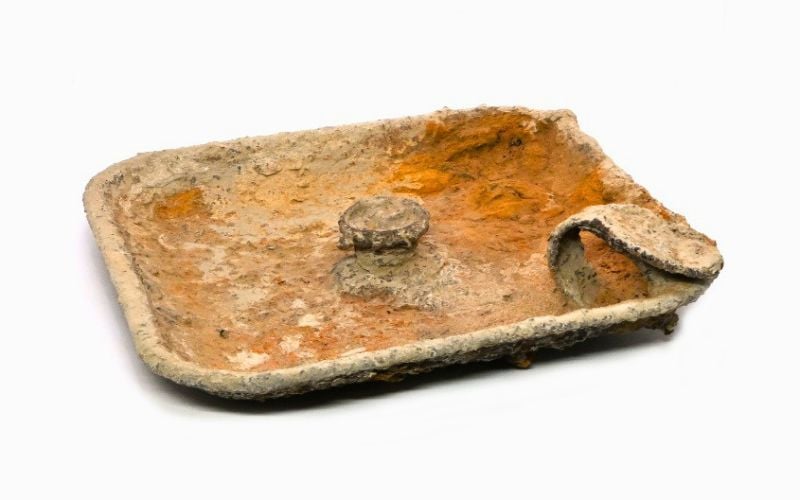
A metal finger-loop candle holder found in the subterranean chamber. (ODAIT)
During the reporting period, the forensic team catalogued and put in storage the mobile/unfixed items from the surface of the memorial garden, including mementos, notes, flowers, and more.
Remaining fixed items, including the statue, will be moved at a later stage.
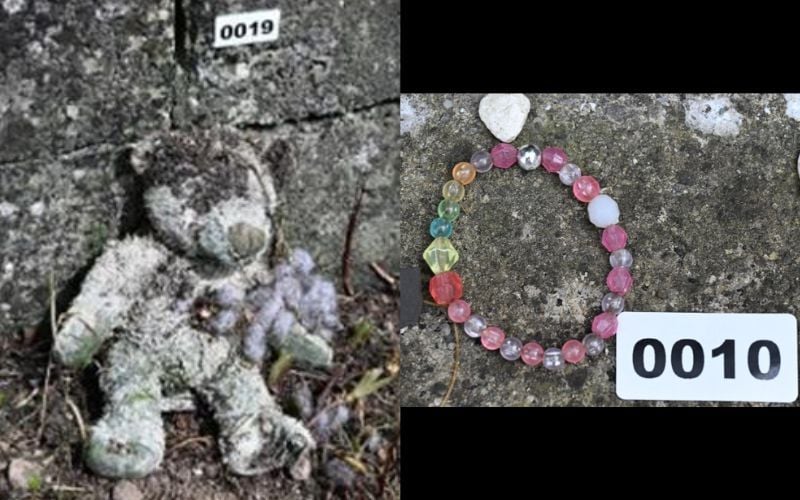
Items catalogued from the memorial garden. (ODAIT)
Tuam Identification Programme
The Identification Programme team collected an additional 22 samples during this period, which have been delivered to Forensic Science Ireland (FSI). This brings the total number of samples taken to 55.
ODAIT’s team travelled to the US, UK, and Canada to meet families and collect samples. As part of these trips, the team also met with diaspora organisations to assist in encouraging family members to get in touch with ODAIT to potentially provide a DNA sample.
In April 2026, on foot of updated scientific advice from FSI, the Government signalled its intention to amend the Institutional Burials Act 2022 to include first cousins as eligible family members who can participate in an Identification Programme and provide a DNA sample.
Following this decision, ODAIT has been in contact with some first cousins to prepare for the statutory determination process and is putting the initial steps in place so that samples may be taken without delay once it is permitted under the legislation. The team will continue to reach out to first cousins as part of this process.
ODAIT is encouraging anyone who believes they may have a family member buried at the site of the former Tuam Mother and Baby Institution to contact its office for guidance. You can call +353 (0)1 539 1777, email [email protected], or visit ODAIT.ie for more information.
Forensic Facility and Mortuary
ODAIT said on Friday that its Forensic Facility and Mortuary at Toghermore in Tuam is nearing completion. This facility will provide the necessary capacity and space for large-scale analysis and appropriate storage of human remains, evidence, and artefacts, and will assist ODAIT to continue to operate to international standards and best practice.
Continuing its policy of keeping families at the centre of our work, ODAIT will invite survivors, family members, and their advocates to visit this new facility in Toghermore in late July. It will be an opportunity to hear updates from ODAIT and to ask questions about the excavation. The team will contact stakeholders directly to provide details for this visit.
Prior to the completion of the facility, ODAIT is availing of a temporary space, which has allowed work to progress.
About the Tuam Mother and Baby Home in Co Galway
The Tuam Mother and Baby Home was an institution for unmarried mothers and their children. Run by the Bon Secours Sisters, it operated from 1925 to 1961.
In 2014, local amateur historian Catherine Corless was researching the Tuam Home's history when she discovered records showing that 796 children had died at the Home, but burial records could not be found, sparking suspicion of a mass grave at the site.
"Significant quantities” of human remains were discovered at the site in 2016 and 2017.
In January 2021, nearly six years after the Mother and Baby Homes Commission of Investigation was launched, the Final Report of the Commission of Investigation into Mother and Baby Homes was published.
Including the Tuam Home, the Commission investigated 18 homes across Ireland, ultimately finding that "a total of about 9,000 children died in the institutions under investigation - about 15% of all the children who were in the institutions."
The report later states: "There is no single explanation for the appalling level of infant mortality in Irish mother and baby homes."
The report says that "a particular catalyst" for the formation of the investigative Commission "was the discovery by Catherine Corless of the possible burial arrangements for children who died in the Tuam Children’s Home."
Following the publication of the report, the Irish Government offered a formal apology to victims, survivors, and their relatives.
In November 2021, the Irish Government published its Action Plan for Survivors and Former Residents of Mother and Baby and County Home Institutions. Part of the plan was a commitment to "advance burials legislation to support the excavation, exhumation and, where possible, identification of remains, and their dignified reburial."
In July 2022, the Institutional Burials Act became law, allowing exhumations to take place at former Mother and Baby Homes across Ireland. Work is underway to amend the legislation to include first cousins as eligible family members.
The Irish Government established ODAIT as part of the Act in October 2022, and in May 2023, Daniel MacSweeney was tasked with overseeing the excavations of children's remains at the site at Tuam.
Pre-excavation works began at the Tuam site in June 2025, and the excavation commenced on July 14.
The excavations, which are expected to take 24 months to complete, continue. The next technical update will be issued in July.


Comments