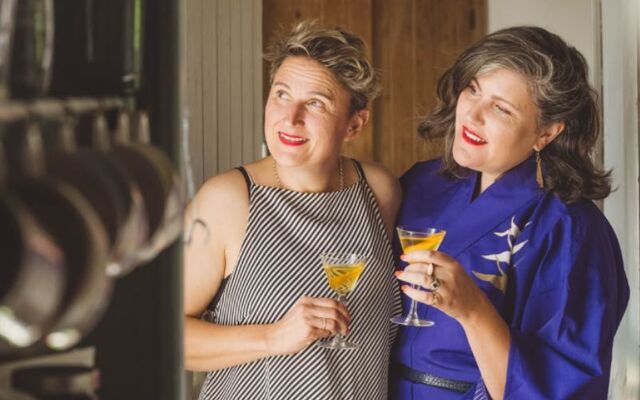
Valentia Island Vermouth has gone from a small cottage kitchen table to the back bar of New York's famed Dead Rabbit, marking Ireland's first entry into a category long dominated by Italy and France. For founders Orla and Anna Snook O'Carroll, the American launch is the latest chapter in a love story that started in art school and turned into an internationally awarded drinks brand.
Long before Valentia Island Vermouth found its way onto the back bar of Manhattan's celebrated Dead Rabbit, it began in a small cottage on one of Ireland's most storied islands.
Earlier this year, the award-winning producer officially launched in the United States through New York and Boston, introducing Ireland's first vermouth to a country where classic cocktails such as the Manhattan, Martini and Negroni have long relied on European imports. For founders Orla Snook O'Carroll and her wife Anna Snook O’Carroll, the expansion marks another chapter in a journey that began not in the drinks industry, but in art school.
Their story is an unconventional one. Neither woman trained as a distiller or winemaker. Instead, they met while studying art in Bristol, where creativity formed the foundation of both their relationship and, eventually, their business. Today, that artistic background is evident throughout Valentia Island Vermouth, from the distinctive illustrated bottle to the thoughtful storytelling behind the brand itself.
Sitting off the Iveragh Peninsula in County Kerry, Valentia Island has long punched above its weight in Irish history. In 1866, it became the European terminus of the first commercially successful transatlantic telegraph cable, transforming communications between Europe and North America. More recently, its cable station has been recognized as part of a joint UNESCO World Heritage nomination with Newfoundland. The island is also known for its subtropical microclimate, dramatic Atlantic coastline, ancient tetrapod footprints and rich maritime history. It is a place where landscape, history and community are deeply intertwined.
It was that sense of community that first captured Orla and Anna after they moved permanently to the island in 2018.
When Anna and I got married here, the people were so supportive. They really put their arms around us and helped us in any way they could. A farmer up the road even lent us his field so our guests could park there. When we started the vermouth, they were exactly the same. They were asking, 'How can I buy it? How do I drink it?' They were right behind it straight away. It's a special place."
Read more
That experience would become the foundation of their business. Rather than simply naming a product after the island, they set out to create something that reflected its character, its people and the landscape around them.
The inspiration for the drink itself arrived unexpectedly.
Anna, whose career had been spent working in some of Bristol's leading restaurants, attended a vermouth tasting hosted by Guardian wine writer Kate Hawkings. She returned convinced that Ireland should have its own vermouth.
Vermouth has traditionally belonged to Italy and France. The aromatised fortified wine first emerged in Turin during the eighteenth century before becoming a staple of European café culture and, later, one of the defining ingredients of classic cocktails including the Martini, Manhattan and Negroni.
Creating Ireland's first vermouth meant starting with a blank page.
That blank page suited two artists.
Orla often describes the process of making vermouth in artistic terms. Instead of working with clay or paint, she and Anna worked with wine and botanicals, experimenting until the different elements came together. It took eighteen months to perfect their recipe, but their creative background continues to shape every aspect of the brand.
"Everything we do comes from an art point of view."
"Our background is in art. We met in art school in England, and we've always said there's a huge art point of view behind everything we do with the vermouth.
Read more
The bottle itself reflects that philosophy. Hidden within its artwork are references to the couple's lighthouse wedding on Valentia Island, while every botanical used in the recipe is illustrated somewhere on the label. The result is a product where the design is not simply packaging but an extension of the story inside the bottle.
Place also played a central role in developing the recipe.
Growing up in County Wicklow, Orla spent much of her childhood outdoors with her father, Anton O’Carroll, a geography teacher and beekeeper from Kerry. Summers were spent cutting turf, tending bees and learning to recognise native plants. Years later, those memories unexpectedly became part of the business. Her father would text whenever local flowers or herbs came into bloom, suggesting new botanicals to experiment with, while techniques used during honey production helped inform some of the methods the couple adopted while developing their vermouth.
"When we were small, we were always outside, either cutting turf or doing the bees with Dad. He was a geography teacher as well as a beekeeper, so we grew up learning about the landscape and the plants around us.' Looking back, Dad had a lot to do with us starting the vermouth because he was always encouraging us to experiment with the botanicals.”
The finished product reflects both that childhood knowledge and the landscape surrounding the vermouthery.
Made using twenty herbs and botanicals, the vermouth begins with notes of caramel before developing layers of herbs, citrus and spice. Orla believes even the Atlantic influences its character, leaving what she describes as a subtle saline finish that speaks to the island where it is made.
Like many successful businesses launched in recent years, Valentia Island Vermouth also owes something to timing.
Although the couple had already begun experimenting with recipes after moving to Kerry, it was the Covid-19 pandemic that gave them the opportunity to fully commit to the business. With hospitality temporarily closed, they suddenly had time to develop the product while consumers, confined to their homes, were becoming increasingly adventurous with cocktails.
Read more
"The first lockdown, Anna started doing the garden and we had a really tidy garden. By the second lockdown, we had a vermouth business and our garden hasn't been tidy since!" she laughs.
Instead of carefully orchestrated launch campaigns, the early days were decidedly more hands-on. Cases of vermouth traveled around the southwest in the back of the couple's Ford Mondeo, while restaurants and retailers followed their progress on Instagram before inviting them in for tastings.
"We were driving around West Cork with cases of vermouth in the back of our Ford Mondeo. I'd post where we were on Instagram and people would message asking us to call in because they wanted to try it so that was a very simple but effective way to bring the product to people."
Recognition followed quickly.
Valentia Island Vermouth has since been named among the world's top ten vermouths by Falstaff while also receiving Best Artisan at Blas na hÉireann and the Guild of Food Writers' overall drinks award. What began around a kitchen table has grown into an internationally recognized premium drinks brand.
Running the business together has required just as much creativity as building it.
The couple divides responsibilities according to their strengths, with Anna overseeing operations and production while Orla focuses on strategy, branding and the company's next steps. Clear boundaries help separate work from home, allowing them to travel together while continuing to grow the business without letting it dominate every conversation.
“We basically have a lot of rules in place. One person is allowed to say, 'Can I talk about work for a sec?' and the other person is allowed to say yes or no. If it gets too detailed, we put it into a meeting for another day."
"Historically, couples have worked farms together. They ran the local shop together. Parents work together all the time. So it's not that unusual to work with your significant other. You just have to keep communication up and make sure you're still having the craic along the way."
That growth now includes the United States.
The recent launch in New York and Boston represents far more than another export market. It introduces Irish-owned bars to a product that allows them to create fully Irish versions of some of the world's best-known cocktails for the first time. Fittingly, the American debut took place at The Dead Rabbit, whose celebration of contemporary Irish culture made it a natural home for the brand.
"We launched in The Dead Rabbit in Manhattan, and it was the perfect place because they celebrate the contemporary Ireland we actually live in while having such a deep respect for our heritage, our craft, our culture, our music and our dancing.
Two further vermouth expressions are already in development, while the founders hope to continue expanding into new markets around the world.
"We're excited about bringing Valentia Island Vermouth to as many bar counters, cocktail menus and restaurants as possible. It makes so much sense for us to bring the first Irish vermouth to the US because Irish bars can now make all-Irish versions of the most ordered cocktails in the world."
Yet despite the awards, international recognition and growing exports, the ambition remains remarkably unchanged from those early days on Valentia Island.
"We want them to taste Ireland, taste County Kerry, taste Valentia Island. Something they have never tasted before."

Comments