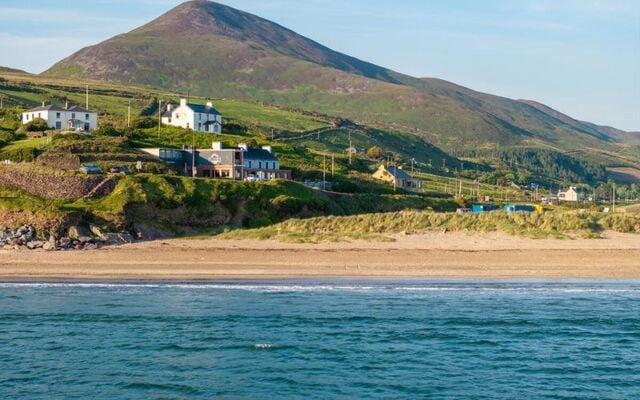
From Inch and Hospital to Prosperous, Granny and Ovens, these Irish placenames have curious origins that reveal layers of language, legend, and local history. Here is a closer look at five of the most unusual names on the map and the stories behind them.
Did you know that Ireland is home to some unusual place names? In this article, I will explore and contextualize five unusual place names: Inch, Hospital (also Spidéal), Prosperous, Granny, and Ovens.
Inch
The name “Inch” actually refers to several locations in Ireland, with the most famous being Inch Strand and village on the Dingle Peninsula in Co. Kerry. The word “Inch” may derive from the Irish words An Inis (which means the island) or Inse (which means river meadow). Other places where you will find the name Inch include Inch Island in Co. Donegal, together with small settlements in counties Wexford, Tipperary, Clare, and Cork.
The Inch Strand in Co. Kerry is five kilometers long, reaches into Dingle Bay, and constitutes a long sand spit and dune system. The strand, which is also known as Inch Beach, and its associated dune system constitute part of the Special Area of Conservation at Castlemaine Harbour.
In addition to its unusual name, the region of Inch and Inch East townlands contains evidence of ancient settlements, including several middens, ringforts, and ecclesiastical enclosure sites. In Inch East, the graveyard enclosure contains a ruined single-cell church. This ruin dates to at least the thirteenth century.
Inch Island, which is around 13 square kilometers in area, lies in Lough Swilly, Co. Donegal, along Ireland’s northern coast. The island lies off the south-western coast of the Inishowen mainland, close to the village of Burt. The island is connected to the mainland by a stretch of road known as the Inch Banks. Inch Island’s highest hill is known as Inch Top and is 222 meters in height.
Inch Island is also known in Irish as Inis na nOsirí, which means “Island of the Oysters.” Inch Castle, a 15th-century building, is located on a cliff overlooking Lough Swilly, and the island is also home to Inch Fort, an early 19th-century defensive structure. The island is also home to a Catholic Church dedicated to Our Lady of Lourdes and a Presbyterian kirk. In 2022, the island's population was recorded as 396.
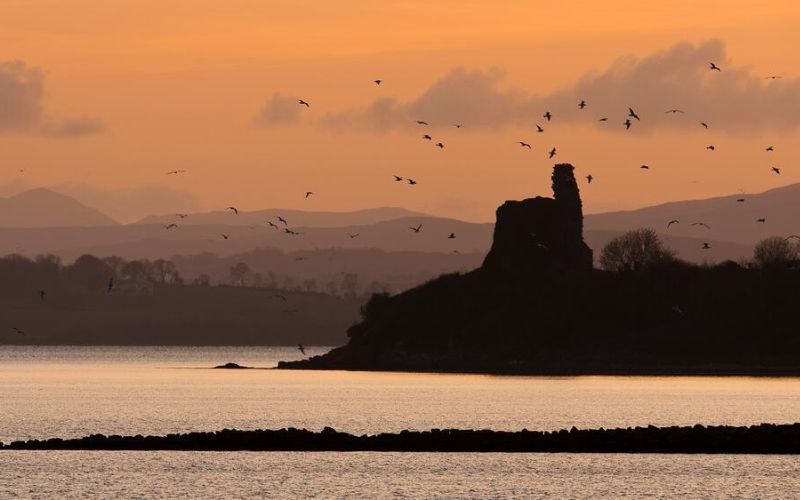

Inch Castle, County Donegal.
Read more
Hospital
The village called Hospital, located in East County Limerick, is another unusual place name. The village lies on the River Mahore, which is a tributary of the River Camogue. Two possible explanations for how the village acquired its name have been proposed.
One explanation is that the crusading Knights Hospitaller built the archaeologically significant Hospital Church here before 1215, and that the village derived its name from these knights.
A second explanation is that the village constituted part of the parish of Aney in ancient times and derived its name from a hospital for Knights Templar, founded in 1226.
The 2022 Census revealed that the village had a population of 674. Interestingly, the place known as Spiddal in Co. Galway derives its name from the Irish (and is its official name) An Spidéal, which means “the hospital.” Around 75 percent of the population of Spiddal are Irish speaking, according to the 2022 census.
There was a medieval leper hospital located in West Spiddal. There have been many other hospitals in the region for many years. These included a famine hospital associated with the Great Famine of the mid-1840s.
Read more
Prosperous
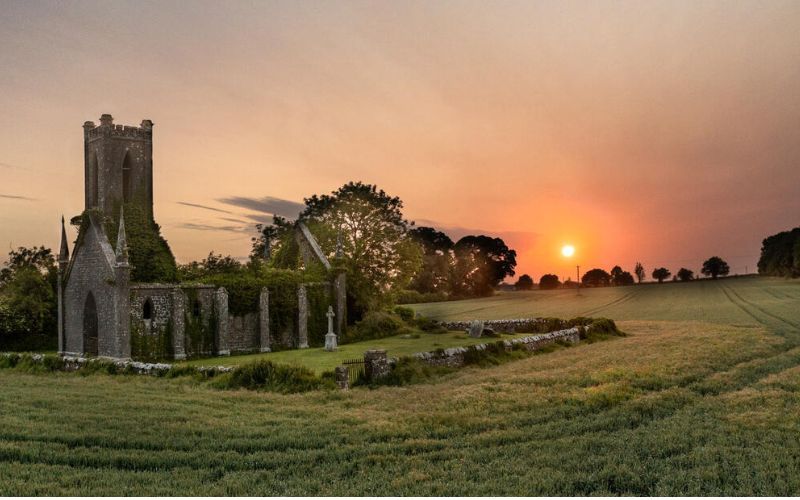
Sunrise mat Ballynafagh Church, Prosperous, Co. Kildare.
Prosperous is another interesting name of an Irish town, and it is located in north County Kildare. Its Irish name is An Chorrchoill, which means “the smooth forest.”
As of 2022, it was the 15th largest town in Co. Kildare, with a population of 2,413.
The village was founded in the late 18th century by Sir Robert Brooke (1744-1811), who gave it the English name Prosperous. In the late 18th century, the town was responsible for producing linen and cotton, but cotton production ceased after about 10 years due to a lack of funds. The area is characterized today by a number of raths (or ringforts), suggesting that the place was settled in early Christian times.
Read more
Granny
You might be interested to know that there is a town called Granny, or Grannagh, in Co. Kilkenny, situated on the banks of the River Suir, north of Waterford city. There is a famous castle in the area called Granny Castle, built by Norman settlers. This site offered strategic and economic benefits to the castle owners, as they could control trade and traffic along the River Suir. Other places in Ireland called Granny or Grannagh include a townland in the barony of Kiltarten, Co. Galway, and a townland in the civil parish of Kilcronaghan in Co. Derry (Londonderry).
Ovens
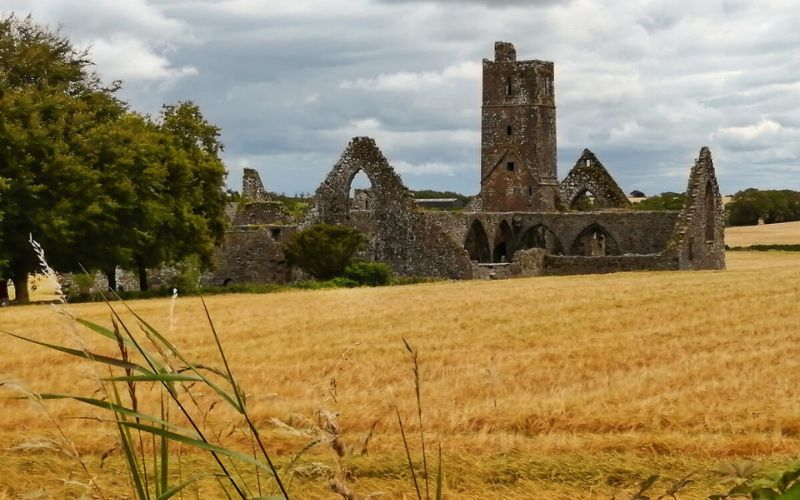
Kilcrea Fanciscan Monastery, in Ovens, County Cork.
Finally, the village of Ovens is located in Co. Cork, adjacent to the town of Ballincollig. The village was formerly known as Athnowen. The population of the Ovens electoral district was recorded as being 1,703 people in the 2006 census. The area is characterized by a limestone cave system that spans the area.
This article was submitted to the IrishCentral contributors network by a member of the global Irish community. To become an IrishCentral contributor click here.

Comments