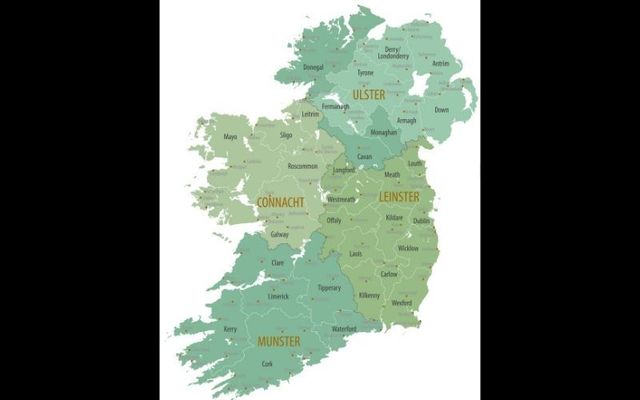
That the four provinces of Ireland began as loosely bordered kingdoms is something of an afterthought to most tourists, but each province is rich in a history that often predates the High Kings’ reign.
In modern times, Ireland has four provinces: Leinster in the east, Connacht in the west, Ulster in the north, and Munster in the south. The Irish word for province, "cúige," derives from the phrase "fifth part," a hat tip to the historical fifth province of Ireland, which now includes County Meath in Leinster. The majority of the province of Meath became part of the county, although more northern areas were integrated into Ulster counties.
Before the Norman invasion in 1169, these five provinces existed as loosely federated kingdoms controlled by Ireland's great Irish dynastic families of Uí Néill/O'Neill (Ulster), Uí Máeilsheáchlainn/O'Melaghlin (Mide/Meath), Uí Briain/O'Brien (Munster), Uí Conchobhair/O'Conor (Connacht), and Mac Murchadha-Caomhánach/MacMurrough-Kavanagh (Leinster).
However, when the Normans invaded and occupied Ireland until 1541, the power of Ireland's great families waned, and the historic provinces of Leinster and Meath gradually merged into a single province. This was mainly due to the introduction of the "Pale," the part of Ireland that was directly under the control of the English government. The "Pale" saw heavy colonization of Leinster, forming the province as we know it today.
The provinces do not hold modern political or administrative purposes (unless rugby is your politics) and simply exist as historical and cultural entities. Sports organizations such as the GAA make use of the provinces to run provincial competitions.
Today, provinces split Ireland’s counties into distinct regions that share a common ground of beautiful landscapes, ancient history, and a myriad of attractions for first-time and seasoned visitors alike. Leinster contains the most counties (12), although the geographical area is not aligned with this.
Read more
Connacht - Galway, Leitrim, Mayo, Roscommon, and Sligo
Connacht, the western province of Ireland, is famous for Galway City, but also for its breathtaking natural landscape, evoking the ethereal poetry of W.B. Yeats in Sligo and the unparalleled portrayal of life on the Aran Islands by J.M. Synge.
Stunning seaside landscapes greet the Connacht visitor, with Roscommon being the only landlocked county in the province.
Leinster - Carlow, Dublin, Kildare, Kilkenny, Offaly, Longford, Louth, Meath, Laois, Westmeath, Wexford, and Wicklow
Leinster is rich with medieval castles, sport, and theater, and is home to Ireland’s capital, Dublin City. The capital, a town originally founded by the Vikings, is rich in historical locations and cultural events to keep tourists entertained.
Leinster is the most populous province and, due to the heavy colonization in this part of the country, it contains many fine examples of medieval, Norman, Georgian, and Neolithic architecture.
Munster - Clare, Cork, Kerry, Limerick, Tipperary, and Waterford
Munster, being the birthplace of the modern Gaelic games, has a strong sporting heritage, especially in hurling and rugby. There are many ancient castles and monasteries in the province. This, coupled with the vast green countryside and three cities, makes it a feature of the tourism industry.
Ulster - Antrim, Armagh, Cavan, Derry, Donegal, Down, Fermanagh, Monaghan, and Tyrone.
Ulster, which includes the six counties of Northern Ireland, draws visitors to its unique feature of basalt columns rising from the sea at the Giant’s Causeway. The beauty of Ulster lives in the influence of several cultures: the Ulster Scots, the Gaels, the Normans, and the Anglo-Normans.
The province also contains Belfast, the capital of Northern Ireland, and the birthplace of the Titanic.
The four provinces are diverse, so whether Ireland is a destination for relaxation or adventure, each one always has something new – or thousands of years old – to discover.
Read more
* Originally published in March 2010. Updated in January 2026.

Comments