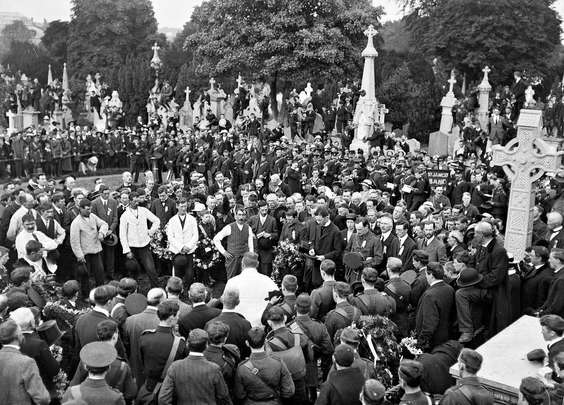
On August 1, 1915, thousands of mourners followed the coffin of Jeremiah O'Donovan Rossa through the streets of Dublin to Glasnevin Cemetery, where Patrick Pearse delivered a graveside speech that would echo through Irish history. What began as a funeral for an aging Fenian who died in New York became a rallying cry for a new generation, setting the stage for the rebellion that erupted eight months later.
Editor's note: Below is an excerpt from Dermot McEvoy’s new book, Real Irish New York, published by Skyhorse Publishing.
On June 29, 1915, Jeremiah O’Donovan Rossa, the old Fenian, died on Staten Island. Legend has it that John Devoy wired Thomas Clarke in Dublin, “Rossa dead. What should I do?” Clarke replied: “Send his body home at once!” Thus began the long, final, and heroic journey of Jeremiah O’Donovan Rossa.
Like many Fenians, Rossa was a very tough character. His family in West Cork was fairly comfortable until the famine destroyed it. It was the trigger that set him afire with nationalism. The odd thing about Rossa is that he never got to fight in any of Ireland’s battles. As plans were being made for a rising in 1865—it was postponed until 1867—he was arrested in Dublin and sent to British prisons where, under brutal conditions, he would live for the next five years. He was freed in an amnesty and sailed for America, arriving in 1871 as a member of the Cuba Five, which included John Devoy, whom he had met in prison.
Rossa's personal life was as complicated as his political one. He was married three times, with his first two wives dying at a young age. In all, he fathered 18 children. In America, he was famous for the dynamite campaign he waged in Britain during the 1880s. Ironically, one of his bombers was Tom Clarke, who would be a central character in his final sendoff. During his time in New York, he challenged the Fenian John Daly to a duel that never took place. He was also shot by a deranged British woman named Dudley because of his dynamite campaign but survived to live another 30 years.
When Rossa died, Clarke said, “If Rossa had planned to die at the most opportune time for serving his country, he could not have done better.”
In one of the great shows of nationalistic theatre (Devoy once said: “No matter how the Irish treat a leader when living—and the treatment is often very bad—they never fail to give him decent burial”), Clarke paraded the body around Dublin as if he had found the Fenian Lazarus. (This idea of using the honored dead as props might have led the British to bury the executed 1916 leaders in a quicklime mass grave to avoid this kind of propaganda.)
Rossa lay in state at City Hall and was given a funeral mass at the Pro-Cathedral. Thousands followed his coffin to Glasnevin Cemetery on August 1st, where Patrick Pearse gave his famous speech: “…the fools, the fools, the fools! — They have left us our Fenian dead, and while Ireland holds these graves, Ireland unfree shall never be at peace.”
Rossa’s funeral was the unofficial launch of what would become the Easter Rising eight months later.
For the full story, read more about it in Real Irish New York, which is available in hardcover and Kindle from Amazon.com.
* Dermot McEvoy is the author of the recently published Real Irish New York: A Rogue’s Gallery of Fenians, Tough Women, Holy Men, Blasphemers, Jesters, and a Gang of Other Colorful Characters. He is also the author of The 13th Apostle: A Novel of Michael Collins and the Irish Uprising and Our Lady of Greenwich Village, both now available in paperback, Kindle, and Audio from Skyhorse Publishing. He may be reached at [email protected]. Follow him at www.dermotmcevoy.com. Follow The 13th Apostle on Facebook at www.facebook.com/13thApostleMcEvoy. ** Originally published in 2021 and updated in August 2026.
Comments