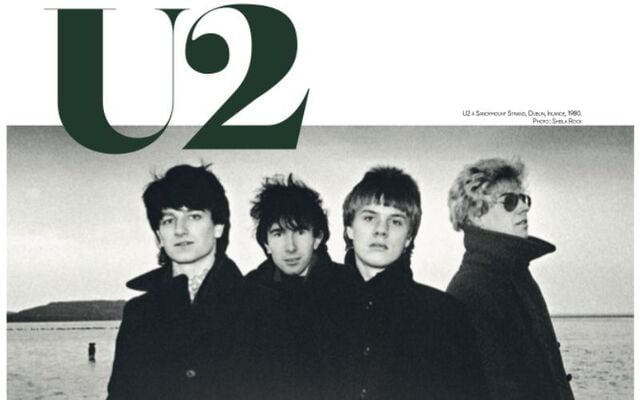
We all have a U2 story. Mine runs from a signed first EP wrapped in newspaper to a night at McGonagle's on South Anne Street in 1978, when four Northside teenagers were still just four lads who stayed on to chat with the crowd after the gig.
I guess we all have our U2 stories. So I was delighted to see that Tourism Ireland, in partnership with the famous French weekly magazine Paris Match and in collaboration with the Centre Culturel Irlandais (CCI), inaugurated on 23 September a terrific exhibition in the courtyard of the CCI, recounting U2’s Dublin story on panels throughout the courtyard.
The exhibition, U2: Une histoire irlandaise, celebrates the band's 50th anniversary with a selection of striking and historic photographs and explores the band’s Dublin roots, the people and places that shaped their story in the early days, as well as the profound impact U2 has had on music and on Ireland’s international profile over the past five decades.
I’m from North Dublin, and my own first U2 story is that a friend, who was also in a band and knew Bono, gifted me a signed copy of U2’s first record, an EP. I remember he wrapped it in newspaper to protect it. He contacted me out of the blue just a few years ago to see if I still had it, but as I left home at 21 with two suitcases, I was unfortunately unable to retrace what happened to it. I would have loved to return it to him, as it was such a souvenir of his own young band days.
My second U2 story goes back to 1978 and 'McGonagle’s', on South Anne Street in Dublin, where I first saw them play with my friend Brigid, just a couple of years after the band had formed. There was a kind of party ambiance after they played, and they chatted with many of us.
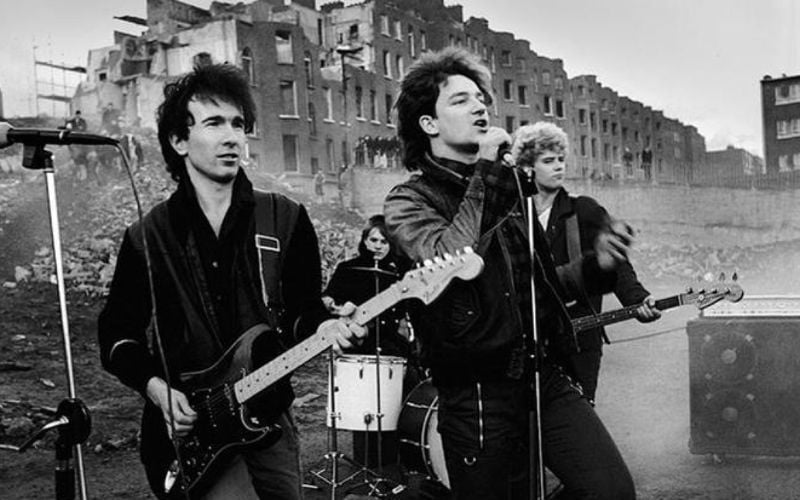

A U2 promo shot for "War".
Brigid stayed over at my house and the next morning got up early to attend a prayer meeting. There were no mobile phones, of course, at the time, and instead of going home as planned after the meeting, she came rushing back to my house, taking a patchwork of Dublin buses to deliver the big news: the lads had been at the Shalom Fellowship prayer meeting she had attended that Sunday morning! We were amazed.
Even though we saw them early on in their career, it was obvious, even to our inexperienced eyes and ears, that the lads were going somewhere – and we didn’t think that included a charismatic prayer group.
I think one of the things that was so exciting about U2, apart from their obvious talent, is something Bono pointed out in a very recent interview with Brendan O’Connor on RTÉ Radio 1. He said they were “a clue to an Ireland that was coming.”
The four had met at Mount Temple Comprehensive School on Dublin’s northside, but their backgrounds were unusual and diverse. Bono was born and raised in Dublin, but his father, Bob Hewson, was Catholic and his mother, Iris, was Protestant. He has often talked about growing up with that mixture of religious identities.
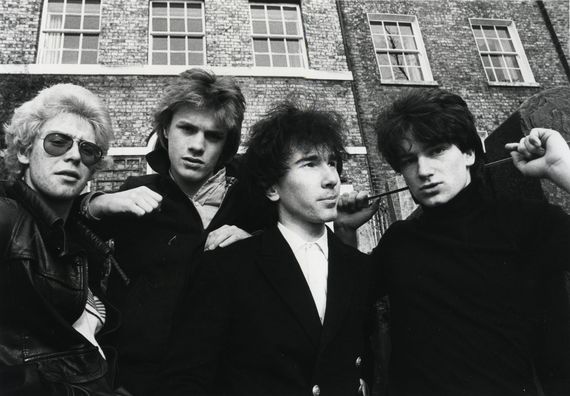
U2 circa 1979 in Dublin.
The Edge was born in England to Welsh parents and moved to Ireland as a child. Adam Clayton was also born abroad and spent part of his early childhood in Kenya before his family settled in Ireland. Larry Mullen Jr. was born and raised in Artane and had a more typical North Dublin background.
Bono pointed to their different “accents, the backgrounds” and “the mixed-up religiosity of it all”. Back in 1976, North Dublin, a mixture of Catholic and Protestant, England, Wales, and Kenya, was pretty exotic. Bono felt that U2 were “not the band you’d expect to come out of Ireland, let alone the north side of Dublin”. Also, their brand of spirituality was a new “live and let live” label; in fact, Adam Clayton did not share the same religious commitment as the other three. They were an optimistic glimpse of a freer Ireland that would resist matching old rigid ways.
As a foursome, they seemed to be an interesting mixture of good boys and rock stars, while also being very much on the pulse of the social changes happening in Ireland around them.
One striking example came during the controversy over the Irish Family Planning Association’s (IFPF) sale of condoms at the Virgin Megastore in Dublin. The IFPA began selling condoms there in 1988, challenging Ireland’s restrictive laws on their sale. After the association lost its appeal in 1991 and its fine was increased to £500, U2 stepped in and paid it. The Virgin condom campaign became an important moment in the campaign for wider access to contraception in Ireland.
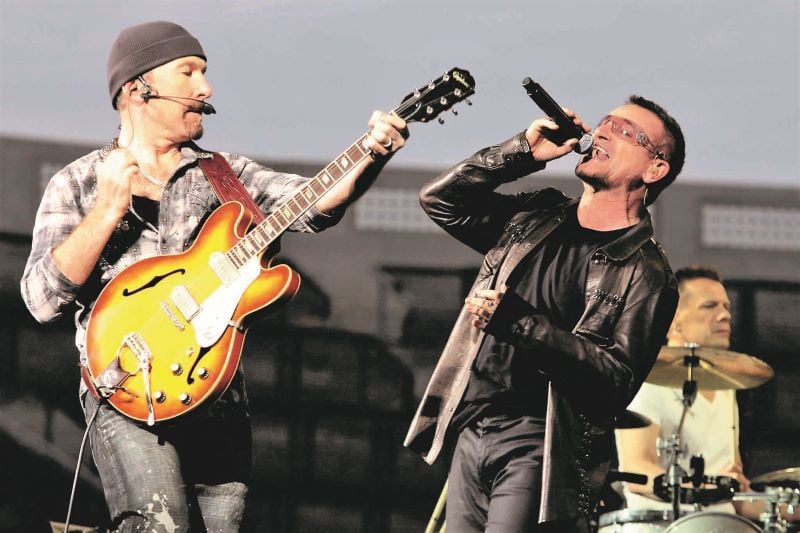
The Edge and Bono playing Croke Park, Dublin, in 2009.
We all have so many U2 memories, and for those lucky enough to be on Grafton Street when U2 gave its surprise concert from Bewley’s James Joyce balcony on Friday, 25 September, as part of their 50th-anniversary celebrations, it will surely be a memory to hang onto.
Earlier that day, they had performed outside Mount Temple, the school where it had all begun. Fifty years earlier, on 25 September 1976, Larry Mullen had pinned what would become the legendary notice to the school noticeboard: “Drummer seeks musicians to form a band”. The teenagers who answered eventually gathered in the Mullen family kitchen in Artane – and U2’s story had begun.
On Bewley’s balcony, half a century later, Bono paid tribute to Glen Hansard, recalling Glen’s busking days and naming him the “King of Grafton Street”. Along with their biggest hits, they played “Falling Slowly”, the Glen Hansard and Markéta Irglová song from the film Once, which won the Academy Award for Best Original Song in 2008.
I wish I could have been one of those lucky people on Grafton Street that day, but I do have the U2: Une histoire irlandaise exhibition to meander through every time I go to the Centre Culturel Irlandais, which is quite often. I can view it at my leisure until 18 December and re-familiarize myself with the key spots in Dublin which marked the band's trajectory.
And I had my own U2 moment in Paris.
On 21 September, after an event organized by the Cercle Littéraire Irlandais in the Chapelle Saint-Patrick at the Centre Culturel Irlandais, just as the courtyard was being prepared for the U2 exhibition, we made our way to the nearby ‘La Contrescarpe’ for an evening of seanchaí storytelling, trad music and Irish dancing.
There, in their beautiful winter room, Pamela Boutin-Bird’s crystal voice brought us back to the late 1980s, with a wonderful, heartrending rendition of U2’s “Running to Stand Still”, from ‘The Joshua Tree’.
We raised our glasses to U2’s 50th anniversary, just a couple of days early.
This article was submitted to the IrishCentral contributors network by a member of the global Irish community. To become an IrishCentral contributor click here.

Comments