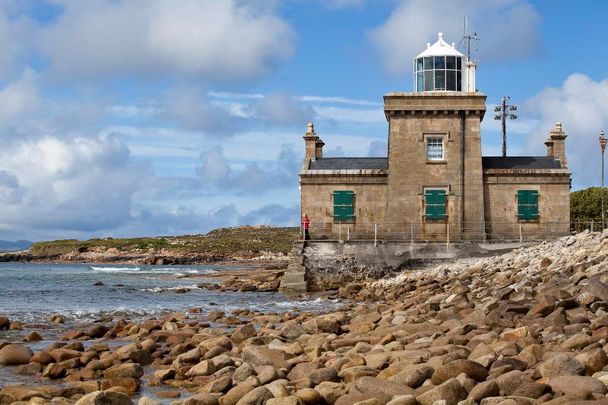
At one o’clock on June 3, 1944, a young clerk at the most westerly point in County Mayo logged a falling barometer, steady wind, and rising rain, and sent the numbers down the telephone line as she did every hour. The next morning a woman with an English accent came back on the line asking her to check and repeat the reading, and the invasion of Normandy, set for June 5, was pushed back a day.
81 years on, a look at how a weather report from a lighthouse in Blacksod on the coast of Co Mayo impacted how the day played out.
On June 3, 1944, Irish Coast Guardsman and Blacksod Lighthouse keeper Ted Sweeney and his partner, Maureen Flavin, delivered a weather forecast by telephone from Co Mayo’s most westerly point.
The report convinced General Dwight D. Eisenhower to delay the D-Day invasion for 24 hours, potentially averting a military disaster and changing the course of World War II.
According to Met Éireann, Ted Sweeney's mother, Margaret, who ran the post office in Blacksod, took over responsibility for the local weather station in 1922 after the British Coast Guard withdrew.
In 1939, a secret agreement was reached for the exchange of weather data between Ireland and Britain.
With the onset of World War II, the demand for up-to-date weather observations grew, leading Margaret and her son Ted to search for extra help and advertise for a post office clerk.
Maureen Flavin, a native of Co. Kerry, answered the posting. As part of her role, she recorded weather reports.
As Met Éireann notes, in the 1940s, "weather forecasts were made subjectively by analyzing the current weather based on weather observations and then extrapolating the state of the atmosphere at a future time.
"Forecasts depended much on the skill and experience of the forecaster in question and were only considered reliable for one to two days."
On June 3, 1944 - her 21st birthday - Maureen took the hourly weather reading at 1 pm, which showed a steady wind and increasing rain as the pressure continued to drop. This indicated unsettled, stormy weather that would affect the English Channel on June 5, the planned date for the D-Day landings, known as Operation Overlord.
On this day in 1944, the D-Day landings took place.
Three days prior, 03/06/1944, a report from the weather station at Blacksod Lighthouse, Belmullet, Co. Mayo, highlighted a brief period of settled weather during a storm, which allowed the landings.
ℹ️https://t.co/1ZOX9Hl5W2 pic.twitter.com/9UOuqH2TJX
— Met Éireann (@MetEireann) June 6, 2025
"That report was sent from here on the 3rd June, and the following morning, there was a query at around 11 o'clock. And then was a second query," Maureen recalled in a 2014 recorded interview with her grandson, Fergus Sweeney.
"A lady with a distinct English accent requested me to 'Please check. Please Repeat!'
"We began to look at the figures again. We checked and rechecked, and the figures were the same both times, so we were happy enough then."
Maureen said, "Eisenhower was making up his mind about whether to enter France or not.
"He was very divided, but when he saw the report from Blacksod Point, it confirmed he made the right decision."
Thanks to Maureen's weather report from Co Mayo, D-Day was moved to June 6, likely saving thousands of lives and helping ensure victory for the Allies in World War II.
In a 2006 interview for RTÉ's Nationwide program, Maureen chuckled: "They could arrange everything, but they couldn’t pre-arrange the weather!
"They had it all worked out to the nearest detail, but our weather report put the first spoke in the wheel.
"They would have gone ahead, and the invasion would have been a complete disaster. There they were with thousands of aircraft, and they couldn't tolerate low clouds. We're delighted we put them on the right road. We eventually had the final say!"
Maureen and Ted married in 1946. It was more than a decade after their fateful weather report that they learned of its significance.
Maureen's grandson Fergus explained to RTÉ News that in 1956, Met Éireann established a new weather station in Béal an Mhuirthead.
"The one in Blacksod (An Fód Dubh) was going to be closed down, and some of the staff from Dublin had come to relocate equipment," he explained.
"When they did, that's when they informed Ted and Maureen that their readings were the crucial ones for D-Day."
In June 2021, Maureen, then 98 years old, was awarded a special honor by the US House of Representatives.
On the 77th anniversary of the D-Day landings, US Congressman and retired 3-Star Admiral Jack Bergman (Michigan First District) wrote that he was “honored to recognize the service of Maureen Flavin Sweeney."
He wrote: “Her skill and professionalism were crucial in ensuring Allied victory, and her legacy will live on for generations to come."
A letter was also read out from the World War II museum in New Orleans, Louisiana.
The special recognition, which has been awarded since 1789, entitled Maureen to receive a proclamation noting her accomplishments, which has been placed in the US Library of Congress for perpetuity.
A 98-year-old woman living in Co Mayo, has been given a special US honour in Belmullet this evening, for the role she played in changing the course of world history with her weather reports | https://t.co/XQUT90EUQw pic.twitter.com/QK32Wxxn9s
— RTÉ News (@rtenews) June 19, 2021
Maureen died at Tí Aire nursing home in Belmullet, Co. Mayo, on December 17, 2023. She was 100 years old.
* Originally published in 2016. Last updated in 2026.


Comments