Telling a tale of murder, mayhem, and regret could easily make for some dark revelations, but Christopher Fitzgerald’s performance shines brightly throughout "The Good Thief."
Fitzgerald transforms renowned Irish playwright Conor McPherson’s gripping tale into a spellbinding story, even though the audience knows how it ends. He lives to tell the tale. Justin Waldman’s exacting direction keeps us in suspense about what happens next. As told by Fitzgerald, it is a shocking story, brilliantly recounted by a horrible person.
The story begins with the unnamed narrator in a bar, trying to drink his former girlfriend, Greta, out of his mind and his life. He introduces himself:
“I was working for Joe Murray at this time as a paid thug.
I scared people for him.
Set fire to places.
Shot people. As warnings.”
As he rationalizes his antisocial behavior, the narrator explains: “Also, I had been beating her up, and I knew it was wrong, but I'm not the issue here, so let's leave it.”
Actually, he is the issue, and a nasty one at that.
He’d been given a job “to go round to his house and scare him.” The next day, despite a crippling hangover, his descent into murder and mayhem begins. Over the next few days, he escapes death numerous times, even as the body count climbs into double digits. Fitzgerald’s nonchalant delivery belies truly heinous acts: beatings that loosen teeth, kicks that knock the wind out of their victims, and, of course, the murders.
McPherson draws on the biblical story of the repentant thief, traditionally known as the “good thief,” who was crucified alongside Jesus. The narrator’s recounting of his misdeeds becomes a plea for redemption through his admission of guilt.
Beyond the sinister brutality and lack of remorse, Fitzgerald’s performance is extraordinary in its portrayal of survival instincts. He recounts his misdeeds and accepts their consequences. He alternates between boorish language and genuine compassion. His performance explodes when he is pressured, trapped like an animal, yet becomes comforting and understanding when he assumes responsibility for others. Fitzgerald manages to act out the most horrible details while leaving the audience with the understanding that this is a man simply doing what he believes he must to survive. A masterful performance.
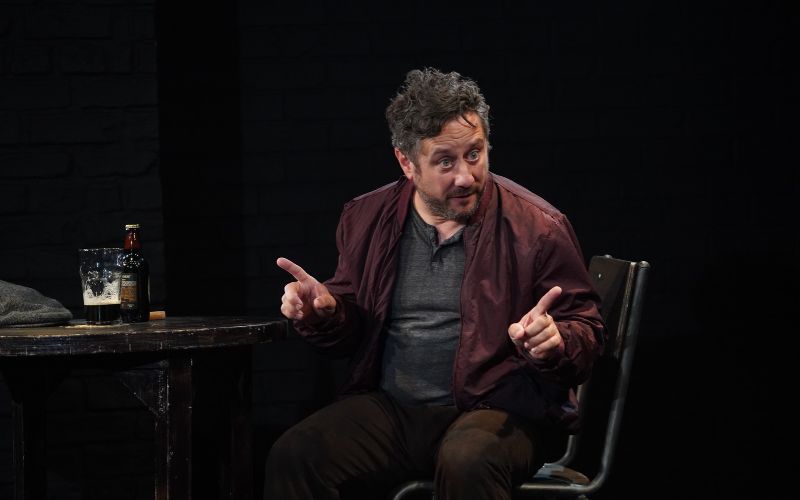

Christopher Fitzgerald in Irish Rep's 2026 production of "The Good Thief." (Carol Rosegg)
McPherson’s script is divided into 26 chapters, short enough to allow Fitzgerald to take a sip or two of his stout while considering his life choices. The chapter breaks also afford the audience time to follow the unfolding tragedy. Waldman smartly uses subtle lighting changes (lighting design by Jen Leno) to signal these pauses. This gives the audience time to absorb each facet of the multiple plotlines, characters, and brutal action that careens toward the climax.
The narrator is pragmatic and grateful for his survival and redemption, which come from an unexpected source. He admits: “... I'd made a pig's mickey of this.”
McPherson populates the story with Irish small-time criminals, primarily in Dublin, but with numerous references to other locations, including Kinnegad, Sligo, and Clontarf. All the criminals despise one another and wish only the worst for their associates. Fitzgerald’s narrator tries to minimize his guilt by claiming he is just muscle, even as he packs a shotgun and revolver “just in case.”
First staged in 1994, the play could easily have been a table read for a Guy Ritchie film. The characters and shenanigans of "The Good Thief" predate Ritchie's English gangster films "Lock, Stock and Two Smoking Barrels" and "Snatch." Both films feature groups of hustlers and con men who are as violent and amoral as possible, with dumb dudes stumbling their way through lives of crime. These films also marginalize women, as does the narrator’s love-hate relationship with Greta, who dumped him in favor of an older, more successful thug. “Power attracts women,” the narrator reasons simplistically.
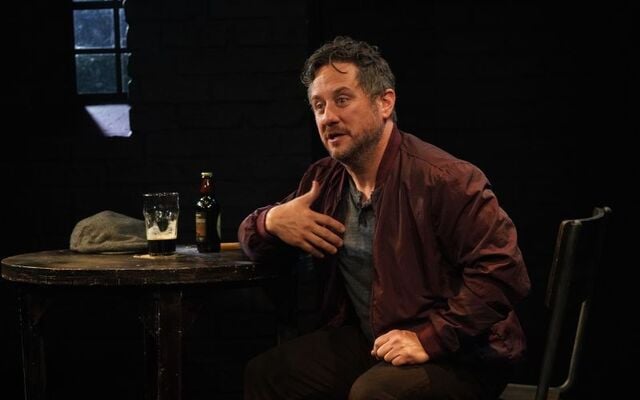
Even on the sparse set—one table and a chair in a nondescript pub—there is attention to detail. On the table sit a beer bottle and a glass. At the start, the glass is three-quarters full. Periodically, Fitzgerald drinks from it, eventually draining it. He then refills the glass and takes a few more sips. By the end of the play, the glass is exactly as full as it was at the beginning. This seemingly simple, completely natural bit of business is a fascinating detail of the performance.
The story also reveals a bit of Irish history. Set in 1994, the play takes place when the IRA was still a consideration for the Garda in solving crimes, since the Good Friday Agreement would not be signed until 1998. Were the murders the result of IRA infighting or simply ordinary criminal-on-criminal violence? The uncertainty surrounding the cause allows the narrator to flee relatively easily while the Garda begin their investigation.
The expression “no good deed goes unpunished” proves true here, as the narrator eventually serves time for his crimes. For audiences, however, "The Good Thief" is time well spent with Christopher Fitzgerald.
"The Good Thief" is at the Irish Repertory Theatre in New York City through December 20.