If you are already dreading this year’s Thanksgiving table, take comfort in knowing it cannot possibly rival the gathering at the heart of "The Playboy of the Western World". Synge’s tragicomedy serves up a homecoming so outrageous, complete with a murdered father who walks back through the door, that the crowd at the premiere caused more mess than anything happening on stage.
If you’re feeling some trepidation about how your Thanksgiving might go, take heart: Your family gathering really can’t be any worse than the raucous reunion in John Millington Synge’s storied tragicomedy, "The Playboy of the Western World"!
This play tells the fanciful (but, let’s be honest, perhaps somewhat realistic) story of a truly dysfunctional family gathering. The gathering on stage was so dysfunctional, in fact, that on the play’s opening night, the audience rioted. Think your Thanksgiving could go south any faster? That would be quite a challenge.
Synge’s story starts on “an evening in autumn” — maybe right about now. Is it just me, or do I hear someone “groaning wicked like a maddening dog” outside? The guests must be arriving!
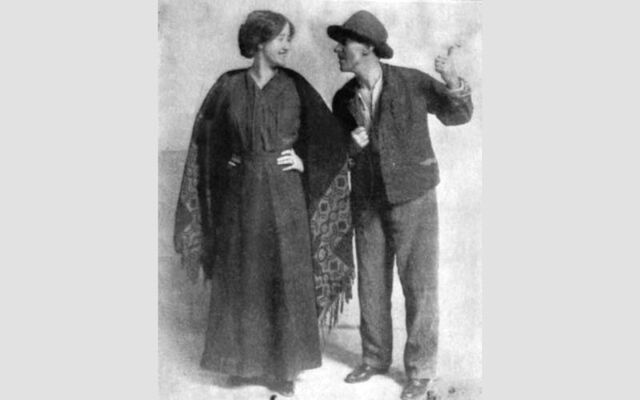
Synge sets the scene by introducing the hosts. The play begins with Pegeen preparing for her marriage to Shawn, for which the bishop must provide a dispensation. We’re starting out on the wrong foot here — the pair are related a little bit too closely for comfort. Shawn conceives of all of his endeavors in the context of Father Reilly’s opinions, a proclivity for which Pegeen (whose name sounds curiously like “pagan”) derides him, beseeching him: “Stop tormenting me with Father Reilly.” In their disagreement over how much say an authority figure should have, they prepare us to witness a donnybrook that extends far beyond the kids’ table.
As a great surprise — the event of the decade, no doubt — an unknown visitor arrives on the scene, and he makes his way into the house. Christy Mahon’s transformation from a “queer fellow…, going mad or getting his death, maybe, in the gripe of the ditch” into “the wonder of the Western World” in the span of fewer than twenty-four hours is little less than miraculous. His arrival on the scene and his subsequent transmogrification are what make this the legendary gathering it becomes. The attention that Christy receives and his intelligence in emphasizing the components of his experience that he believes will garner further attention lead to his increased confidence in himself. He brings not a throwaway side dish, but in fact the play’s main course: a story about his having killed his father, which he bastes with the gravy of exaggeration, pouring it on thicker with each retelling.
Read more
Starving for some adventure and a gathering that will make their lives more exciting, the villagers declare their loyalty to Team Christy. Pegeen, so moved by his display of faux valor, suggests that his arrival was meant to be, proclaiming: “I’ll be burning candles from this out to the miracles of God have brought you from the south today, and I, with my gowns bought ready, the way that I can wed you, and not wait at all.” This is about to become the biggest hooley the village has seen in years! Christy concurs with Pegeen’s assessment, declaring: “It’s miracles, and that’s the truth.” Miracles, or perhaps he’s just like that unexpected holiday guest we’ve all known — the one with the crazy story and fortunate lack of people present who are able or willing to contradict him.
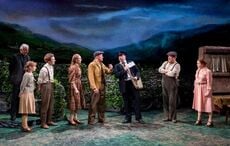
As everyone is settling into their new “reality,” an uninvited guest arrives late — after dinner, but just in time to serve up some humble pie for dessert. Having been firmly declared dead by his son, in multiple retellings of the tale, the supposedly dead Old Mahon walks through the door. Padraic Colum, who was in the audience on opening night, reports that the audience “‘had been growing hostile to the play from the point where Christy’s father enters. That scene was too representational. There stood a man with a horribly bloodied bandage upon his head, making a figure that took the whole thing out of the atmosphere of high comedy’” (quoted in Corkery). A bloodied bandage and a dead man walking — not your typical family gathering!
What follows is a hilarious — and awkward — reckoning of the story with the facts that have just presented themselves, in the form of an angry and injured Old Mahon. Christy, spotting his father, exclaims: “Saints of glory! Holy angels from the throne of light!... It’s the walking spirit of my murdered da!... Where’ll I hide my poor body from that ghost of hell?” The Widow Quin, who has more worldly experience than does the young playboy, greets Old Mahon “in great amusement.” She has seen a thing or two at a gathering, perhaps more raucous than this one, and she is unflappable. Pegeen asks Old Mahon, “Is it rose from the dead?” Not quite. It’s just that he, like every Irishman in history, has an exceptionally hard head.
Read more
If we try to analyze the reason for Christy’s wild actions and even wilder tale, we must return to the causes which impelled him to the separation. Christy’s impetus to achieve liberation, especially from a father who is trying to make his future miserable through a marriage to a mother figure who is more than twice Christy’s age, can be understood as an extreme version of the generational conflict that became particularly pronounced in Ireland because of social and economic realities. Instead of doing something subtle, like settling for becoming the official family bird carver, Christy tries again to dispatch his father. This time, the Mayoites, including Pegeen, consider it a “dirty deed.” As we’ve seen at our own tables, a tall tale, masterfully told, is generally acceptable; however, it’s usually best to avoid violent altercations in polite company.
Witnessing the whole to-do, the neighbors, instead of lauding Christy, brand him with flaming turf, tie him up, and prepare to bring him to the police. Seems like he’s one fried turkey. Yet it is his own father, whom he has apparently tried to kill twice and threatened to kill a third time, who rescues him and then vows his fealty to his son. In this most unlikely of alliances, we see that blood is thicker than water.
The play ends with the ghosted Pegeen lamenting the end of the visit. The future of the father and son is uncertain. Pegeen, the most independent-minded Mayoite, ends the play with her keen: “Oh my grief, I’ve lost him surely. I’ve lost the only playboy of the Western World.” With such a conclusion, there is not much hope for improvement on any front. And still, someone will have to clean up the mess, just as any host does after a good (or bad) Thanksgiving dinner.
Read more
At the first performance of the play, the mess was not just on the stage, but in the audience, too. David Cairns and Shaun Richards have explained that the opening play on the opening night of The Playboy of the Western World was Synge’s already-successful Riders to the Sea, which garnered audience applause and appreciation. The audience began the evening with an expectation of serious peasant drama and ended with a raucous comedy. Imagine showing up for a quiet dinner and being greeted by guests swinging from the chandeliers. There are several theories as to why the riot took place, but suffice it to say that the impropriety of the whole thing was enough to cause a ruckus in the crowd.
So, this Thanksgiving, if you’re lucky enough to have a somewhat peaceful family gathering, or even to have a quiet day alone watching the parade on TV while enjoying some cranberry sauce, don’t wish for something better! Your family, I can almost guarantee, has nothing on the villagers in The Playboy of the Western World — and certainly can’t hold a candle to the craziness of the Mahons. Happy Thanksgiving!
Recommended Reading
David Cairns and Shaun Richards. “Reading a Riot: The ‘Reading Formation’ of Synge’s Abbey Audience.” Literature and History 13.2 (Autumn 1987): 219-37.
Daniel Corkery. Synge and Anglo-Irish Literature: A Study. Cork: Cork UP, 1947.
* Maura Grace Harrington Logue earned her Ph.D. with a concentration in Irish literature at Drew University. She is co-editor of The Irish-American Experience in New Jersey and Metropolitan New York: Cultural Identity, Hybridity, and Commemoration (Lexington Books, 2013) and is the author of numerous peer-reviewed articles on Irish literature and portrayals of the Irish in literature. She has taught English at the university level, and she is known professionally as The Graceful Grammarian; her communications consulting business bears this name. A lifelong resident of New Jersey, she has ambitions of inculcating in her young sons her love of their Irish heritage, but she is thwarted in these efforts by their enthusiasm and erudition far outpacing hers.
This article was submitted to the IrishCentral contributors network by a member of the global Irish community. To become an IrishCentral contributor click here.