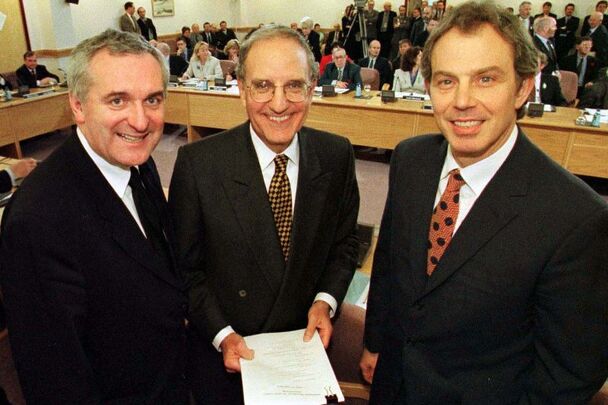
British Prime Minister Andy Burnham made his first trip to Northern Ireland since his elevation to his new job on August 27.
Given Burnham’s desire to decentralize power out of London and Westminster, somewhere in the back of the mind was a hope that the Prime Minister might offer a positive attitude towards the idea of a border poll – or at least indicate that he was willing to talk with all parties about any issue. I thought he would offer a muddled message and say something like “I think it is more important to focus on the cost-of-living crisis.”
I was wrong.
British Prime Minister Andy Burnham said on Thursday that a referendum on a united Ireland is "off the table.”
Burnham made the comments during his first official visit to Northern Ireland, where he met with Stormont political leaders.
"I'm here, as I said earlier, to listen, and I will take a collaborative approach, but some issues will be off the table, and that is one issue that will be off the table," Burnham told reporters in Belfast.
Now, as the leader of the United Kingdom, Prime Minister Burnham has the right to discuss or not discuss any issue he chooses. However, he does not have the right to say that a border poll is “off the table.”
I would suggest to the Prime Minister that he looks at the text of the Belfast/Good Friday Agreement. One of the key points of the Belfast/Good Friday Agreement is that it offers a peaceful way for Irish nationalists to pursue Irish unity. It was this creation of a peaceful way to achieve Irish unity that helped to end years of political violence in Northern Ireland.
I would remind Prime Minister Burnham that the Belfast/Good Friday Agreement is an international agreement made by Great Britain that must be honoured. No British Prime Minister has the right to pick and choose what parts of an international treaty he wants to honour. No where in that Agreement does it say that the issue of a border poll is “off the table.” Instead, the Belfast/Good Friday Agreement says that:
- The participants endorse the commitment made by the British and Irish Governments that, in a new British-Irish Agreement replacing the Anglo-Irish Agreement, they will:
- recognise the legitimacy of whatever choice is freely exercised by a majority of the people of Northern Ireland with regard to its status, whether they prefer to continue to support the Union with Great Britain or a sovereign united Ireland;
- recognise that it is for the people of the island of Ireland alone, by agreement between the two parts respectively and without external impediment, to exercise their right of self-determination on the basis of consent, freely and concurrently given, North and South, to bring about a united Ireland, if that is their wish, accepting that this right must be achieved and exercised with and subject to the agreement and consent of a majority of the people of Northern Ireland
It continues:
- (2) But if the wish expressed by a majority in such a poll is that Northern Ireland should cease to be part of the United Kingdom and form part of a united Ireland, the Secretary of State shall lay before Parliament such proposals to give effect to that wish as may be agreed between Her Majesty’s Government in the United Kingdom and the Government of Ireland.
It adds:
- Subject to paragraph 3, the Secretary of State shall exercise the power under paragraph 1 if at any time it appears likely to him that a majority of those voting would express a wish that Northern Ireland should cease to be part of the United Kingdom and form part of a united Ireland.
Like any international treaty, there is room for interpretation in the text of the Belfast/Good Friday Agreement. Prime Minister Burnham certainly can argue for his interpretation of what the Belfast/Good Friday Agreement means about a border poll. Other parties can advance their views as well. This is what we call political debate.
What Burnham cannot do is simply say that a border poll is “off the table.” An international treaty, signed by Great Britain, puts the border poll right in the centre of the table.
This article was submitted to the IrishCentral contributors network by a member of the global Irish community. To become an IrishCentral contributor click here.


Comments