Fifty years after loyalist gunmen and rogue state forces murdered his brothers John Martin, Brian, and Anthony, Eugene Reavey has won a civil settlement from the PSNI and the Ministry of Defense, along with a formal acknowledgment of collusion and an apology. But newly uncovered documents reveal that military files on the attack remain locked away under an 84-year embargo, meaning the full truth won't surface until 2061, long after Reavey himself is gone.
Eugene Reavey’s long journey to learn the full truth about the collusion surrounding an attack on the family home that resulted in the murder of his brothers — John Martin, Brian, and Anthony — in 1976 recently resulted in “vindication,” when the Police Service of Northern Ireland (PSNI) accepted and acknowledged its misconduct and provided an apology. Still, it was not a complete success, as military files related to the attack remain under a 1977 embargo for 84 years and cannot be made public until 2061. Only then will the Reavey family and the public learn the full truth about the murders.
In his book, The Killing of the Reavey Brothers: British Murder and Cover-up in Northern Ireland, Reavey recounts the shocking history of the case. Part of his story follows.
On January 4, 1976, a group from the loyalist Ulster Volunteer Force (UVF) and individuals of the state security forces killed 6 members of two families - the Reavey and O’Dowd families - in coordinated sectarian attacks 15 miles apart.
The 3 Reavey brothers were the only ones home that Sunday evening. Masked gunmen entered the house with guns blazing. John Martin was shot 14 times, and Brian was shot 3 times. Anthony attempted to flee from the intruders and hid under a bed. Shot 6 times, he initially survived. He crawled on his hands and knees along a floor thick with blood to check on his brothers. They were both dead. He then crawled 200 yards to ask a neighbor for help. Anthony succumbed to his wounds in the hospital 3 weeks later.
Police found 43 spent bullet casings fired from 4 weapons. One of the weapons, a machine gun, had been stolen from a British Army base in Glenanne, County Armagh, by a corporal in the Ulster Defense Regiment (UDR). The fact that the weapon went missing was not recorded in military logs. Recovered in 1976, it was linked years later to 11 sectarian murders.
A newspaper described the two attacks as “the worst night of sectarian slaughter since the start of the loyalist assassination campaign.” Things got worse the following day. On January 5, members of the IRA committed the Kingsmill massacre, stopping a work van and shooting 10 Protestant workers to death in a field.
Read more
Like more than a thousand other Troubles-killings, no genuine effort was made to investigate the Reavey and O’Dowd murders. As far as the Royal Ulster Constabulary (RUC) was concerned, these crimes were not a priority, and the investigation lay dormant for decades.
In 1999, John Weir, a former RUC officer serving a 14-year sentence for murdering a Catholic, told a reporter there was a group of rogue RUC officers who “worked side-by-side with terrorists in the UVF, the British Army, UDR, and numerous shadowy figures from various UK security agencies.” He said, “[t]heir mission was clear, namely to take the war to Catholic communities with the intention of wiping out the IRA even if it meant killing innocent people like the Reaveys, the O’Dowds, and others.” In short, Weir and his peers decided “that they should break the rules to curb the terrorists.”
The Troubles are referred to as a “dirty war” because government security officers often bent and broke laws in their fight against the IRA. The law-breaking was intentional, adhering to an ends-justify-the-means mindset.
Another journalist, writing a book, secured an affidavit from Weir in which he stated that the Reavey brothers were shot to death by 5 people. The group included members of the UVF, an RUC reserve constable, and a member of the UDR. The group formed part of the Glenanne Gang. The gang was responsible for over 100 sectarian murders committed in County Armagh and the Republic of Ireland during the 1970’s.
Weir was disgruntled over how the government had treated him. This motivated his statements to journalists. But he would not cooperate with the government in building a case against his confederates.
A PSNI specialized unit, the Historical Inquiries Team (HET), formed to reexamine thousands of Troubles-killings with a goal of providing answers to victims’ families, began to review the Reavey murders in 2007. (The HET was authorized to reexamine but not to re-investigate cases.) After years of experiencing the police’s silent treatment about his brother’s case, Reavey now started to learn about it.
HET verified that the 3 Reavey brothers “were completely innocent victims and had no connection to any paramilitary group.” In an interim report, HET criticized the initial murder investigation for not following normal police procedures. Specifically noted was the RUC’s failure to secure the scene of a burned-out car believed to have been used in the attack, failure to retain evidence, failure to retain incident logbooks, and failure to conduct follow-up investigations. The car was not photographed or tested, nor was a book of evidence compiled. The RUC also failed to explain whether a police vehicle checkpoint had been removed from the area near the time of the murders. The interim report was damning. It provided some answers and described cover-up behavior bearing the hallmark of collusion. But a final HET report was not issued. The unit was disbanded in 2014 after suffering budget cuts.
A decade later, Northern Ireland’s Public Prosecution Service announced that insufficient evidence existed to bring charges against anyone involved in the Reavey brothers’ attack. (Nor has anyone been prosecuted for the Kingsmill massacre.) This was not the end, because the civil case Reavey had filed against the PSNI and the British Ministry of Defense (MOD) for collusion and trauma remained active. That case went to trial recently. Both agencies settled on day 5 of the trial. The PSNI agreed to pay the Reavey family $175,000, and MOD agreed to pay $225,000.
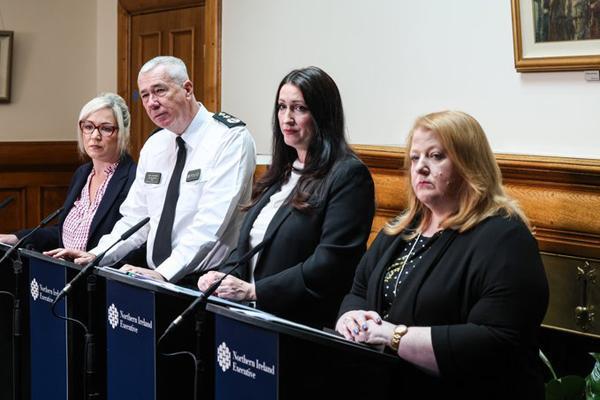
Additionally, a statement by PSNI Chief Constable Jon Boutcher was read in court. He publicly acknowledged the generational grief and trauma suffered by the Reavey family. The dead brothers’ parents and siblings suffered a wound that could not heal. Boutcher accepted without reservation that neither Eugene Reavey nor his brothers had any involvement whatsoever in any paramilitary activity, and he fully accepted the previous statement from HET regarding the brothers’ innocence. This was important to Reavey because his now-deceased parents wanted the murdered brothers’ names cleared publicly. Finally, Boutcher acknowledged “that the behavior and failures of members of the RUC may have contributed to the murders,” and he apologized for this conduct and its resultant consequences.
Deep down, all of us yearn to be treated with dignity and respect. It’s what drives families to spend years seeking answers about a loved one’s death. And it’s what makes the civil settlement in the Reavey case significant.
The government accepted responsibility for its misconduct and publicly acknowledged the victims' innocence, in addition to the family’s loss and pain. As Reavey’s solicitor at Phoenix Law said, this settlement is a form of vindication for the family. Reavey recognized that it is the most that can be achieved after 50 years.
Along Reavey’s journey seeking truth and justice, Ciaran MacAirt of Paper Trail, a legacy archive researcher, uncovered a military document revealing an 84-year embargo on the release of military files related to the Reavey killings. The document was supposed to have remained hidden. But MacAirt found it during his research. Reavey had been unaware of its existence.
Read more
The document indicates that military files about the attack exist but cannot be made public until 2061. It begs the question: Who are they protecting? Only in 35 years can a fuller understanding of what happened - why the family was targeted; who planned, approved, and knew about the attack; who perpetrated the murders or assisted in them; and why the truth was suppressed - become clear. Reavey will not be alive to hear the full truth by then. As referenced in the book, “the ghosts of loved ones” will haunt him until he dies.
In Northern Ireland (NI), collusion cases involving loyalist paramilitary killers and government security officers follow a certain path. First, the government lies about what happened instead of investigating. Then, it engages in a cover-up. This forces those who lost loved ones due to collusion to spend decades doggedly fighting for truth and justice. And just to ensure the indefensible need not be defended in the open, the government brands some facts confidential so the complete story cannot be publicly revealed.
That’s what happened when a public interest immunity (PII) application was upheld in the Paul Thompson Inquest case. Thompson was murdered in 1994. NI courts had ruled that Thompson’s family was entitled to hear a “gist” (summary) of information in one of seven confidential PII files, due to its relevancy at the Inquest proceeding. Earlier this year, the UK Supreme Court held that any release of PII information is solely a decision for the NI Secretary of State (NISOS), not the courts nor even the PSNI Chief Constable. The NISOS refused to release the Thompson gist.
Similarly, in the Sean Brown case, a NI Coroner held he was unable to conduct an effective Inquest due to “many hundreds of redactions” made to government files. He recommended that a public inquiry into Brown’s1997 murder be conducted, because the inquiry process “would allow the sensitive material [i.e., in national security files] to be examined and tested in a closed hearing.” NI courts agreed with the coroner that a public inquiry should be held. The NISOS, however, rejected the recommendation. The issue is now before the UK Supreme Court, with arguments scheduled for October.
The government’s aim - in asserting PII claims, redacting confidential information, or embargoing files - has been consistent. It’s to hide the true story about collusive murders from victims’ families and the public at large. The Reavey family, like so many other NI families, must continue to battle to get the answers they deserve, because the British government forces them to do so.
This article was submitted to the IrishCentral contributors network by a member of the global Irish community. To become an IrishCentral contributor click here.

Comments