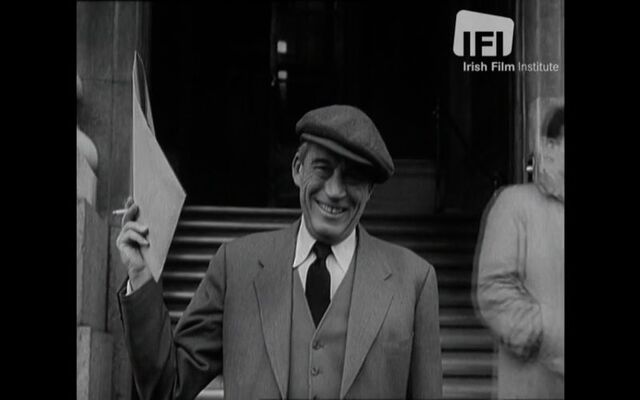
August 28 marks the anniversary of John Huston's death, and a rare 1964 newsreel from the Irish Film Institute captures a lesser-known chapter of his story, the day he formally became an Irish citizen. Long before he settled into his Georgian home in Co Galway, the Missouri-born director had already fallen for the country that would come to claim him as its own.
In this 1964 newsreel, news reporters waited outside the Government Buildings on Merrion Street in Dublin for the famous film director John Huston after he officially became an Irish citizen.
The director, famous for films such as "The Maltese Falcon" and "Moby Dick," was born in Missouri in 1906. His grandfather, Robert Moore Huston, was an Irish man from Armagh who emigrated to Canada shortly before the Famine.
John Huston first visited Ireland in 1951, where he stayed in Wicklow in the home of Garech Browne, a member of the Guinness family. He visited many times thereafter, and on one of these occasions, he bought and restored an old Georgian house, St Cleran’s in Craughwell, Co Galway.
His daughter, Anjelica Huston, attended school at the well-known Kylemore Abbey for many years. The National University of Ireland, Galway, now has a dedicated film school named in his honor.
"John Huston Becomes an Irish Citizen" is part of the Irish Free State's Gael Linn Collection.
The Irish Film Institute's Gael Linn Collection
Gael Linn was established in 1953 to promote the Irish language and culture. Co-founder and first manager, Riobard Mac Góráin, immediately realized the importance of promoting the language through entertainment and popular media. Gael Linn’s initial foray into production was the first regular indigenous cinema newsreel since the Irish Events series of the 1920s.
In 1955, Ernest Blythe, Chairman of Comhdhána na Ghaeilge, lent Gael Linn £100 to produce a film, and the Amharc Éireann (A View of Ireland) newsreel was born.
From 1956 to mid-1957, Amharc Éireann consisted of short, single-story pieces distributed to cinemas throughout the country monthly. Their popularity was immediate, and by mid-1957, Rank Film Distributors agreed to supply them to Irish cinemas alongside their own newsreel, which was issued fortnightly.
By 1959, the success of this homegrown newsreel led to its being produced weekly, and it expanded to include four separate news stories. The series continued until 1964, when the immediacy of television as a means of relaying news to the Irish population rendered the newsreel obsolete.
Produced by Colm O’Laoghaire, a total of 267 editions of Amharc Éireann were made.
Although Gael Linn’s Amharc Éireann production ceased in late 1964, its influence is ongoing. The range of Irish interest subjects covered (from hard news stories to more magazine-like items) provides a vivid window into modern Ireland at a particularly progressive point in its development and offers first-hand insight into the country's moral, cultural, and economic development throughout the Whittaker and Lemass eras.
"John Huston Becomes an Irish Citizen" is published here thanks to the Irish Film Institute (IFI), which IrishCentral has partnered with to bring you a taste of what their remarkable collection entails. You can find all IrishCentral articles and videos from the IFI here.
To watch more historic Irish footage, visit the IFI Archive Player, the Irish Film Institute’s virtual viewing room that provides audiences around the globe with free, instant access to Irish heritage preserved in the IFI Irish Film Archive. Irish Culture from the last century is reflected through documentaries, animation, adverts, amateur footage, feature films, and much more. You can also download the IFI Archive Player App for free on iPhone, Android, Apple TV, Amazon Fire TV, and Roku.
IrishCentral has partnered with the IFI to bring you a taste of what their remarkable collections entail. You can find all IrishCentral articles and videos from the IFI here.
* This article was originally published in 2025 and updated in 2026.


Comments