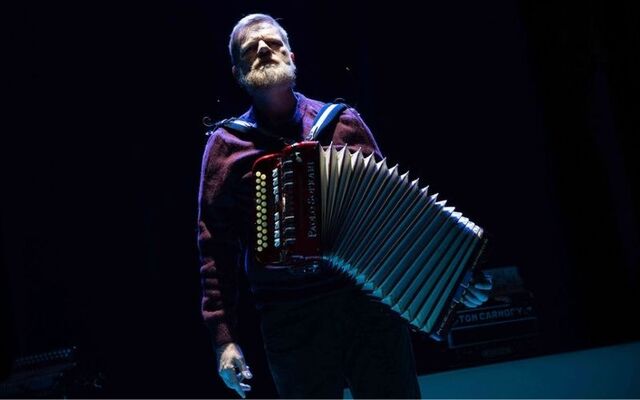
Accomplished accordionist Danny O’Mahony hopes to honor the traditions of his Irish mentors. His playing throughout "Bellow" is beautiful and soulful, ample evidence of the many awards he has earned since childhood.
Seeking to create a theatrical work, Danny approaches experiential theater maker Gary Keegan. Gary responds by shaping a piece drawn from Danny’s life as a childhood prodigy and his successful performing career.
While Danny initially wants to tell a story rooted in tradition, Gary’s process ultimately yields a deeper, more powerful portrait of the artist.
What might have been a straightforward documentary about an Irish accordionist becomes a gripping personal drama, driven by a stunning soundtrack and an emotionally resonant story.
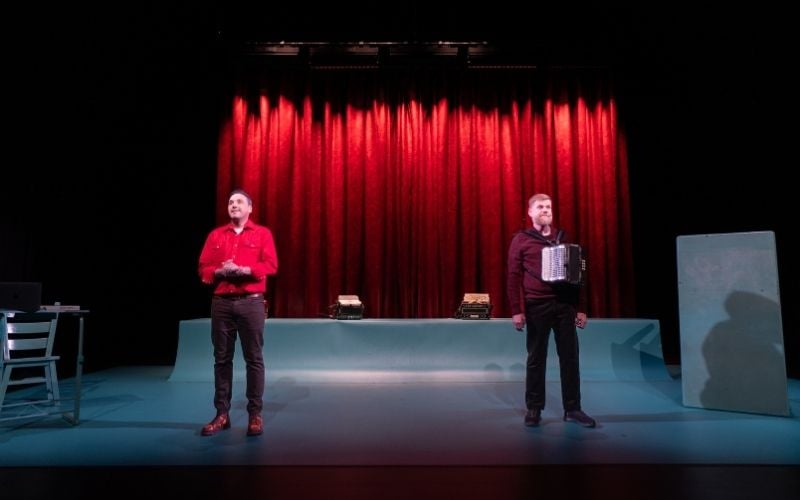

Gary Keegan and Danny O'Mahony in "Bellow." (HanJie Chow)
Written by Feidlim Cannon, Gary Keegan, and Danny O’Mahony, and directed by Brokentalkers Theatre Group, Bellow deftly explores the act of making art through the principle of saying “Yes.”
As Gary explains: “My work has to be made new each time, right. It builds from the ground, and that work requires a different set of skills, okay?”
The show unfolds through a series of exercises Gary guides Danny through, each designed to lower Danny’s defenses and reveal his authentic self. As a framework, Gary turns to Keith Johnstone’s book "Impro."
Danny admits—hesitantly—that he is so closely identified with his instrument that he feels abandoned when it is no longer in his arms. As he opens up about his childhood, vulnerability deepens, and emotional intensity builds.
Throughout the performance, the push–pull motion of accordion bellows serves as a recurring metaphor. That movement reflects Danny’s struggle to honor tradition while accommodating Gary’s drive to create something new. When the collaborators agree that talking may not be the best way to express emotion—or to stave off boredom—dancer Emily Kilkenny Roddy enters the piece.
Emily perceptively identifies the emotions Danny experiences while playing and translates them into movement with striking effect. She becomes a physical embodiment of Danny’s childhood memories, not all of them joyful. Themes of isolation, possible abuse, the loneliness and exhilaration of performance, and the physical and emotional imbalance of the performer emerge.
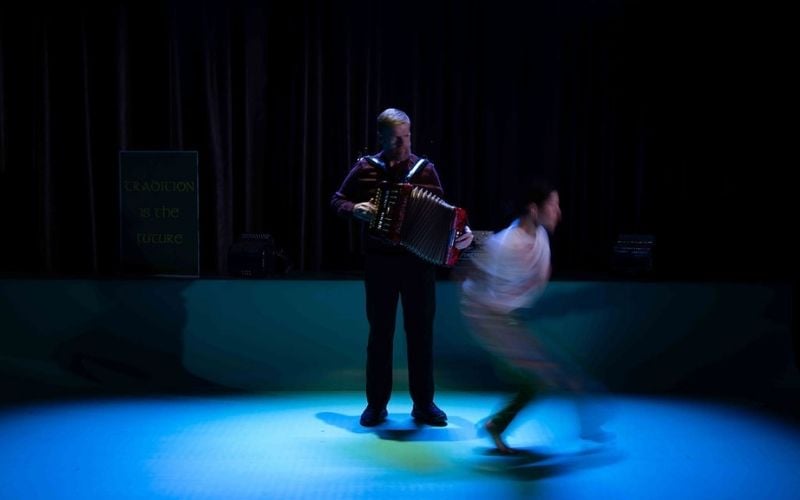
Danny O'Mahony and Emily Kilkenny Roddy in "Bellow." (HanJie Chow)
Danny reflects: “I’ve used my music all through my life to give ease to myself. To give joy to myself. To give delight to myself. I’ve used my music to give all of those feelings to others. But there is a horrible aspect to music for me—there is a darkness for me in that very bright space. That space wasn’t a safe space, so music led me to danger.”
The set design by Sabine Dargent is stark yet highly effective. As the narrative evolves, the minimal set pieces are swiftly repurposed to serve new functions. An easel used to chart Danny’s emotions on a stick figure becomes a table and later a platform for Emily’s movement. Lighting by Sarah Jane Shiels captures the shifting emotional terrain of the piece, while sound design by Valgeir Sigurðsson amplifies Danny’s performances. Voiceovers convey Danny’s thoughts when emotion overtakes him. The stagecraft is understated, precise, and expertly executed.
Early in the show, Gary voices a concern about the project: “Are we going to make a piece of work about something as obvious as the healing power of music?”
Yes, music has healing power. Bellow also demonstrates that experimental theater can be a source of healing—for accordionist Danny O’Mahony, and for the audience as well.
"Bellow" runs at the Irish Arts Center through January 18 as part of the Under the Radar Festival.


Comments