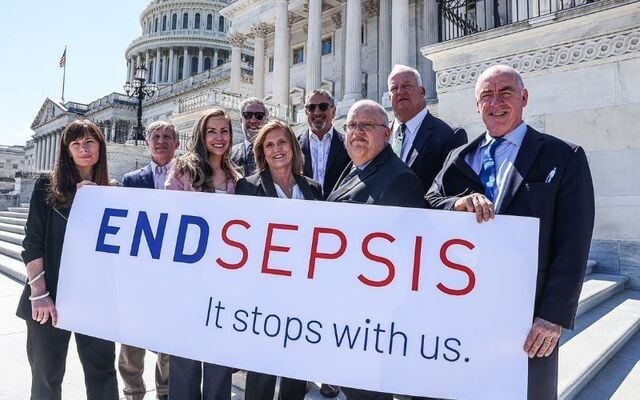
The influential Problem Solvers Caucus has formally endorsed the Securing Enhanced Programs, Systems and Initiatives for Sepsis (SEPSIS) Act (H.R. 7116), legislation to strengthen the national response to sepsis and improve patient outcomes.
The legislation, which is currently before the House of Representatives as well as the Senate, mentions Rory Staunton, the Irish American 12-year-old boy who died from undiagnosed sepsis in 2012.
Following his tragic death, his parents Ciarán and Orlaith Staunton launched the sepsis advocacy nonprofit End Sepsis, which is currently working to secure passage of the Sepsis Act.
End Sepsis welcomed the endorsement from the influential bipartisan group of 45 members of the US House of Representatives.
"This significant bipartisan endorsement sends a powerful message: preventing needless deaths from sepsis is not a partisan issue," End Sepsis said in a statement.
"It is a national priority – and Congress must act."
View this post on Instagram
What is the Sepsis Act?
The Sepsis Act would direct the CDC to educate hospitals on addressing sepsis and improve federal data collection on pediatric cases; strengthen coordination across the Department of Health and Human Services while supporting the development of a sepsis outcome measure and requiring a report to Congress; and
require a congressional briefing on the CDC’s sepsis activities and establish a voluntary recognition program for hospitals with effective or improving sepsis programs.
The Sepsis Act previously secured bipartisan support in the House of Representatives when it was introduced by Congressmen Donald Norcross (D-NJ) and Tom Kean Jr. (R-NJ). It is now co-sponsored by Representatives Brian Fitzpatrick (R-PA), Josh Gottheimer (D-NJ), Michael Lawlor (R-NY), Nick LaLota (R-NY), David Rouzer (R-NC), and Delegate Eleanor Holmes Norton (D-DC).
Similarly, in the Senate, the Sepsis Act is co-sponsored by Senators Charles Schumer (D-NY), Susan Collins (R-ME), Andy Kim (D-NJ), Amy Klobuchar (D-MN), Christopher Murphy (D-CT), Lia Murkowski (R-AK), Jim Banks (R-IN), and Christopher Coons (D-DE).


Ciarán Staunton, Senator Chuck Schumer, and Orlaith Staunton.
"More bipartisan momentum"
Announcing the endorsement, Problem Solvers Caucus member and Sepsis Act co-sponsor Congressman Norcross said: “No condition so treatable should be so fatal, yet even with excellent medical care I was lucky to survive my own battle with sepsis.
“We already know what resources can make a dramatic difference for treating sepsis. Congress has the unique ability to equip more hospitals with the tools to save lives, and there’s no reason both parties can’t be part of the solution.
"I'm extremely grateful to the Problem Solvers Caucus for creating even more bipartisan momentum for my SEPSIS Act.”
Caucus member and Sepsis Act co-sponsor Congressman Kean said: “Sepsis can impact anyone — young or old, sick, or healthy — and preventing deaths depends on early recognition and timely intervention.
"I am pleased to see the SEPSIS Act, that I introduced with Congressman Norcross, endorsed by the Problem Solvers Caucus. It is critical that we put patients over politics, and this bipartisan legislation would strengthen sepsis care through expanded education, national information-sharing on best practices, and improved pediatric data collection."
The Problem Solvers Caucus is proud to endorse the bipartisan SEPSIS Act, led for endorsement by @RepDonaldNorcross and @CongressmanKean, to improve how hospitals recognize and respond to sepsis.
Sepsis affects 1.7 million Americans and claims 350,000 lives each year. It is also… pic.twitter.com/QiDUXORuHn
— Problem Solvers Caucus (@ProbSolveCaucus) August 12, 2026
Problem Solvers Caucus Co-Chair, Congressman Tom Suozzi (NY-03), commented: “Sepsis can turn a medical emergency into a life-or-death situation in a matter of hours, but most fatal sepsis cases are preventable.
"Our doctors and healthcare workers need the tools and information to recognize sepsis and act quickly.
"The SEPSIS Act is a commonsense bill to strengthen early detection, improve the standard of sepsis care across the country, reduce the burden on the healthcare system, and save lives.”
Caucus member and Sepsis Act co-sponsor Congressman Fitzpatrick added: “Sepsis remains among the most dangerous and unforgiving medical emergencies in our healthcare system. The SEPSIS Act advances a thoughtful, bipartisan framework to improve early recognition, strengthen hospital response, and deliver better outcomes for patients.
"When we know where intervention can save lives, Congress has a responsibility to translate that knowledge into action. I applaud Representatives Norcross and Kean for their leadership on this initiative."
You can learn more about End Sepsis here. You can ask your Congressional representatives to sign on to the Sepsis Act via this online form.




Comments