Editor's Note: The following piece has been shared with IrishCentral from the American Irish Historical Society's (AIHS) Treasures of Time, stories from the collections and archives of the American Irish Historical Society in New York City.
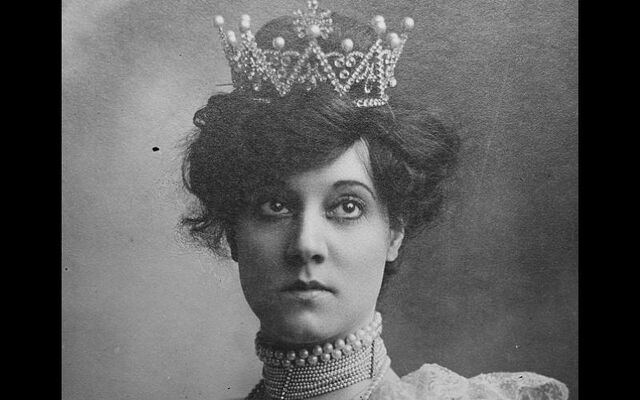
Mabelle Gilman Corey, the third inhabitant of our current AIHS headquarters at 991 Fifth Avenue, was far more than just the wife of William Ellis Corey. She was a Broadway star, and a woman of wit, beauty, and unapologetic ambition.
Her life spanned continents, scandals, and even Wartime captivity. Her journey from California to a Parisian chateau and Nazi internment camp reads like a novel filled with fame, fortune, heartbreak, and resilience.
Mabelle Lavona Gilman was born to Charles Henry Gilman and Jeanette R Curtis. She went on to attend Mills College in Oakland, California, where she studied voice under the celebrated instructor Julie Rosenwald. It was here she emerged as a talent in musical comedy.
Mabelle made her stage debut in London on July 11, 1896, as Rosa in "The Countess Gucki." Shortly after, in September 1896, she bagged her first Broadway role playing O Kinkoto San in "The Geisha." This marked the start of a transatlantic career that would make her a star. She went on to lead in several other live shows in the UK and US. By 1905, Mabelle was firmly established as a musical comedy star, admired for her charm and sharp sense of humor.
This was the year she first met William Ellis Corey, the powerful President of the United States Steel, and a married man. Despite this, Corey was enamored by Mabelle, and the pair began an affair that would become one of the most sensational scandals of the Gilded Age.
Eventually, Corey’s wife Laura Cook requested a divorce. However, due to restrictive divorce laws in their home state, Pennsylvania, Laura had to travel to Reno, Nevada, to secure a divorce that allowed her full custody of their son, Allan. This divorce and William's quick remarriage to Mabelle helped establish Reno as a destination for quickie divorces.
Following this, Mabelle and William married on May 14, 1907. The ceremony was performed by the Rev. Dr. J.L. Clarke of the Bushwick Avenue Congregational Church. It was reported that the couple attempted to have the ceremony performed by a Catholic priest or an Episcopal clergyman, but they declined to officiate. Corey purchased a new chateau in France for Mabelle, alongside valuable jewels and a wedding gift of $1 million.
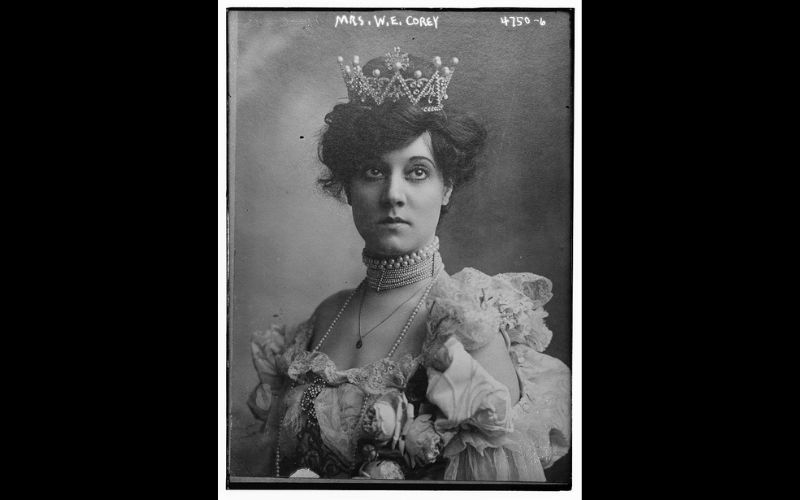

Mabelle Gilman Corey. (Courtesy AIHS)
Though the pair were initially passionately in love, their marriage was not a happy one. As time went on, Gilman grew increasingly disenchanted with life in America. She complained of too much noise and spent the majority of her time at the chateau in France, where she hosted lavish parties and mingled with European nobility. On one trip back to New York to spend the holidays with her husband, Mabelle said, "I love this country, but I could never live here again because the noise would drive me mad." As her marriage to Corey began to deteriorate, Mabelle was quoted saying: "American men are more worried about accounts receivable, stocks, and bonds rather than their wives."
By 1923, the marriage ended in divorce, this time in Paris.
After her divorce, Mabelle’s life took a turn towards royal intrigue as she began a relationship with Luís Fernando de Orleans y Borbón, Infante of Spain. On April 20, 1929, she even converted to the Roman Catholic faith in preparation for marriage.
However, despite Mabelle’s conversion, the wedding never came to pass. Luís Fernando and his lawyer repeatedly attempted to obtain a higher annual allowance from her wealth. In June 1929, a disillusioned Mabelle called off the engagement. She gave a rare interview about the situation in which she said, "It’s hard to be broken off, but it is impossible to turn the sacrament of marriage into a bargain counter. I don’t know if I’ll ever love another man. For the present, I don’t care. I have always said that American men make the ideal husbands, although they lack the polish that many Europeans possess."
Mabelle settled permanently in France, living a quiet life of luxury until the outbreak of World War II in 1940. She was captured by the Nazis and interned at a camp near Vittel, where she remained for two years. Little is known about her time here, and she never spoke publicly about this experience. Considered harmless to the German war effort, she was released in 1942 alongside all female prisoners over the age of 60.
After the war, Mabelle returned to the United States, spending her later years in relative obscurity. She died on November 14, 1960, at the Blessed Trinity Missionary Cenacle in Brooklyn, New York. She was cremated and her ashes spread in the garden of the Blessed Trinity.
From San Francisco stages to Fifth Avenue mansions and French internment camps, Mabelle Gilman Corey lived a life few could imagine. She remains one of the most intriguing figures to ever call 991 Fifth Avenue home.
References:
- European Royal History Journal (2023) The American Lady Who Almost Became an Infanta of Spain: Mrs Mabelle Gilman Corey. Available at: https://eurohistoryjournal.com/the-american-lady-who-almost-became-an-infanta (Accessed: 11 November 2025).
- Reid, J. and James, R. (2004) Uncovering Nevada’s Past: A Primary Source of the Silver State. Reno: University of Nevada Press.
- New York Times (1907) ‘W.E. Corey Weds Mabelle Gilman: Ceremony Ends at 1:30 A.M.’ New York Times
- New York Times (1912) ‘Too Noisy for Mrs Corey’. New York Times
- New York Times (1923) ‘Mrs W.E. Corey Gets Divorce in Paris: Former Mabelle Gilman, Actress, Wins Her Freedom from American Steel Man’. New York Times, 23 November.
- New York Times (1929) ‘Mabelle Gilman Corey Will Wed Prince Luis; Announces She Has Become Catholic’. New York Times, 11 May. Available at: https://www.nytimes.com/1929/05/11/archives/mabelle-gilman-corey-will-wed-prince-luis-announces-she-has-become.html (Accessed: 11 November 2025).
- New York Times (1942) ‘Nazis Free U.S. Woman: Mabelle Gilman Corey, Former Actress, Released in France’. New York Times, 12 October (Accessed: 12 November 2025).
This column is adapted from the blog of the American Irish Historical Society (AIHS). Read the full stories at AIHSNY.org/blog.
Founded in 1897 and located on Museum Mile in New York City, the American Irish Historical Society (AIHS) preserves and promotes the history and cultural legacy of the Irish in America through its archives, art collections, and public programs. Learn more at AIHSNY.org.


Comments