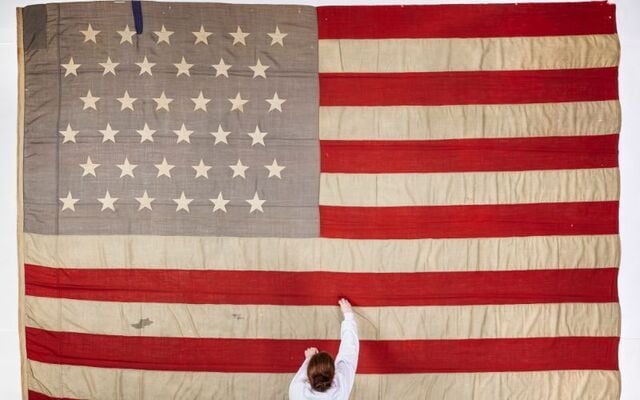
The National Museum of Ireland at Collins Barracks will mark the 150th anniversary of the Catalpa Rescue Mission with a rare public display of the ship’s flag, a historic symbol of Fenian daring and transatlantic Irish-American cooperation. The Flag of the Catalpa will go on view on Saturday, April 18, and Sunday, April 19, 2026, in the Palatine Room.
Measuring 4.5 by 3 meters and featuring 36 hand-sewn stars, it is the largest flag in the national collection and was the official flag of the United States between July 4, 1865, and July 4, 1867.
The flag is one of the last surviving artifacts linked to the dramatic prison break in Western Australia that unfolded 150 years ago, from April 17 to 19, 1876. During the operation, six Fenian prisoners escaped from a British penal colony and made their way aboard the US whaling ship Catalpa.
James Wilson, Thomas Darragh, Martin Hogan, Michael Harrington, Thomas Hassett, and Robert Cranston were among 62 Irish Republican Brotherhood leaders and supporters transported to Fremantle after the Fenian uprising of 1867. By 1875, most had been released, but these six men remained behind bars.
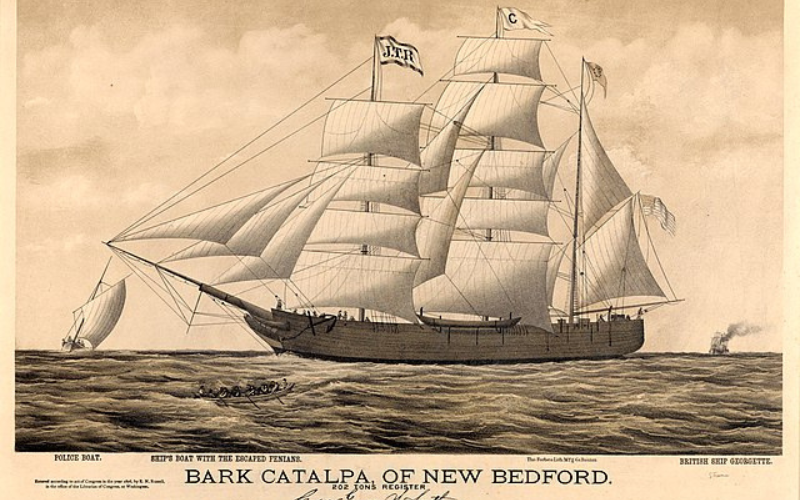

Original lithograph created by E.N. Russell, January 1, 1876.
The rescue was organized through the efforts of John Devoy, leader of Clan na Gael in New York, along with John Boyle O’Reilly and Thomas McCarthy Fennell, both of whom had been imprisoned in Fremantle. They arranged for the purchase and refitting of the Catalpa so it could sail to Western Australia and bring the prisoners to the United States.
In April 1876, after an 11-month voyage, the Catalpa arrived off Western Australia under the command of Captain George Anthony and waited for the men to escape. When the six Fenians finally boarded the vessel, the Georgette, a ship operated by the British authorities in Fremantle, gave chase and threatened to fire unless the crew surrendered the prisoners.
Captain Anthony responded by raising the American flag and warning that any attack would mean firing on the United States. The Georgette backed down and returned to Fremantle, helping the Catalpa escape safely to New York.
Read more
Patrick O’Donovan TD, Minister for Culture, Communications and Sport, said, “The Catalpa rescue is a significant moment in the history of the fight for Irish independence. It is also symbolic of the important role Irish American relations played in its success, and timely, given the 250th anniversary of the signing of the Declaration of Independence in 2026.
“There are celebrations happening globally for this event, including programs that my Department is supporting through the local authority network in Kildare and Dublin, and with support from the Department of Foreign Affairs and Trade in Rockingham, Australia, where the prisoners escaped from. I am very pleased that my Department could also support the National Museum of Ireland so that members of the public can now view this storied flag at Collins Barracks as we mark the 150th anniversary of the rescue mission.”
Brenda Malone, Curator of Military History at the National Museum of Ireland, said, “This is a really evocative piece of history that we’re putting on display for the public. The Catalpa rescue mission is one of the most celebrated prison breaks of this era and an important milestone in the fight for Irish independence, with its success boosting confidence in and support for the cause in both Ireland and the United States of America.
“To have the original flag from the historic mission under the care of the National Museum is a real honor and privilege, and we are delighted to be able to share this piece of history with the public this month.”
Dr. Éimear O'Connor, Interim Director and Director of Collections and Access at the National Museum of Ireland, said, “We are thrilled to showcase the Catalpa flag to the public to mark the 150th anniversary of the historic Fenian rescue in Western Australia. It is the largest flag in the national collection, and its size and delicate condition prevent it from being shown in standard gallery spaces, but it will be on display in the Palatine Room for two days to mark the anniversary, making this a rare opportunity for the public to view this important historic object in person.”
For more information visit Museum.ie.

Comments