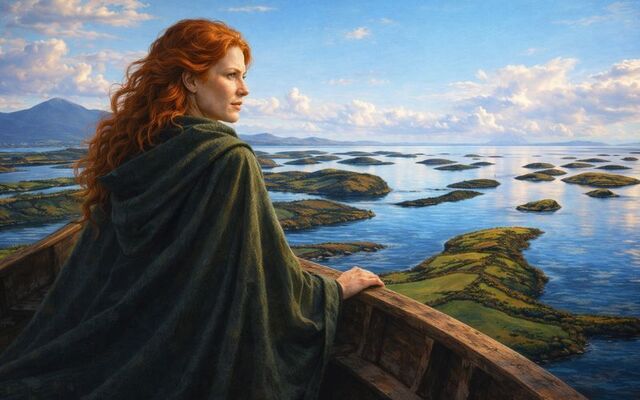
This second installment in a five-part series written by writer, producer and actor Keelin McCool, who is currently in development with the period drama feature "Mama Pirate," traces the world that forged Gráinne Ní Mháille. In Clew Bay, where the calm waters conceal a labyrinth of islands, sandbars and treacherous channels, the old ways of sea knowledge helped make the legendary pirate queen nearly impossible to outmaneuver.
Gráinne's Clew Bay looks deceptively tranquil. Its calm waters wrap around a coastal plain and curl into inlets, forming a basin dotted with approximately 141 low-lying, oval-shaped islands called drowned drumlins, creating a seascape that geologists refer to as a “basket of eggs”. This collection of shallow hills jutting out of the water was formed during the last Glacial Age, when the British-Irish Ice Sheet retreated, and sea levels subsequently rose.
Through the centuries, the bucolic bay looked benign to travelers unfamiliar with it. But it was almost impossible to navigate without first-hand knowledge of the narrow passages and varying depths. And in storms and darkness, it became treacherous - and deadly. This deep understanding was the source of her power and her leverage.
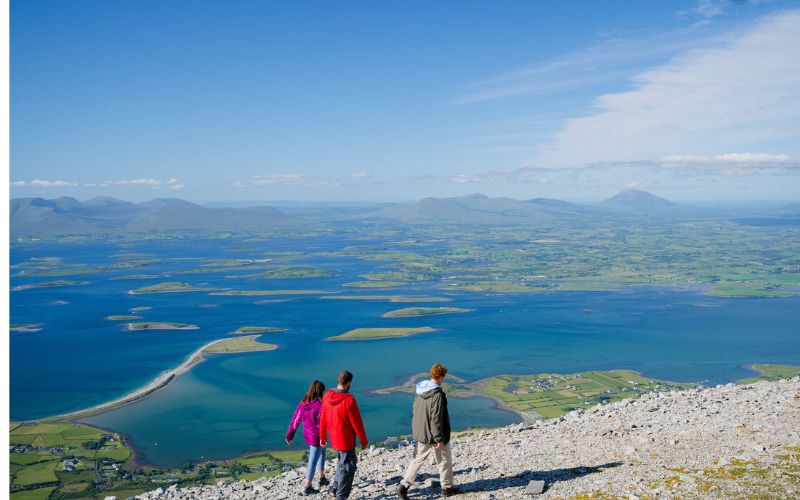

A view of Clew Bay from the summit of Croagh Patrick.
Locals knew that one wrong decision by a sailor unfamiliar with this seemingly serene coast could cause tragedy. A route that was usable at one stage of the tide might become too shallow or too narrow later. Higher water could hide hazards by covering them, making the surface appear passable even when rocks, shoals, or bars lay beneath. Lower water exposed more of the bay’s structure, but it also reduced the margin for error. So in Gráinne’s case, an outsider trying to pursue - or impose order - was at a distinct disadvantage.
The vessels, or galleys, of Gráinne’s time were constructed to operate within these constraints. Gráinne would use these to mount coastal raids, or transport Scottish gallowglass - mercenary warriors hired to assist clans in battles - as they could hold between 200 and 300 men. They were modeled after earlier Viking ships, with long, narrow hulls and shallow drafts, an extended prow, and a high transom. They were clinker-built, with the hull planks overlapping, making them more flexible in rough weather and lighter and faster, as the more solid outer planks absorbed the pummeling of open-sea waves.
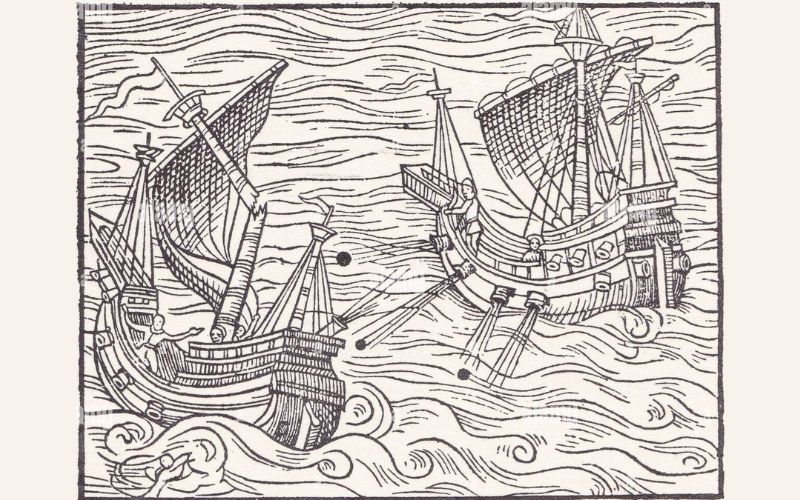
Ships from the mid-1500s.
Most had a single mast with a triangular lugsail, used on sea voyages or for long distances, which pointed toward the bow to pull the vessel forward and keep it steady when winds blew up. In calmer weather or when there was no wind, oars allowed the vessel to maneuver more quickly in battles or through narrow passages. With up to thirty oars and multiple men at each oar-- meaning there could be 90 rowers and 100 men standing at the ready--Gráinne’s galley could reach speeds up to 7 knots, making it a very powerful weapon.
This speed and agility provided Gráinne with a clear advantage. When she once came across a shipwreck on the rocks off Achill Island, her boat quickly moved in close so she could rescue the sole survivor, Hugh De Lacy--who subsequently became her lover--and salvage the booty that had been dashed upon the rocks. And when English warships tried to stem her piracy of their trading ships by hunting her down, their deep drafts and slow movement were no match for the nimbleness of the galleys that could glide over sandbars or submerged rocks and disappear into inlets, leaving the English to abandon their game of hide-and-seek. Sir Henry Sidney was impressed enough to describe her as “a most notorious woman on all the coasts of Ireland,” and a “most famous feminine sea captain”.
Trade was also part of Gráinne’s influence. She not only used her ships to plunder; she came from a family that operated within a west-coast economy that depended on sea routes, tolls, transport, fishing, and overseas trade. The O’Malleys had long-standing links with Spain, sending out salted fish, pine marten skins, fleeces, cattle hides, and tallow, and bringing back iron, weapons, and wine.
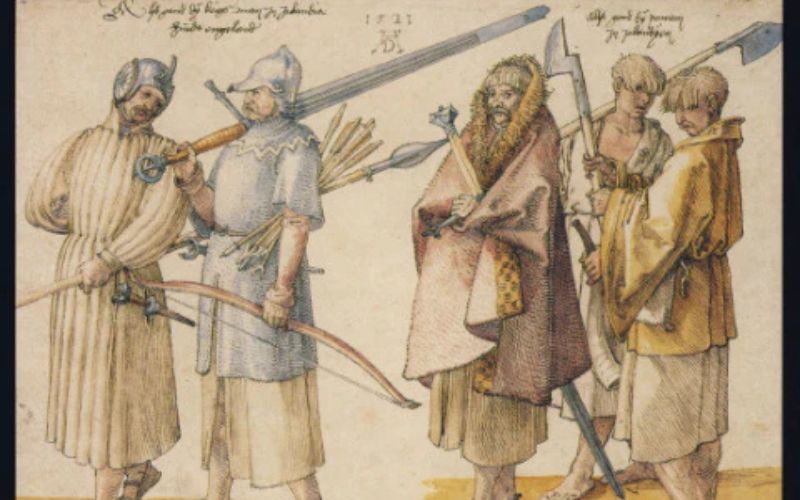
Durer Warriors.
This mattered because Galway was a merchant stronghold dominated by a tight-knit group of Anglo-Irish merchant families aligned with England, with its own privileges and a clear suspicion of neighboring Gaelic powers. The O’Flahertys, into whom Gráinne married, also depended on the sea for trade, food, and transport, but were a threat enough that Galway merchants sought to keep them out of the city. A French traveler, Jacques-Louis de Bougrenet, Chevalier de La Tocnaye, who visited Galway in 1796, wrote that he saw the inscription, “Oh! God! Deliver us of the ferocious O’Flaharty’s” still carved on the walls leading in.
The O’Malleys and the O’Flahertys, nevertheless, knew how to work around these choke points. Her real influence came from knowing how to move goods, men, tolls, and information through a coastal highway with no localized authority. The same waters that could hide shoals and sandbars could also create an alternate commercial system.
Once the coast dropped from sight, different skills took over. Instruments like the astrolabe could help a navigator judge latitude by the sun or stars, giving some sense of how far north or south a ship had drifted. But it could not find a narrow harbor entrance, read a tide that was turning, or tell you which channel would still be deep at dusk. For that, knowledge still lived in the crew.
And this is where Gráinne’s command remains something more than just seamanship. Her power resided not only in the open water, but in her own connection to the unique geography of her home--and where control could still be exercised by those who knew it best.
Read the first installment in the series here.
* Keelin is a writer/producer/actor. As co-producer of the gender equality in Hollywood documentary, "This Changes Everything", she enlisted Meryl Streep, Shonda Rhimes, Cate Blanchett, and others to participate. She is currently in development with the feature "Mama Pirate". For more, stay up-to-date on the project on Instagram @MamaPirateFilm.

Comments