For many in the Irish diaspora, there comes a point where the usual tools- therapy, meditation, journaling- stop being enough. Something older still seems to be humming underneath, something collective and unmistakably Irish, and that's exactly where a new program called Beyond the Irish Question begins.
What hums underneath has a name and a history: Famine and forced emigration, a mother tongue broken across generations, a church-and-state architecture that turned shame into inheritance, and a partitioned island whose fractures still surface in family silences long after the politics move elsewhere. Beyond the Irish Question doesn't explain this history or try to resolve it, it offers people ground to inhabit, in their bodies, their relationships, and in patterns carried forward without ever being chosen.
View this post on Instagram
Founded by Irish psychotherapist Simon Courtney, Beyond the Irish Question is a nine-month cohort designed for people of Irish descent, both on the island and scattered across the diaspora, who have already done meaningful inner work and sense that a deeper layer is still waiting to be faced. It is not therapy in the traditional sense, nor a heritage tour or a tidy history lesson. It is a group exploration held together in community, built around the idea that what we don't look at in our past can quietly continue to shape our present.
Over eight modules, participants examine themes such as becoming and belonging, ancestral lineage, land and language, and power and polarization. The work happens through live group sessions, smaller triads for more intimate conversation, and teaching from Simon and guest facilitators along the way. The aim throughout is not to resolve these tensions into something neat and comfortable, but to stay with the ambivalence itself. As the program's founders put it, the holding is the actual work.
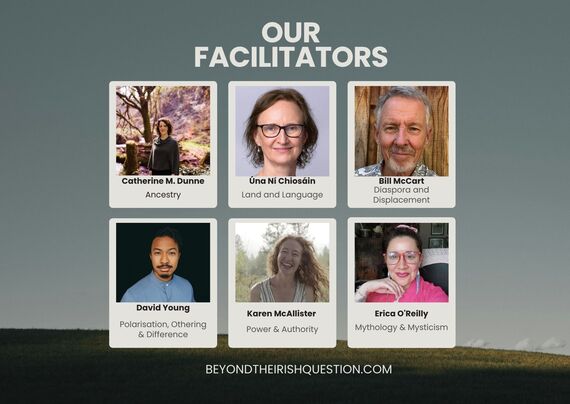

The Beyond The Irish Question facilitators.
That approach asks something real of participants, and the first cohort showed it delivers something real in return. Members moved from carrying inherited shame and silence toward more freedom, more aliveness, and a deeper connection to their own lineage and to one another. Left unaddressed, this material doesn't simply disappear. It keeps shaping people's lives without their consent. Faced together, in community, it can finally come back into relationship.
What past participants are saying
The response from the first cohort speaks for itself.
"If you're interested in experientially exploring what constitutes the uniqueness of your Irish inheritance, this is the place to start." - Martin
One participant, M.N., said, "This was one of the most valuable investments I have made in my journey to know & understand myself, my heritage and culture. I have and will continue to recommend it to others."
Grace, another participant, spoke to how the work touched every part of her.
"I thoroughly enjoyed this course in all kinds of ways. Seeing and understanding the richness and depth of my Irish culture, the good the bad and the ugly. The topics covered, the small-group discussions, and the growing awareness of the personal are collective. It fed my mind, heart and spirit." - Grace
How to join cohort 2
Cohort 2 opens on September 23, with registration closing September 20. Interested readers can find full details, module descriptions, and enrollment information at beyondtheirishquestion.com .
Note that this code cannot be combined with the existing 10 percent earlybird discount, so anyone who has already applied the earlybird rate will need to cancel it first in order to use the IrishCentral code at checkout.
For those who have long sensed that their relationship to Irishness runs deeper than culture or heritage, deeper even than the inner work they've already done, Beyond the Irish Question offers something rare. It offers company for the journey inward, and a chance to let what was fractured in Irish families and communities finally begin to heal.
For more information, visit www.beyondtheirishquestion.com.