
In the Irish Repertory Theater’s second mounting of Eugene O’Neill’s "The Hairy Ape," director Ciarán O’Reilly skillfully maintains the taut tension of watching a caged animal rebel throughout the 90-minute production.
In addition to O’Neill’s themes of alienation, frustration, and anger, the production delivers all the hallmarks of expressionist theater: a visually stunning set, gloomy lighting, and a haunting soundtrack for the main character’s personal nightmare.
This version of the 100-year-old play is visually stark and sonically unsettling—and very well done.
The plot unfolds through ever more dismal realizations for Yank, a stoker on a steamer bound for New York in the 1920s. Magnificently played by Jon Beaver in his New York stage debut with the Irish Repertory Theater, Yank struggles to belong and be respected for who he is, rather than what he does. He prides himself on being in charge of his fellow stokers in the hellhole that is the ship’s furnace room.
Classes collide when a wealthy social worker, Mildred (Elizabeth Teeter), the daughter of a steel baron, visits the hellhole in a half-hearted attempt to understand and help the workers. Upon seeing Yank—a large, hairy figure covered in sweat and soot—she recoils in horror.
“Take me away! Oh, the filthy beast!”
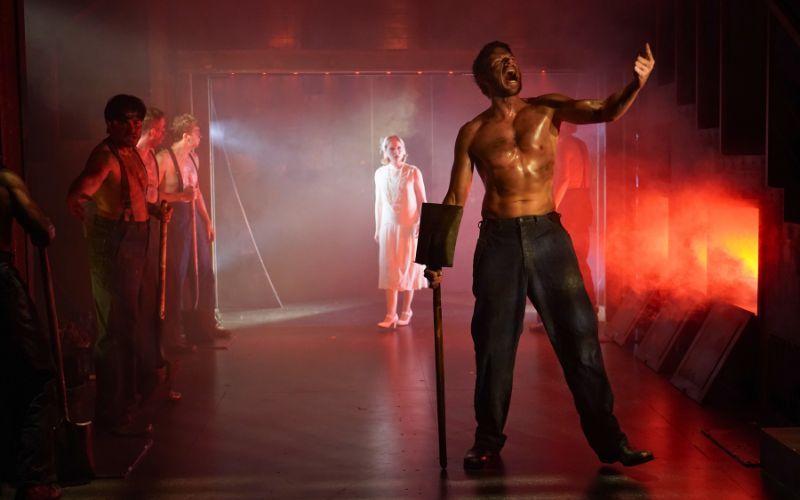

Ariyan Kassam, Harrison Tipping, Adam Petherbridge, Elizabeth Teeter and Jon Beavers in Irish Repertory Theatre's 2026 production of "The Hairy Ape." (Carol Rosegg)
Although Yank is initially attracted to Mildred, her disgust and immediate retreat confirm all the rejection he has experienced throughout his life. Yank seeks revenge against Mildred, which leads him into increasingly humiliating and dangerous situations after the ship docks in New York. He views himself as an animal caged by others, but also as a victim of his relentless desire to “belong.”
The play is a snapshot of the social and economic issues of the 1920s industrial revolution, yet it remains relevant and vexing today. It addresses how technology changes the nature of work, as well as wealth disparity and political power. O’Neill shockingly shows how technology threatens workers’ identities and self-worth—a lesson that can be repeated today.
100 years ago, unions fought for workers’ rights and safety; today, unions still battle over these issues. In the play, the steel barons control Yank’s future. How different is that from billionaires today deciding the future of AI while wielding enormous political power?
Yank admits that his work doesn’t require “thinking.” He performs strictly physical labor but believes it is important because it powers the ship. An older stoker, Paddy (the perfectly cast John Keating), recalls working on clipper ships, where skill was required to work with nature. Technology has replaced nature and diminished the need for skill in work.
“’Twas them days men belonged to ships, not now. ’Twas them days a ship was part of the sea, and a man was part of a ship, and the sea joined all together and made it one.”
Paddy reflects on the stokers in the ship’s hellhole: “I’m thinking—caged in by steel from a sight of the sky like bloody apes in the zoo!”
Yank tries to confront Mildred and seek revenge for her hurtful reaction. He and his friend Long (Ariyan Kassam), an Industrial Workers of the World union sympathizer, linger among the churchgoing crowd on Fifth Avenue.
Yank aggressively confronts the swells on the street, causing a man to miss his bus—evidently a crime requiring arrest. While in jail, an inmate characterizes the IWW as the “Industrial Wreckers,” causing Yank to assume that the organization has a violent charter, much to his liking, but with tragic consequences.
The skill of the play’s ensemble cast in taking on multiple roles mirrors one of O’Neill’s underlying themes: workers are interchangeable. During the Fifth Avenue scene, costume designer Orla Long conceals the actors’ faces behind masks. Stokers in one scene; pedestrians in another.
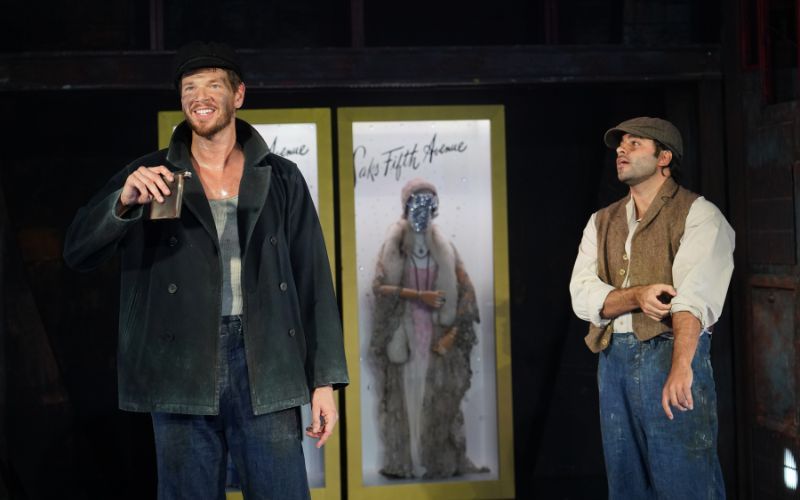
Jon Beavers and Ariyan Kassam in Irish Repertory Theatre's 2026 production of "The Hairy Ape." (Carol Rosegg)
The staging, brilliantly designed by Charlie Corcoran, accommodates eight scenes, from the tranquility of deck chairs to the smoky hellhole where workers shove coal into blazing furnaces, to stacked jail cells and a zoo in which an ape appears in silhouette. Each setting captures the existential gloom draped over the production. Lighting designer Michael Gottlieb and sound designer Florian Staab combine to capture the existential chill of expressionism through soundscapes, sharp angles, and dim, shadowy lighting.
For example, to create a visual metaphor, a separate stage is lowered from the ceiling to reveal the next scene. Beneath it, the stokers march in line as the upper stage descends. The stokers must crouch ever lower, eventually resembling a line of bent apes marching offstage. It is a wonderful example of functional set design reinforcing the theme of workers being treated as animals.
A reboot of Irish Rep’s 2006 staging, this production demonstrates that the threat of technology changing the nature of work remains highly relevant in the age of AI. After 100 years, The Hairy Ape remains a stunning prophecy of the ripple effects of the industrial—and now technological—revolution.
"The Hairy Ape" is at the Irish Repertory Theater in New York City through November 15, 2026.




Comments