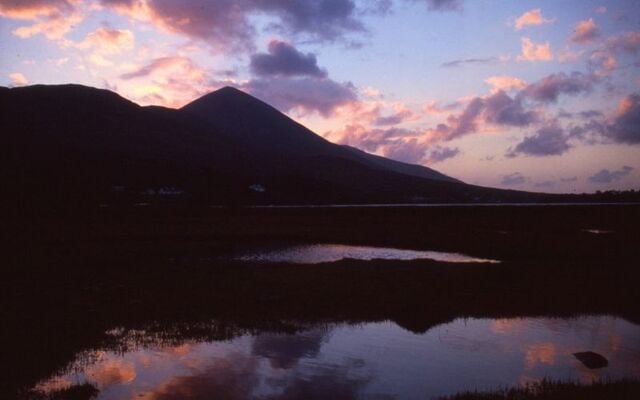
In the “Annals of the Fifth Master,” there survives a gold-gilded manuscript, rumpled and dog-eared in its fading yellow stock, that tells of St. Patrick and his meeting with the publican Kieran O’Looney on the shores of Lough Corrib in Connemara, Co Galway.
This ancient manuscript, which I have painstakingly translated from a mixture of Gweedore Gaelic and bog-Latin, depicts a 5th-century Ireland filled with clever druids and pretty priestesses, who worshiped red-specked lizards and tawny bullfrogs in hopes of salvation.
St. Patrick managed a Christian foothold in this “hovel of pagans,” in Co Armagh and swiftly moved westward to the province of Connacht. The saint heralded his march with a string of successes: taming a seething bull in a chieftain’s field, halting two charging mastiffs by simply raising his hand bell, and converting throngs of heathens with his fine chat and wondrous deeds.
The saint wasn’t long in Co Galway, however, when he was greeted by a crossroads bard who sang a bawdy ballad about Kieran O’Looney’s public house. This den of devilment, thought Patrick, would be the perfect springboard to the wild North Atlantic coast and all the infidels who resided there.
When Patrick entered O’Looney’s Pub, he quickly grappled at his throat. Down the length of bar stood hangmen, nine-time widows, shillelagh-shocked wood kernes, fishwives, grave-snatchers, and a rabble of rowdy rogues who spat and cursed obstreperously. There were “chippies" with their kirtles hiked way above their bare-dimpled knees, and a flock of children bleating like lost lambs. There were one-eyed skinamalinky tib-cats and feather-plucked canaries who warbled hoarsely through the thick welkin of turfsmoke. There were also stacks of lewd song sheets and steaming plates of pig’s head, along with fishmongers and ferrymen tormenting a doddering carline who was moidered in drink.
But what really turned Patrick’s blood to paste were the crude drawings hung about the place, showing the gnashing jaws of lean and hungry greyhounds ready to sink their enameled spikes into the fleshy flanks of soft-mittened hares: the blood sport known as “hare coursing.”
“I’ve arrived,” panted Patrick, taking a stool.
Famished from his long trek, the saint snitched a tomato from the counter.
“Would ye be wanting some salt for yer fruit?” shouted Kieran O’Looney, causing the patriarch to choke on a seed.
“Not at all,” answered Patrick, wiping his bearded chin. “You see, I’ve come to convert the pagan lot of you to Christianity, and see you baptized in Lough Corrib tomorrow morning.”
“Baptize us,” smirked a nine-time-widow, drawing her blade. “Sure, can’t we go scrubbing our own heads?”
“And curse, tell me,” challenged the publican, “what would Christianity do for the likes of us?”
“It may well save you from eternal damnation,” braved Patrick, “and enlighten you in this world as well. If you were a Christian this moment, you might think of propping a twig beneath that one-legged canary of yours that is forever toppling off its perch.”
“But we need a sign,” chuckled Kieran, “for we’re as shallow-hearted as a moonless tide.”
“In that case,” answered Patrick, gazing up at the ghastly drawings on the wall, “I’ll wager my faith against your billy-goat divinity that my Three-in-One God will deliver me a hare this evening that will escape your two best greyhounds in the morning.”
Hearing this, the patrons blew their snouts in laughter. Why, Kieran had the two best greyhounds in all of Hibernia, and Patrick’s hare would stand no more a chance in escaping their jaws than a tasty dumpling would in a Sunday stew.
Kieran raised his voice above the din of merriment. “If, sir, your hare escapes my two top greyhounds, namely Jupiter and Mars, I will lead the entire province to the shores of Lough Corrib tomorrow. But, what, o wispy-bearded preacher, will you give me if beaten?”
“I will allow you to be veiled in the golden slumber of intoxication through the 21st century,” promised the saint.
“Aye, ‘tis a generous offer, indeed,” chortled the publican. “But all that drinking will take a heap of money now, won’t it?”
“A purse of gold, so,” Patrick reluctantly agreed.
Read more
That evening, furled in prayer and meditation, the good saint walked through the hazel wood and there, proud as a new pratie, stood a wee little dapper brown hare. “My prayers have been answered,” gasped Patrick, picking up the little bundle of nerves.
Next morning, people from as far afield as Ballynabucky came to witness the match between O’Looney’s two brindled champions and Patrick’s shivering hare. The rules were explained with Kieran’s dogs being put in a sally slip and Patrick’s hare positioned at midfield with its wet snout pointing towards a small gap in the hedge, where he might make good his escape.
The signal was given, and the rabid crowd let out a thunderous roar as the hare went heart-bursting toward the gap. The greyhounds were soon alongside him, but the adroit fellow sidestepped, zig-zagged, and crisscrossed, leaving the pursuing hounds somersaulting in a tangle of limbs. But the hounds persisted, and it was Jupiter who took one last lunging leap at the mouth of the gap and caught the luckless hare by the cotton of its scuttling tail.
The heathens split the heavens with applause as Jupiter triumphantly carried the hare by its ears in a victory lap before dropping the poor creature at the saint’s feet.
“Have yourself a good drunk,” conceded Patrick, handing Kieran a purse of gold. The saint then picked up his frozen friend and made his way through the mass of pagans toward the Kingdom of Kerry.
Now, if you ever visit Connemara, do stop in and have a pint at Kieran O’Looney’s cluttered old pub. But say nothing to the publican about his meeting with St. Patrick. After all, Ireland is a Christian country nowadays, and Kieran has long since been off the drink.
*This story first appeared in The Berkshire Eagle on March 17, 1987. Kevin O’Hara is the author of “Last of the Donkey Pilgrims: A Man’s Journey through Ireland." You can learn more about him on his website, TheDonkeyman.com.
This article was submitted to the IrishCentral contributors network by a member of the global Irish community. To become an IrishCentral contributor click here.

Comments