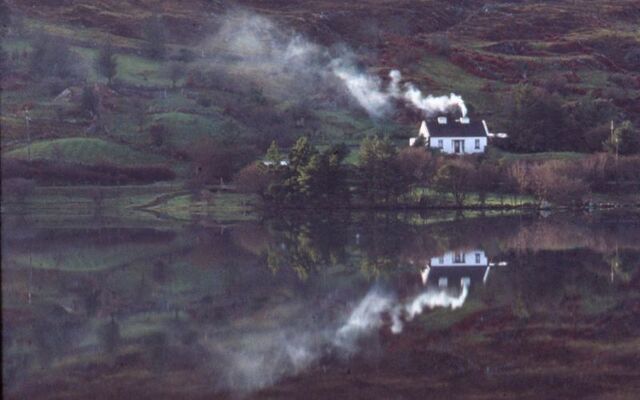
On a brisk September afternoon, along the chalk-white coastline of County Antrim that overlooks the North Channel and Mull of Kintyre, my donkey Missie and I came upon a crippled man of late middle age.
He was weighed heavily on a walking stick, and though my progress would be unduly slowed, his eyes pleaded that I not pass him by.
“A man must be in a terrible hurry if he hasn’t time to speak to another man,” he said, shortly after I had committed myself to walk alongside his limping gait. He introduced himself as Martin Bailey, who had left the city of Belfast after 22 years “to marvel at the evening clouds.”
We soon came to his bungalow; a small, low-lying converted shop where he invited me in for tea. Once I settled Missie in his paddock, I entered the kitchen where he eagerly asked about my travels.
“I suppose you haven’t stumbled into faeryland in your wanderings?” he asked, pouring out the tea.
“No, I haven’t,” I replied.
“‘Twould be like the faeries to keep their distance from a stranger walking a blessed donkey with a hazel stick in hand. ‘Twas Queen Maeve herself who said she could walk the world armed only with a staff of hazel.”
“What’s your idea of a faery?” I asked, always intrigued when meeting one of this fading breed of storytellers—someone who either truly believed in the Good Folk or simply enjoyed spinning a tall tale for any unsuspecting traveler.
“As you might know, faeries are the fallen angels who were neither good enough for heaven nor bad enough for hell. So, given a second chance, many of them scattered into the vales and drumlins of Ireland. Some of these are the finest of faeries, ‘the wee gentle folk,’ who are forever saving us without our knowing.
“Yet others are as black-hearted as the Devil himself,” he went on. “They steal infants from their cradles, blight our potatoes, and dance with glee each time they rekindle the Northern Troubles.”
Read more
“Have you ever stumbled into Faeryland?” I next asked.
“Aye, on two occasions--both coming within a year to the day of one another. The first occurred when I was a young man living in the Lakeland district of Enniskillen. Why, if I hadn’t listened to my grandfather’s instructions to turn my coat inside out once I stumbled into their presence, they would’ve surely nabbed me.
“On that haunting night, I was walking home with the moon late on the rise. Suddenly, two faery winds swirled their funnels of dust about me. So I quickly turned my coat inside out, and no sooner was it done than the whirling winds whisked away in a deadly hush. But, I tell you, I wasn’t the same for a month or more, and would tremble at the slightest breeze.”
“Why do you think the evil faeries came after you?”
“I was a bit of a poet in my younger years, always scratching bits of verse. Evil faeries are fretfully afraid of poetry, for a poet’s words are simply the whisperings of God.”
“What about your second brush with the faeries?”
“My second brush was far worse than the first; a bold attack against a poem I recited that evening at a neighbor’s house. Home I was walking when I heard the whirring spokes of an approaching bicycle. ‘Good night,’ says I, tipping my cap to a grinning old man who, before my boondoggled eyes, turned into a cackling hag who hissed and spat like a hare. By the time I gathered my senses, he had turned into a toothless, yellow-waxed man.
“I ran helter-skelter up the road but he was forever at my side, not pedaling at all, but now sporting a smile of tombstones that sprouted from his gummy jaw. The spokes of his wheels then caught my cuffs and hurled me to the ground. I knew for certain I was caught in the faerie realm because my throat filled with lumps the size of cherries and my limbs went as limp as jelly sticks.”
Martin paused to take a sup of his tea, and continued.
“Left with neither hope nor chance in the blackness of that moonless night, I could feel my soul trickling through the marrow of my ribcage. Yet I stumbled on through the dark and finally collapsed in the very graveyard where my family is buried. There, the hissing cackle of the male-hag spat out curses before vanishing, leaving hot droplets of candle wax in its wake.”
“Then what happened?” I eagerly prodded.
“I crawled home and went straight to bed where I lay three days unconscious and three days mad. When I finally shook off the faery-jigs, my neighbor, Willie Kane, who held a bounty of knowledge about wicked faeries, couldn’t understand how I had escaped them a second time. Rummaging through my coat pockets, he asked, ‘Whose checkered handkerchief is this?’ ‘’Tis mine, right enough,’ says I. And says he, ‘And who did it belong to before it belonged to you?’ ‘My grandmother,’ says I. And says he, ‘Arragh, now, there you have it,’ waving my handkerchief in the air. ‘That’s what saved ye, Martin, me boy, for there’s great power in a grandmother’s handkerchief, and I’ve never known it once to fail against the evil faeries.’”
“Never known it once to fail,” I chuckled. “How many times in the history of faeryland has one ever been saved by a grandmother’s handkerchief?”
“I can only vouch for that one time,” said Martin, mildly annoyed. “But that one time was plenty more than enough. And since that desperate night, I’ve yet to blow my snout in any other hankie. And that’s the telling of the truth, I tell you, or may God strike . . . the two of us dead!”
*Kevin O’Hara is the author of “Last of the Donkey Pilgrims: A Man’s Journey
through Ireland.” You can contact him via email at [email protected].



Comments