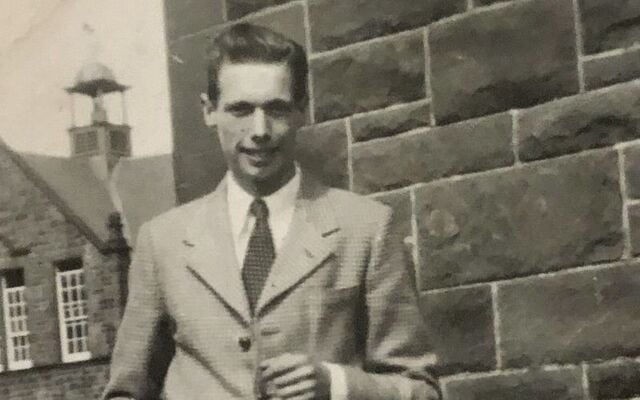
Katherine Simmons' father's serenades came without warning, usually from behind the wheel on a day trip whose destination she had long since forgotten. What stayed with her instead was the feeling of it, that sense of safety and simple happiness, like stepping outside after a hard winter into the first warmth of spring.
One of my most treasured memories of my father was when he would sing to us.
His serenades were not a constant, but occurred spontaneously, generally while he was driving. The destinations of those day trips, I cannot recall. What I do remember is the feelings his singing evoked: safety, comfort, simple happiness, like stepping out your front door after a particularly harsh winter to the first embrace of springtime.
And when my father sang, the world could do no wrong.
His repertoire was vast and varied, and his choice of song could fluctuate depending on his mood in that particular moment. Though not a professional singer, he could hold a tune quite nicely. His voice, deep and strong, would always sound just a wee bit higher in pitch when he sang of
Although born to an Irish mother, his family moved to Scotland, where he was raised, then in later years returned to the US, where he became general manager of an Irish Pub in midtown Manhattan, called Rosie O’Grady’s.
While he favored Irish music, one of my father’s most sung tunes was "Loch Lomond," a traditional Scottish folk song he learned as a boy.
"By yon bonnie banks and by yon bonnie braes,
Where the sun shines bright on Loch Lomond
Where me and my true love will never meet again
On the bonnie, bonnie banks o' Loch Lomond."
Read more
And my father, a poet at heart, would never fail to share the meaning of those melancholy lyrics involving two prisoners of war, one to be released and the other to be hanged. The high road represented the normal road of life, and the low road represented the road that the soldier sentenced to death would take, his soul returning to his homeland in the highlands.
On some days, my father quoted strange, yet interestingly captivating poems I recall to this day:
‘Who killed Cock Robin? I said the sparrow, with my bow and arrow. I killed Cock Robin.'
That one never quite sat well with me as a child or, for that matter, an adult, as I could never bear the thought of the robin being speared.
When in a whimsical mood, my father might sing this nonsensical children's song of which I still don't know the meaning, yet it never failed to lighten the mood if someone was having a bad day:
"Oh! Mairzy doats and dozy doats
And liddle lamzy divey
A kiddley divey too, wouldn’t you?
A kiddley divey too, wouldn’t you?
Read more
And how can I forget the many romantic songs my father loved? I recall one tune performed by Perry Como, which my father sang often..."I wonder whose kissing her now?" Though as a child, I often pondered from the back seat of our station wagon, why my father would be kissing another woman…
And then there was the daring Louie Armstrong number:
"Oh when we're dancing and you're dangerously near me, I get ideas. I get ideas...”
Or, the slightly more madcap and risqué:
“Cigarettes! And Whiskey! And wild, wild women. They’ll drive you crazy they’ll drive you insane!”
The tune was so catchy that my toddler sister would sometimes sing along, much to the dismay of my mother.
Another selection my father sang throughout his life was from the classic movie, "My Fair Lady." An uplifting song I too found so lovely, that I chose it for the dance with my father on my wedding day:
“On the Street Where You Live"
"I have often walked down this street before
But the pavement always stayed beneath my feet before
All at once am I, several stories high
Knowing I'm on the street where you live"
When his four daughters prepared to leave home for our first year away at college, my father had a ritual, this one too, in song. He never failed to serenade us with this favorite:
“We're no awa'tae bide awa"
Read more
Whose translation goes something like this: "Oh, we are not away to stay away, We are not away to leave you. We are not away to stay away. We will always come back and see you."
And as our family gathered around the dining room table the night before the departure, my father would raise a glass and, in that high-pitched tone, sing these words earnestly in tribute. My mother, understandably sad a daughter was leaving home, did not share his enthusiasm and often left the table in tears but not before casting a few choice words at my father. But he never wavered, delivering the lyrics without a hint of sadness or woe, as was his nature.
And I will always love that sentiment of leaving - but always coming home.
There is one more song, which will forever remind me of my father: the beautiful and haunting ballad, “Green Fields of France,” which tells the tale of a traveler who passes the tombstone of a young Irish soldier, Willie McBride, and the pointlessness of war.
“Did they beat the drum slowly, did they play the fife lowly?
Did they sound the death march as they lowered you down?
Did the band play the Last Post and Chorus?
And did the pipes play 'The Flowers of the Forest?”
My dear dad himself departed this world, far too soon… But not without one last song to be sung.
On one of my last visits, knowing my father was nearing the end of his life, I slowly walked the hospital corridor, bleak and sterile, leading to his room. Approaching, I paused. There it was, the sound of that distinct, slightly high pitched voice. Entering, I glanced at his bedside; my sister in the corner, and neatly tucked beside him, his three young grandchildren mesmerized by the tune.
And knowing his days were dear, he sang to them the song he loved:
“You take the high road and I’ll take the low road but I’ll be in Scotland afore ye.” Where wild flowers spring and the wee birdies sing, On the steep, steep side of Loch Lomond.”
This article was submitted to the IrishCentral contributors network by a member of the global Irish community. To become an IrishCentral contributor click here.



Comments