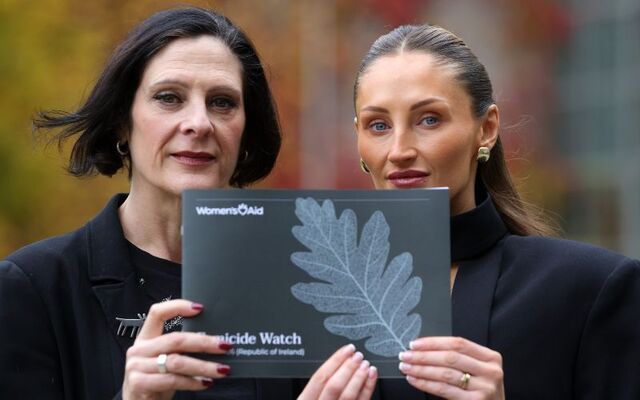
The Irish charity Women's Aid has published a new report, Femicide Watch 1996 - 2026, that shows femicide in Ireland rising again after two decades of decline.
For 30 years, the Women’s Aid Femicide Watch has counted and remembered every woman killed in violent circumstances in the Republic of Ireland. The Irish charity says that in the absence of official data, the information is tracked through local and national media coverage.
The Femicide Watch report shows that between 1996 and 2026, 291 women died violently. Two in three women (68%) were killed in their own homes. Stabbing with a knife or other sharp object was the most common method (34%).
The report shows that progress on femicide in Ireland has reversed. The number of violent deaths of women in Ireland fell steadily from a high of 67 women between 1996 and 2000 to a low of 31 between 2016 and 2020. However, there was a 29% increase from 2016–2020 to 2021–2025.
13 women have died in violent circumstances so far this year. That is almost double the seven women who lost their lives in 2025.
The new report was released on November 25, the International Day for the Elimination of Violence against Women. It was launched at a gathering of national and international experts in Dublin to discuss best practice on preventing domestic violence homicides, including femicides, and lessons for Ireland as the country prepares to introduce a new system of Domestic and Family Violence Death Reviews.
“Behind every one of these 291 entries is a woman, and a family left behind," Women’s Aid CEO Sarah Benson said in a statement.
"For 30 years we have kept this record so that no woman’s death is forgotten.
"13 women have died violently in Ireland this year, almost twice as many as last year. That should alarm every one of us. After years of decline, the number of women killed is rising again."
View this post on Instagram
The most dangerous place for a woman
Women's Aid says that according to its Femicide Watch, the greatest danger comes from men women knew. Of the 235 resolved cases, including those resolved through the courts and murder-suicides, almost nine in ten women (89%) were killed by a man known to them. 57% were killed by a current or former partner, 32% by a male relative or acquaintance, and 11% by a male stranger. Two in three women (68%) were killed in their own homes. Women aged 26–35 are the largest age group, at one in four (26%) of the women on the record.
There have been 25 murder-suicides. In 24 of them, the killer was the woman’s partner or ex-partner; in the other, it was her son. In 40 incidents, others were also injured, including parents, siblings and bystanders.
Benson said: "Our findings match what UN and EU data show: the most dangerous place for a woman is her own home, and the most likely killer is a man she knows, very often a current or former partner.
"Intimate partner femicide rarely comes out of nowhere. Separation, coercive control, non-fatal strangulation, threats to kill and stalking are all known warning signs.
"When a woman tells Women’s Aid that she is afraid for her life, we believe her."
"Domestic violence kills women, and it kills children too."
The warning signs seen in femicide cases mirror what women disclose to Women’s Aid. In 2025, the organization had 37,790 contacts, during which 62,275 disclosures of domestic violence against women and children were made. These included 1,321 disclosures of a man threatening to kill the woman, her children, a family member or himself; 512 disclosures of non-fatal strangulation; 906 disclosures of stalking; and 1,522 disclosures of abuse during pregnancy. Nearly one in three women (32%) using Women’s Aid services were being abused by an ex-partner.
Benson continued: “Leaving does not always end abuse. Risk rises sharply around separation and stays high for about a year.
"For every woman whose life is taken, thousands more are living on a knife’s edge of fear. Domestic violence kills women, and it kills children too. 25 children have been killed alongside a woman on our record, and 410 children have lost their mother, most of them under 18.”
National Femicide Memorial
To mark the 30th anniversary of the Femicide Watch and the International Day for the Elimination of Violence against Women, Women’s Aid has launched ‘We Remember’ – a dedicated online memorial remembering all the women included in the Femicide Watch at Femicide.ie.
Earlier this week, with the support of Dublin City Council, Women’s Aid planted the National Femicide Memorial Oak in Merrion Square Park, in memory of all victims of femicide on the island of Ireland and across the world.
Benson said: "Our intention is to ensure that each woman is remembered for who she was, rather than how she died.
"While we record the killings of women in Ireland, we hope the memorial reminds people that each one matters, and that every woman’s life is unique and irreplaceable."
View this post on Instagram
"We need a national risk assessment framework"
Women’s Aid welcomes indication that the Department of Justice is developing a model for Domestic and Family Violence Death Reviews (DFVDRs) and the Government’s commitment to establish Regional Multi-Agency Critical Planning and Response Teams (MACPARs).
Benson said: "Every death review must include specialist domestic violence services, funded to take part, and must meaningfully involve families, including children where appropriate.
"Reviews should begin with domestic homicides and child deaths and extend to suspected suicides following domestic abuse within a set timeframe. There must also be real oversight of recommendations, including a public database of anonymised reviews, so that lessons are acted on and not left on a shelf.
"Services across Ireland currently use a patchwork of risk assessment tools. We need a national risk assessment framework, built on a mapping of current practice and informed by victim-survivors and specialist services, that understands coercive control and its impact on children.
"Each regional MACPAR should have an independent chair, specialist support for bereaved children, a resourced secretariat and a case management system, so that every family member receives a consistent response.
"Ireland also needs a statistical definition of femicide and continuous, comparable data collection, as recommended by the European Institute for Gender Equality and the European Women’s Lobby.
"And we want to work with the media on training for responsible reporting, because how these deaths are reported shapes how the public understands them.”
"We need everyone to recognise this violence"
Benson added: "Ireland is one of the wealthiest countries in the world, and we have good laws. Yet women are still being killed by the men closest to them. Most men choose never to behave this way, and that is exactly why we need everyone to recognise this violence and call it out.
"The forthcoming 4th National Strategy must reconfirm an all-of-Government approach so that we finally build an Ireland with zero tolerance for domestic, sexual and gender-based violence.
"Every woman has the right to be safe in her home and in her community, but this is not the case for too many."
Support Information: Women’s Aid 24-hour National Freephone Helpline: 1800 341 900, or visit WomensAid.ie. National Male Advice Line: 1800 816 588.