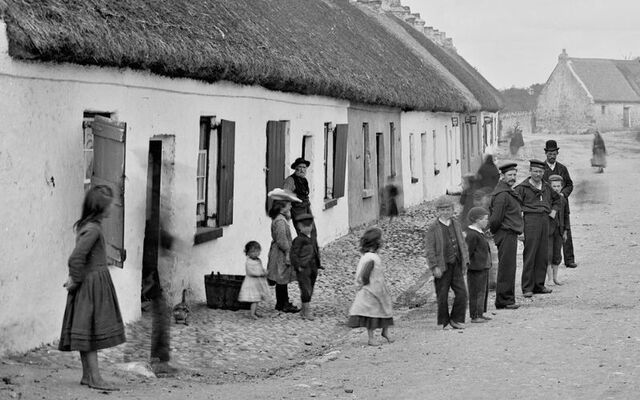
What was Ireland like a century ago?
The public will gain a new insight into what Ireland was like a century ago as the 1926 Census - which was taken on April 18, 1926 - goes online for the first time.
The first taken since the formation of the Irish Free State, the 1926 Census will be accessible to genealogists, historians, and the public in Ireland and around the world via the National Archives website from Saturday, April 18.
Ireland's National Archives says the preparation of the 1926 Census of Ireland for public release was "a monumental undertaking."
Work to digitize Ireland's 1926 Census involved careful preservation, high-resolution scanning, and transcription of every sheet, Ireland's National Archives said.
The result? A fully searchable online resource on the National Archives website that offers an unprecedented view of Irish life in 1926.
Ireland's National Archives says: "Census 1926 holds a unique place in history as it was the first census conducted after the establishment of the Irish Free State.
"Taken on 18 April 1926, it provides a detailed snapshot of life in Ireland during that period."
On the day of the 1926 Census, Ireland's population was 2,971,992, with 49% female and 51% male. 92.6% of the population was Catholic, while 18.3% of the population spoke Irish.
Of those who were employed, over half - 51% - worked in agriculture,
Over half the population - 51% - worked in agriculture, while 14% were in manufacturing, 6.5% were in commercial, finance, and insurance, 4% were fishermen, 7% were domestic servants, 4% were professionals, and just 0.2% worked in mining.
The 1926 Census data was controlled by Ireland's Central Statistics Office before being transferred to the National Archives.
Outlining the size of the data, the National Archives said: "Census 1926 is stored in 1,299 boxes, containing over 700,000 return sheets. The returns are laced together in 2,494 canvas volumes, each representing an enumeration area within each of the 26 counties.
"Census 1926 is made up of 21 data sets listed in Household Returns (A Form) and Enumerator Returns (B Form)."
How to search Ireland's 1926 Census records
The National Archives ha s provided instructions for how to explore its website:
- Head to NationalArchives.ie
- Click "Search the Census Records"
- Scroll down, select the year you want to search, and enter any information you might have
- Click the search button to view your results
- Use the 'Narrow your results' options to filter your search, and the 'Sort By' feature to organize results alphabetically by surname, first name, and more.
View this post on Instagram
Ireland's 1926 Census public programme
To mark the release of the 1926 Census, a public programme will unfold over several months and include a wide range of cultural, educational, and creative events.
Dublin Castle, the British Academy in London, and Boston College will host major exhibitions in April and May 2026, while a touring exhibition will travel across Ireland, bringing the census to communities nationwide.
View this post on Instagram
"The Good Luck Club," a site-specific theatrical production by acclaimed Irish company ANU Productions, will take place at the National Archives in May and June 2026, exploring the human stories behind the census data.
View this post on Instagram
A landmark RTÉ documentary airing in April 2026 will offer fresh interpretations of the census, featuring historians, artists, and descendants of those recorded.
A new book, "The Story of Us: Independent Ireland and the 1926 Census," will feature 18 essays by leading historians, exploring themes of identity, migration, language, and everyday life.
A teachers’ pack and learning resource will be made available to schools, while a series of talks, workshops, and presentations will support family and local history research.
A major conference in Dublin in June 2026 will bring together scholars, archivists, and the public to reflect on the census’s legacy.
View this post on Instagram
Centenarian Ambassadors
Ahead of the release of the 1926 Census records, the National Archives appointed 48 Centenarian Ambassadors — individuals who were alive when the Census was taken and whose names appear in the original records.
Drawn from almost 100 centenarians who contacted the National Archives, the Ambassadors were born between 1920 and 1926 and today live across Ireland, while members of the Irish diaspora in the US, Canada, Britain, and Australia are also represented.
The Centenarian Ambassador programme captures first‑hand personal testimony from people who were present in Ireland at the time of the 1926 Census. Their stories offer a rare, living perspective on a century of Irish life and will be preserved by the National Archives as part of the permanent historical record.
As part of the programme, each Ambassador took part in a short, recorded conversation about their life and memories. These video and photo stories will be shared in association with Census 1926 activities around the country. Each Ambassador has also received a specially designed commemorative mug and certificate to mark the occasion.
The following individuals are our Centenarian Ambassadors for the 1926 Census. Born between 1920 and 1926, they represent communities across Ireland and the wider Irish diaspora.
- Sr. Eileen Creagh, Australia
- John Larkin, Canada
- Charlotte Elizabeth Kinkade, Cavan
- Joan Coll, Clare
- Sr Miriam Twohig, Cork
- Joseph Patrick Davis, Cork
- Kathleen Gibbings, Cork
- Kathleen Fitzgibbon, Cork
- Noelle Newenham, Cork
- Margaret Mary Walsh, Cork
- Mary Hosford, Cork & Dublin
- Susie Boyle, Donegal
- Sr. Florence Hutchinson, Donegal
- Catherine Leahy, Dublin
- Eileen Casey, Dublin
- Joseph Courtney, Dublin
- Máire Walsh, Dublin
- Mary Gilsenan, Dublin
- Moya Connelly, Dublin
- Michael Hickey, Dublin
- Pauline Kearns, Dublin
- Sarah Dwyer, Dublin
- Jeremiah Murphy, Dublin
- Seamus Shelly, Dublin
- Denis O’Donovan, Dublin
- Marie Tubbert, Dublin
- Sr. Mary Patricia Lynn, Fermanagh
- Bridget Mary O’Connor, Galway
- Sr. Agatha Durkan, Galway
- Sr. Dorothy Duggan, Galway
- Sr. Felicitas Geraghty, Galway
- Sr. Paul Carmody, Galway
- Anne Meskell, Limerick
- Bridget Landers, Limerick & Cork
- Mary Bannon, London
- Patrick Kenny, London
- Breda Bridget Robertson, London
- Bridget Joyce, Mayo
- George O’Connor, Meath
- Ann Carey, Meath
- Sr. Bosco Daly, Offaly
- Maureen Hanley, Offaly
- Frances Conroy, Tipperary
- Nancy Lally, Chicago
- Moira Toomey Putman, Illinois
- Bridget Keating, Waterford
- John Patrick McNaboe, Westmeath
- Iris Suzannah Dungan, Wexford
View this post on Instagram

Comments