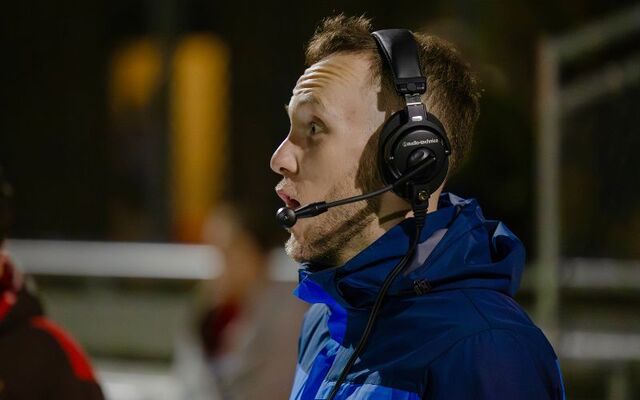
From "Morning Ireland" to the sidelines of New York soccer, rugby and Gaelic games, Oisín Coyne has built a fast-rising broadcasting career on versatility, work ethic and an accent he was once told to soften. Now settled in New York, the Kildare native is proving that leaning into his Irish identity, rather than hiding it, is exactly what sets him apart in one of the world's toughest media markets.
At 24, Oisín Coyne has already grasped something increasingly important about making it in sports media: being good behind a microphone is only part of the job.
Since moving to New York, the Kildare broadcaster has made a virtue of versatility. He moves between soccer, rugby league and Gaelic games, turns broadcasts into social media content and has carved out a niche telling the stories of Irish athletes and communities that can otherwise go unnoticed in the vast American sporting landscape. Add a formidable work ethic and a willingness to say yes before spending too long wondering whether he is ready, and Coyne has begun to distinguish himself in a city hardly short of aspiring sports journalists.
His Irishness has proved unexpectedly useful too. The accent, knowledge of Gaelic games and interest in the diaspora that he brought from home have not been obstacles to overcome. Increasingly, they are what make him different.
Four or five commentaries in a week is not unusual. One recent Sunday involved five games back-to-back.
"It doesn't feel like a job," Coyne says, although five consecutive games can test that theory. "Five games on the bounce, then it kind of sometimes feels like a job."
Much of that experience has come through New Logical Sports, the New York sports media company he joined shortly before Christmas 2025. He was quickly thrown into a busy soccer schedule, sometimes calling for around four games a week. Rugby followed, then Gaelic football and hurling.
Young enough not to overthink it
Coyne came through online and local radio, including KFM and Midlands 103, before taking an internship with RTÉ in 2024. Then the Paris Olympics created an unexpected opening.
With senior broadcasters in France, Coyne found himself presenting sport on Morning Ireland for four months, barely into his twenties.
"That's the most listened-to show in the country," he says. "That's an opportunity to showcase you have a bit of 'cop on' in the industry, but I probably didn’t realize the scale of it."
There were, he readily admits, "a few mispronounced horses along the way" during the racing. "But we did the job."
That inexperience might have been intimidating. Coyne thinks it helped.
"I had that naivety about me where I didn't really care for that. I think that's exactly what benefited me."
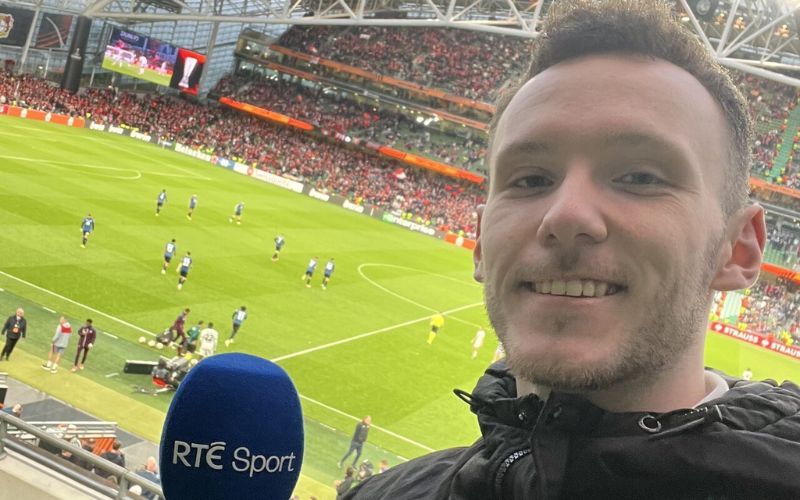

Oisin Coyne.
Finding his voice
From performing mock commentaries while playing FIFA to presenting bulletins on the radio, Coyne’s process to ‘find his voice’ has evolved.
"The feedback I would have gotten is that I was pretty monotone," he says. "I'm always conscious, am I being exciting enough?"
"It's not a case of trying to manufacture that," he says. "It doesn't sound like you. It doesn't sound natural."
Then came a particularly useful piece of advice from Kevin Egan, the Irish broadcaster who has forged a successful career in American soccer.
"Do not change your accent. You need to be comfortable with your own voice."
Far from being something to soften for American audiences, the Kildare accent has become an asset. US soccer audiences are accustomed to Irish and British voices through years of watching European football.
"They don't want you to start talking like a baseball announcer," he says.
"It's literally about finding your own voice and becoming comfortable with it and I’ve found the US response to my accent and voice to be very positive.."
The Irish advantage
That idea extends beyond how Coyne sounds. It increasingly shapes the stories he chooses to tell.
His interest in Irish sport abroad began at RTÉ, when an open brief for a sports package led him towards GAA clubs across Europe. At the European hurling finals, he interviewed an Indian student who had previously played cricket before moving to Belgium and taking up hurling with the Earls of Leuven.
The video attracted around 250,000 views on TikTok.
"I was like, okay, this is actually something kind of niche and good."
In New York, Coyne has turned that instinct into a distinctive area of coverage. Gaelic Park offered both a community and an unusual amount of commentary experience. New York may be packed with aspiring sports broadcasters, but there are fewer equipped and willing to call every available Gaelic football and hurling game.
"There's not too many people willing to do the commentary over here," he says. "It was a win-win situation."
Through New Logical Sports, that interest has expanded into the wider Irish sporting diaspora. Coyne has reported on Irish internationals in American soccer, including Denise O'Sullivan at Gotham FC and Kevin O'Toole at NYCFC, alongside county players continuing their GAA careers after emigrating. His reporting has also taken in Irish running clubs, community soccer and the supporters who travel extraordinary distances across America.
"My passion isn't just covering games," he says. "It's telling the stories of Irish people through sport."
Coyne arrived in New York knowing one person and with little involvement in the city's GAA scene. He says emigration has actually made him more conscious of an Irish identity he had drifted somewhat away from while traveling.
"You kind of lean into the Irishness when you're starting off somewhere fresh."
Gaelic Park quickly became a home away from home. In a city that can feel enormous and anonymous, Coyne could take the train north and suddenly find himself among people who had grown up remarkably close to where he did.
"For me, the GAA, it's all about connection," he says. "It definitely makes you feel less homesick."
Professionally, that same connection has given him something difficult to manufacture: a genuine niche in a crowded market.
Finding an audience
Coyne has also understood that finding a good story is only half the battle. A young journalist needs to know how to make it travel.
A Media Production Management graduate from Dublin City University, he wrote his thesis on the impact of digital media on sports journalism in Ireland. He now treats social media as part of the journalism itself.
"The way the algorithms work, you can literally, with 500 followers, reach an audience of 50,000 within less than a day," he says. "So I've put that as a priority now with my work."
When Coyne commentates, he often records himself behind the microphone. A strong call can become a social clip, portfolio material and an introduction to viewers who might never otherwise encounter New York GAA.
Across the summer, his GAA and World Cup-related content generated more than two million views across digital platforms.
For supposedly niche material, the audience is not particularly niche.
"You need to be across all channels," he says.
One assignment can involve commentary, writing, audio, television and social video. Coyne sees that versatility as essential for the next generation of sports journalists.
"The whole traditional linear thing where you're only one entity as a journalist doesn't really exist anymore."
Work Ethic
None of it works without the energy to sustain it.
There have been 13-hour shifts, seven-day weeks and Sundays spent moving directly from one game to the next. Even holidays are apparently not entirely safe.
"Even any time I go on holidays, I bring the mics just in case," Coyne says.
A player might be there. An interview might present itself. Something might happen.
"You never want to give up an opportunity."
The ambition behind it has been remarkably consistent. As a teenager, Coyne listened to commentators and practiced the job himself while playing FIFA. In 2022, when asked where he wanted to be in four or five years, his answer was America for the World Cup.
"Everything I do is with a purpose to get to a place where I'm traveling around the world, to World Cups and games."
Sports broadcasting has also trained him not to dwell too long on things.
"Every hour is a deadline," he says. "There's no time for overthinking or procrastinating. It's go, go, go."
At 24, there is plenty still to learn, something he readily acknowledges. But New York has given him a remarkably effective education.
New Logical Sports has provided the volume of games needed to sharpen his commentary. Gaelic Park has given him a niche. Social media allows the work to travel far beyond the commentary box. His interest in Irish sport has given him stories that are both professionally useful and personally meaningful.
And the Kildare voice he once worried was too monotone has become part of what distinguishes him.
Making himself heard in American sports broadcasting has not required Coyne to sound more like everybody else. So far, the opposite has been true.
"I really think I’ve found my voice in New York."




Comments