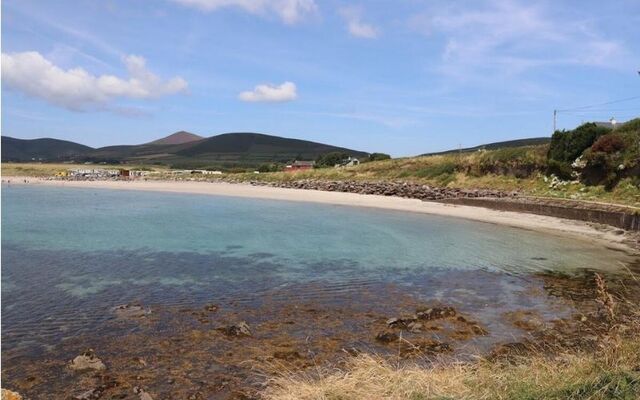
On October 4, 1939, barely a month into World War II, people living around Ventry Harbour on the Dingle Peninsula watched a German submarine rise out of the water off their shore. U-35, commanded by Kapitän Werner Lott, had sunk a Greek merchant ship in the Atlantic and taken its crew aboard rather than leave them to the sea. Lott brought all 28 Greek sailors to the Kerry coast and put them ashore in neutral Ireland, where they were fed, sheltered, and passed into the care of the authorities. The episode was extraordinary enough that it reached the cover of Life magazine in the United States.
In London, it read very differently. Guy Liddell, counterintelligence chief at MI5, wrote that same month that "Éire's neutrality is rapidly becoming a farce," claiming a German submarine had sailed into Dingle for repairs. More reports followed of hidden U-boat bases along the west coast and of submarines slipping in three times a week behind canvas screens. None of it was true, but the tales suited British suspicions, and a few Kerry men were only too happy to keep them alive for visiting reporters. One official coast watcher, Hugh Wren, later punctured the whole myth by pointing out that most of the submarines in question had been sighted from bar stools.
Many in Britain were convinced that Ireland was secretly aiding the Germans during World War II, all thanks to the imagination and yarn-spinning of a few Kerry natives.
Guy Liddel, counter-intelligence chief of Britain’s MI5, wrote in October 1939, “Éire’s neutrality is rapidly becoming a farce. German sub sailed into Dingle for repairs.” This was followed by “Frequent reports coming about submarine bases on the west coast of Éire,” and “A submarine comes in three times a week and is camouflaged with a canvas screen,” a few days later.
There was, in fact, no truth to these stories, but the British were eager to believe them, especially after the German U-boat U-35 sank a Greek ship off the English coast. The Germans rescued the 28 sailors and landed them at Ventry, Co. Kerry. The story was even featured on the cover of the popular American magazine, Life.
Hugh Wren was an official coast-watcher during the Second World War, working at various points in Kerry from Ballybunion to Dingle. He dismissed many of the stories told about U-boats being seen off Kerry, saying, “Most of the submarines had been seen in pubs.”
Read more
It appears that there may have been a tall tale or two spread to English journalists by the people of Kerry to keep the charade going, and many of them may have, in fact, begun in pubs. A Daily Mail correspondent who traveled to Ireland told of how he heard about dealings between the Irish and the Germans that “would make any Briton’s hair stand on end.”
The correspondent reported that he had been shown a pub in Dingle where a U-boat captain had proposed a toast to the downfall of Great Britain and had met a man in another pub who told him about submarines coming to one of the islands to buy fresh fruit and vegetables.
These tall tales aside, there were two instances where German spies found their way to Ireland and landed in Kerry. These incidents gave the British some reason to be suspicious.
In June 1940, Walter Simon was spotted coming ashore at Dingle and burying his radio. While waiting for a bus from Dingle, he was invited to the pub by local Michael Nelligan. After drinking three glasses of whiskey and buying a full bottle for the bus journey to Tralee, where he could catch the train to Dublin. Simon was spotted, obviously drunk, by two Garda (police) detectives, James Colley and Bill Walsh. The pair had been staking out the station as part of a widespread search for the man who had come ashore.
Read more
They followed Simon to Dublin before stopping and questioning him. Simon gave his name as Karl Anderson and said that he had been visiting family but was returning to Dublin after having an argument with them. He was arrested as soon as he stepped off the train. His fingerprints were checked, and it was confirmed that he was Simon and that he had been deported from Britain in July 1938.
In July 1940, he was convicted of illegal entry into the country and sentenced to three years.
The second German spy arrived just 12 days later, this time coming ashore at Minard, Co. Kerry.
Willi Preetz was brought to the coast by a U-boat and fared slightly better than Simon. He evaded arrest until August and succeeded in transmitting some weather messages to Germany.
Preetz’s one big advantage was that he was married to an Irish woman and so, although a foreigner, did not attract as much suspicion. He married Sarah Reynolds from Tuam, Co. Galway, in Germany in 1935 and had previously visited the Reynolds family in Ireland on two occasions.
Once the war began, he fled to Ireland from England. The Reynolds family said that he had arrived in Ireland before the outbreak of war, and so he was allowed to stay.
Read more
Preetz slipped out of the country and returned to Germany in December 1939, at which time he joined the Abwehr, Germany’s military intelligence arm.
He was trained to use the radio to transmit weather information and was sent back to Ireland in June 1940. He lived in a flat on Westland Row in Dublin and took note of barometer readings displayed in shop windows.
However, the demon drink was also to be the downfall of this spy, as he was much more interested in partying than transmitting his notes back to the Germans and got on the wrong side of his wife’s family by getting her younger sister “into trouble.”
There were other reports of suspicious behavior, and one instance, in particular, where the alarm was raised following reports of a man coming ashore near Inch Strand near Dingle in September 1940.
Those reports were unfounded, however, as no other German spy was found. “A thorough search of the peninsula from Dingle Bay to Tralee Bay was carried [out] on the 29th inst by 250 military accompanied by gardaí and local security forces, but no trace of the man alleged to come ashore was found,” said Garda Superintendent Michael Ó Laoghaire of the affair.
* Originally published in 2015 and updated in 2026.



Comments