The 25th Amendment to the United States Constitution was written by a 25-year-old son of Irish emigrants from the Bronx.
The 25th Amendment allows the President to appoint a Vice President whenever that office falls vacant, allows an incapacitated President to step aside temporarily without forfeiting the office, and provides a mechanism whereby the Vice President, upon a majority vote of the Cabinet, may declare the President incapacitated and serve as Acting President until he recovers.
Professor John Feerick is the former Dean of Fordham Law School (1982 - 2022), a highly respected lawyer who was called on in major arbitration cases but is best known, by far, for his pioneering work on the 25th Amendment.
Truly, the quietly spoken son of Mayo has done the state some service. His seminal book “From Failing Hands: The Story of Presidential Succession” is the core work, so well-argued that it was nominated for a Pulitzer Prize upon its release.
Readers may think that succession issues can be easily resolved. Yet, as recently as 1963, when President Kennedy was assassinated, there was no mechanism to appoint a vice president once Lyndon Johnson stepped up to the presidency.
There was also no mechanism if Kennedy had not been killed, but had been left in a coma and needed to be replaced. The amendment was clearly long overdue.
The amendment has proven vital since it was passed in 1967.
Richard Nixon, with Watergate looming and Vice President Spiro Agnew forced to resign in an unrelated scandal, chose Gerald Ford under the 25th Amendment to become Vice President. Ford later used the amendment when he became president to appoint Nelson Rockefeller as his VP.
The amendment has been used by Ronald Reagan, handing over his powers temporarily to VP George H.W. Bush after being shot. It was also used by George W. Bush when he underwent surgery, handing temporary control to VP Dick Cheney.
All in all, it has been used six times since it was passed 50 years ago, a sure indication of how important a piece of legislation it was.
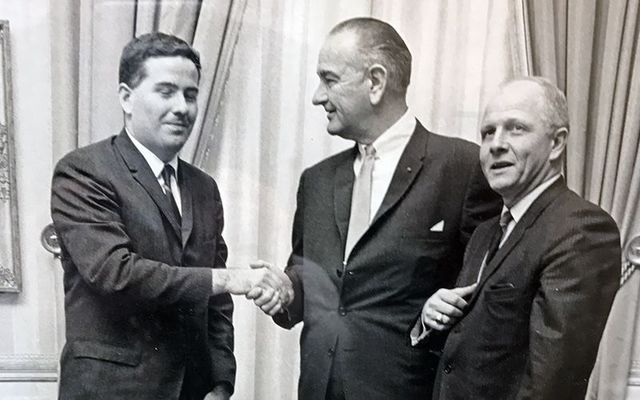
Modest to a fault, Professor Feerick, 89, waves away the credit, but there is no doubt he was at the heart of creating the vital amendment. President Lyndon Johnson asked him to the signing in the Oval Office, a moment he cherishes deeply, though he just made it after a delayed plane flight.
About the amendment, he states: “The Twenty-fifth Amendment is the product of extensive debate and discussion, in which full account was taken of the history of presidential succession and the many worthy suggestions offered for improvements in the succession framework. The amendment provides an approach to presidential succession which allows for an effective transfer of power in all cases of presidential inability,” Feerick concluded.
Even if he had never written the amendment, Feerick would paint a striking picture of a fantastic success story for a son of Irish immigrants.
From the poor farmlands of Mayo to the heights of the legal profession in America, it has been quite a journey for Feerick and his family.
His mother, Mary Boyle, arrived from Mayo in 1928; his father, John Feerick, a year later.
It was not an auspicious time after the stock market crash of October 1929, but the young Irish couple, who met at an Irish dance hall, made the best of it.
I’m sure they never dreamed their son would go on to such incredible heights as Dean of Fordham Law School. There is also the Feerick Center for Social Justice, which works with students, alumni, lawyers, and community volunteers to connect low-income New Yorkers to the legal resources they need and cannot afford.
During his term, he became editor of the Fordham Law School Journal. A controversial student election where the winner resigned and there was no obvious successor piqued his interest in presidential succession races.
One week before the Kennedy assassination in November 1963, Feerick had written a scholarly essay on presidential succession. When Kennedy died, and it became apparent there was no provision for a Vice President, Feerick’s article became the focus of legal scholars, politicians, and the public alike. A constitutional minefield had suddenly opened, and urgent action was needed.
The new President, Lyndon Johnson, had health issues, and the next two people in line for the presidency were 71-year-old John McCormack (the Speaker of the House) and 86-year-old Senate Pro Tempore Carl Hayden.
Suddenly, the 25-year-old kid from the Bronx found himself advising the American Bar Association as it hurriedly determined what action should be taken on presidential succession.
Later, he served as a key advisor to the Senate Judiciary Subcommittee and its chairman, Senator Birch Bayh of Indiana, as the 25th Amendment was drafted.
They were very conscious that eight Presidents died in office prior to the 25th Amendment’s ratification on Feb. 10, 1967 – four from illness and four by assassination. Several times, constitutional crises had just been averted.
The need to set firm parameters for presidential succession has never been greater. Feerick, though a young and untried lawyer, proved more than equal to the task. It was his first significant contribution to society.
His immigrant parents would surely be very proud. As for John Feerick, even today, his sense of duty is palpable. The old immigrant community values that he still holds dear are hard work, sharing, and giving back. John Feerick has done his share.
You can watch Feerick discuss the 25th Amendment here in 2017 with Bob Herbert's Op-Ed. TV:
In 2020, Feerick's 'That Further Shore: A Memoir of Irish Roots and American Promise' was published by Fordham University Press.
* Originally published in October 2020, last updated in April 2026.


Comments