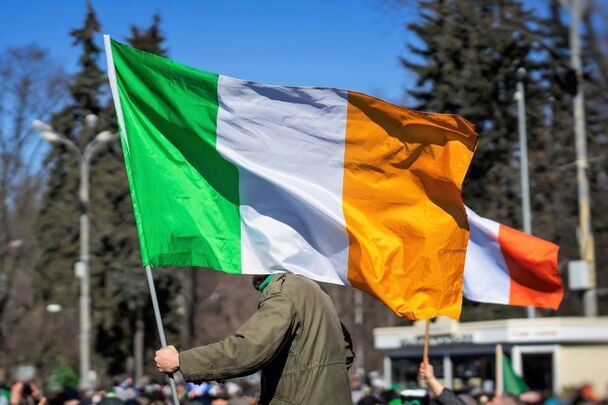
For thirty years, the accepted story of the Irish Tricolour traced its birth to Waterford in 1848 and Thomas Meagher. Now a groundbreaking new book, "The Irish Tricolour: The Truth behind the Symbols and Struggles that Defined a Nation", by John Crotty, pushes the flag's origins back nearly two decades, crediting a forgotten Dublin patriot named Emelia Hamilton and uncovering an unexpected early chapter in America.
For 30 years, an inaccurate origin story has been relayed about the Irish Tricolour. The previous understanding stated that the flag emerged in 1848, allegedly brought from Paris by Thomas Meagher following a donation by French ladies. It was claimed the flag was first flown in Waterford in that year, on March 7th.
So established has the story become, it will surprise the reader to learn that not a word of this is true. A first dedicated book on the Irish Tricolour has pushed this symbol's origins back 18 years, restoring a forgotten female patriot to the limelight while bringing America into the story.
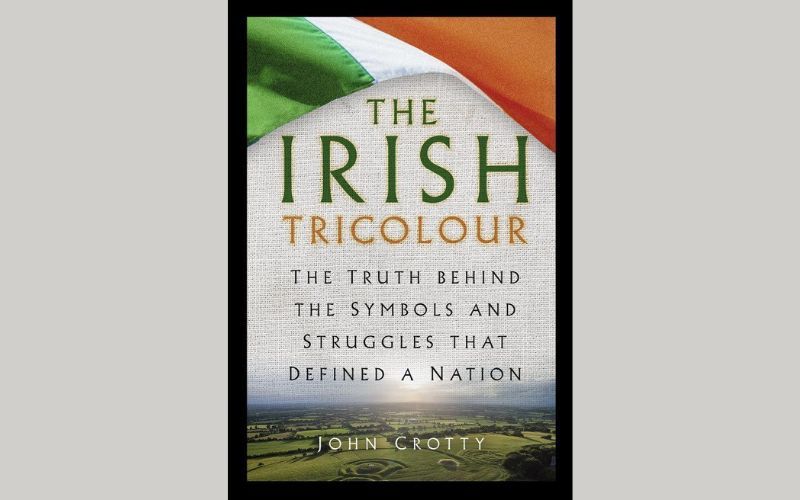

"The Irish Tricolour: The Truth behind the Symbols and Struggles that Defined a Nation", by John Crotty.
Research now reveals the symbol first appeared in September 1830, inspired by the goodwill of Catholic Emancipation. This concession removed the restriction that prevented Irish Catholics elected to government from taking their seat in London's Parliament. This was achieved by Daniel O'Connell, who then set his sights on 'Repeal', a campaign to restore a Parliament in Dublin, which had been disbanded by the 1801 Act of Union.
To achieve this aim, O'Connell called for 'orange and green to unite', green representing Ireland's Catholics, orange its Protestants. He voiced the wish so often that it led to a first physical flourish in March 1830. A green - orange cockade, or rosette, appeared at a political event in Cork City, the peaceful symbolism drawing praise.
Read more
More occasions of green and orange entwined appeared throughout the year before white was added in September, creating the first Irish Tricolour. It was the work of a young Dubliner, Emelia Hamilton, a resident of Annadale Cottage in Fairview. She crafted a green, orange, and white rosette, which was presented at a meeting convened to send salutations to the French on their Revolution that year.
Emelia's device was presented with a letter that made clear its intention, forever establishing the Tricolours peaceful symbolism. She included two lines from an Irish poem - "Let orange and green, no longer be seen, b'stained by the blood of our island".
So was born the symbol that would become the Irish national flag.
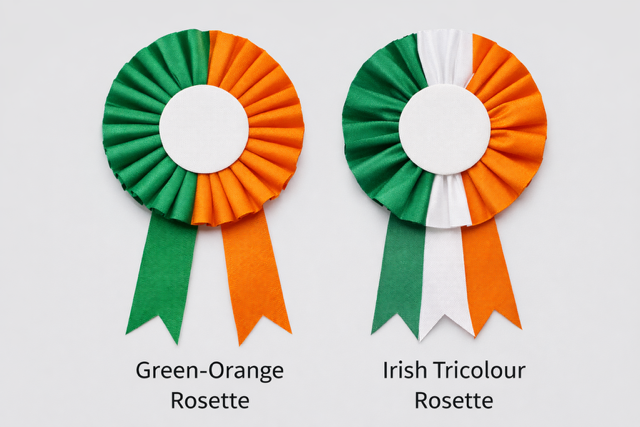
The first Irish tricolour was in rosette form
Emelia's new Tricolour was proposed as a national flag by a British newspaper and soon saw use by Daniel O'Connell's Repeal campaign. When he returned from taking his seat in Parliament in December 1830, tricolours flew with abandon, in flag, banner, and rosette form. The green - orange device also saw ongoing use, both intending the same message of peace between the factions. The Tricolour saw frequent use in parades and events before the first recorded flying over an Irish building occurred, at Dunsoghly Towerhouse in 1832, a 15th-century castle in Saint Margaret’s, Dublin.
A first also took place in America, as the Tricolour crossed the ocean for the first time.
An exact Tricolour of green, white, and orange was presented as a gift to the Chairman of the Friends of Ireland group in Charleston, South Carolina, in 1831. A scarf of the same colors was also presented, the remarkable moment marking the first recorded appearance of the Irish Tricolour in America, but also the first current clear record of it appearing in its exact modern green, white, and orange format, in that order. The symbol would fly with decreasing popularity as the 1830's progressed. Daniel O'Connell's efforts at achieving Repeal ultimately failed.
The Tricolour was re-popularised in 1848 as a new group took up the mantle of increased Irish freedom, the Young Irelanders. They first used the green - orange device associated with O'Connell's Repeal campaign in early 1848, using it for their annual membership cards and wearing green-orange neck-clothes. The group took to flying French Tricolour after the French Revolution erupted in February that year, before an important return of the Irish Tricolour was broadcast to the nation on March 7th, 1848. This took place in Enniscorthy, County Wexford, where a Tricolour of 'orange, green and white, expressive of the union of parties', was flown. Reported in all nationalist press, it cannot have been missed by the Young Irelanders who swapped the French flag for this Irish tricolour within weeks. They first flew it at their Limerick premises on Saint Patrick's Day.
One of the locations the Young Irelanders flew the French Tricolour was Waterford City, the city’s Mayor writing to authorities in Dublin asking what he should do about the flight of a tricolour. This letter was ‘discovered’ in the 1990s leading to an assumption that he was referring to an Irish Tricolour. He was not. Several other references clearly stated the fight of the 'French Republican flag' in the city on March 7th. Flights of the French tricolour were far more common at this juncture.
Read more
There was some involvement to come for Waterford's famous son, Thomas Meagher. He was among a group traveling to France in late March 1848 to send salutations to the French administration and seek support for Irish aims, led by group leader William Smith O'Brien. They failed to secure vocal French support. Disappointed, O'Brien and Meagher attended a theatre performance in Paris with their host, Cork's John Patrick Leonard, which included a dramatic rendition of the French anthem and passionate unfurling of the French Tricolour.
Duly inspired, and having already made use of the Irish Tricolour back home, the group had a Tricolour made, which they brought to Dublin, presenting it at a meeting as a symbol of French support for Irish aims. The language used in Meagher's rousing speech led many of the younger attendees at the meeting to assume this was a new symbol. However, the older contingent in the room would have been well aware of the nearly two-decade-old symbol, linked to the campaigns of Daniel O'Connell. The moment marked the formal adoption by the Irish Confederate group.
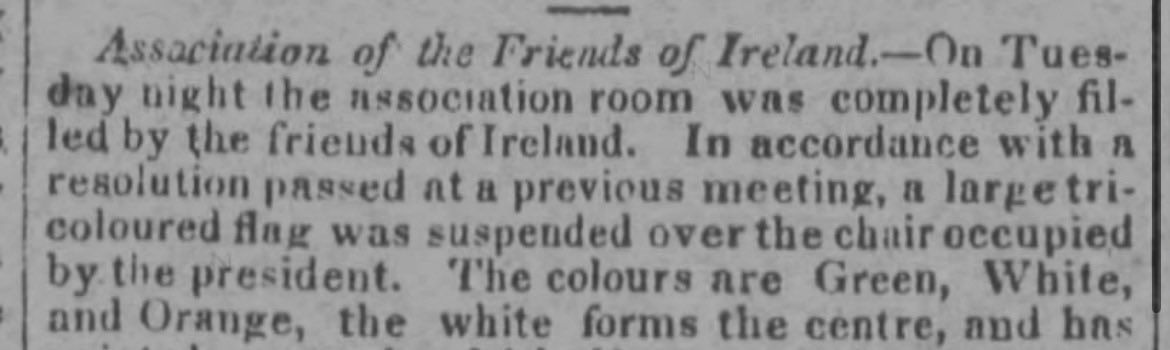
Friends of Ireland, Charleston, 1831
The group tried to stage a rising in Ireland in 1848, with disastrous results; the leaders were arrested and transported. But not before they had cemented an association between the Tricolour and Irish Republicanism, one to the liking of later generations, including those of 1916.
America entered the Tricolour’s story again around the late 1860s, as Irish and American Fenians licked their wounds from failed efforts at furthering Irish independence. The reforming groups would adopt a new symbol after its existence was highlighted by a group of 'Fenians on the Alleghanies' - the Irish Tricolour, raised by the Kane City circle in 1868. The flag became the secret symbol of Clan na Gael, the American arm of the Irish Republican Brotherhood, which also used the symbol in secret back in Ireland. It was stored for the explosion of patriotism that was the Easter Rising, 1916, the Tricolours appearance in the rising leading to its national use and formal state adoption.
The new research in the book also reveals that the flag was the chosen symbol of the Rising, held in secret for over half a century for just such an event. Senior IRB figure Diarmuid Lynch confirmed it had 'long been revered' by the IRB, while Michael Staines relayed that at a meeting planning the Rising, "It was agreed that the Tricolour should be adopted".
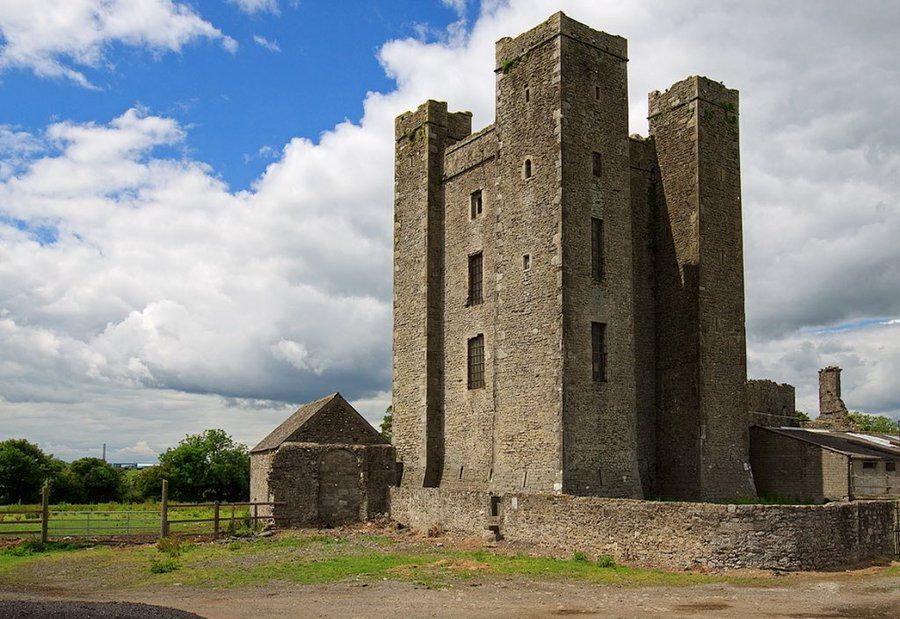
Dunsoghly Towerhouse
These new findings write a new chapter in Ireland’s history, placing the national flag’s emergence 18 years earlier than previously understood. It appeared amid the goodwill of Catholic Emancipation, with an early American flight in 1831. Its return in 1848 for that year's rebellion gave it an important link to Republicanism.
America entered the fray once again with an important adoption by a group of Kane City Fenians, before vital American support funded the Easter Rising, which secured the symbol's rise to premier national emblem. It overtook the green harp flag, which was in use since 1642, with earlier use in azure going back to 1280.
History, it seems, does not sit still. New tools and new finds continue to shape our understanding.
* "The Irish Tricolour: The Truth behind the Symbols and Struggles that Defined a Nation" by John Crotty is available on Amazon here.
This article was submitted to the IrishCentral contributors network by a member of the global Irish community. To become an IrishCentral contributor click here.
Comments