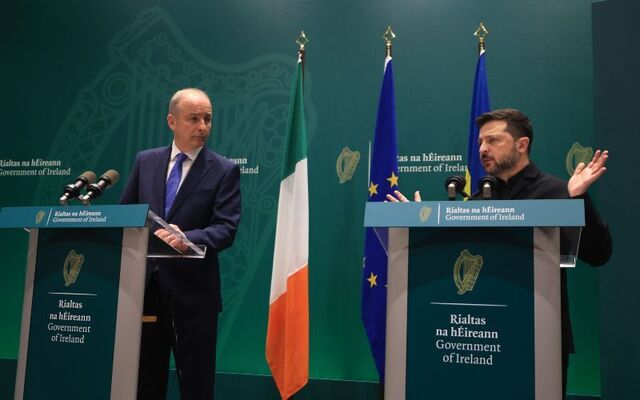
Dublin woke on Thursday morning to closed bridges, checkpoints, and restricted airspace as up to 50 heads of state and government arrived for the ninth summit of the European Political Community. It is the largest diplomatic undertaking in the history of the Irish State, and it places Ireland, however briefly, at the center of Europe's scramble to end the war in Ukraine.
The EPC brings together more than 50 EU and non-EU leaders from every corner of the continent, from Iceland to Armenia, according to RTÉ.
Canadian Prime Minister Mark Carney is attending, as is NATO Secretary General Mark Rutte. Seven leaders of EU institutions are also in the room, among them European Commission President Ursula von der Leyen, along with Belarusian opposition leader Sviatlana Tsikhanouskaya.
There are notable absences. Turkish President Recep Tayyip Erdogan is at the COP31 summit in Antalya, Spain's Pedro Sanchez is campaigning in a snap election, and Belgium's Bart de Wever is tied up in budget talks at home.
In all, more than 50 delegations and some 500 participants are expected in the capital.
Ukraine dominates the room
The war in Ukraine, now well into its fifth year, is once again the subject nobody can avoid.
Ukrainian President Volodymyr Zelensky is one of only three leaders addressing the opening plenary session directly, alongside the Taoiseach and European Council President Antonio Costa.
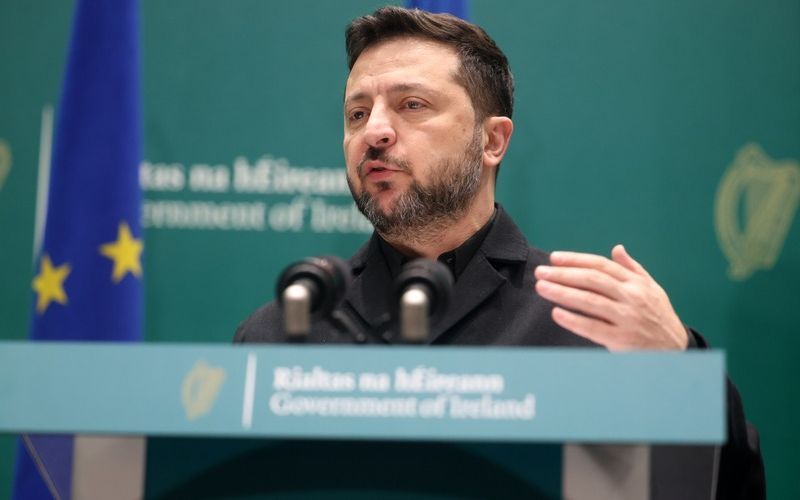

Ukrainian President Volodymyr Zelensky.
Zelensky met Martin at Government Buildings on Wednesday evening, his third visit to Ireland in 12 months. Speaking afterward, he thanked Ireland for its "unwavering support for our people, for Ukraine, for our defense," in remarks reported by RTÉ News.
He also pushed back on any settlement negotiated over Europe's head. "This war is in Ukraine, and ending this war without Europe's participation would be unjust, and it would be impossible," he told reporters.
The Taoiseach was blunt about Russia's strikes on Ukrainian towns and cities. "It is barbarous, and it is vile," he said, adding that the Ukrainian people deserve a just and lasting peace above all else.
Zelensky also said he was open to co-producing drones with Ireland, and Martin confirmed work is under way on a memorandum covering drone manufacture, particularly for maritime security.
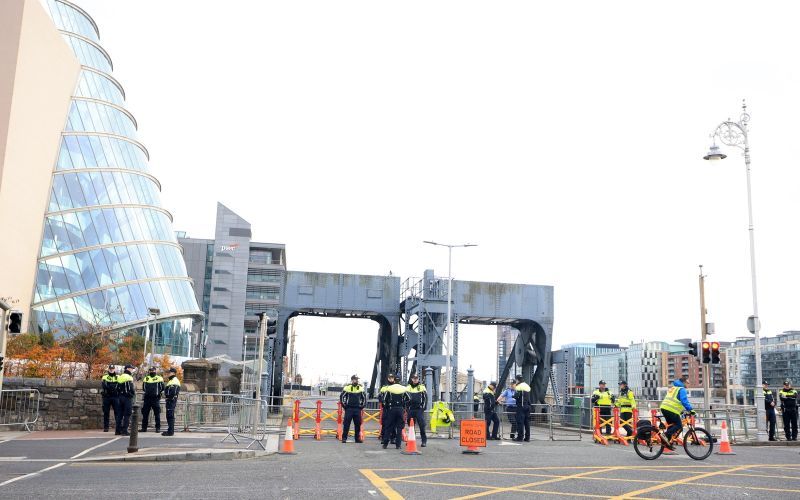
Security check points outside Dublin's Convention Center for the EPC.
Trump's envoys are flying in
Ireland's hosting duties have handed the State an unexpected walk-on part in the peace process.
US President Donald Trump's special envoys Steve Witkoff and Jared Kushner announced on Tuesday that they would travel to Moscow to brief Russian President Vladimir Putin on two days of talks in Abu Dhabi, then continue to Dublin to brief Zelensky on Putin's response.
Beyond agreement in principle on a large prisoner exchange, there appear to have been no major breakthroughs in the Emirates. Zelensky has floated the possible exchange of 1,200 prisoners of war.
The Ukrainian leader made clear that he thinks the outcome rests in Washington. Progress, he said, depends on how hard Trump is willing to lean on the Russian president.
Dublin under lockdown
The policing effort dwarfs anything mounted for a US presidential visit. The Irish Independent reported that more than 5,000 gardaí have been deployed and airspace over the capital restricted as the events shut down the city center.
According to the Irish Presidency, every member of An Garda Síochána is involved, either policing the Dublin events directly or keeping communities covered elsewhere in the country. Over a 72-hour period, more than 15,000 twelve-hour shifts are being worked, supported by some 35,000 hot meals.
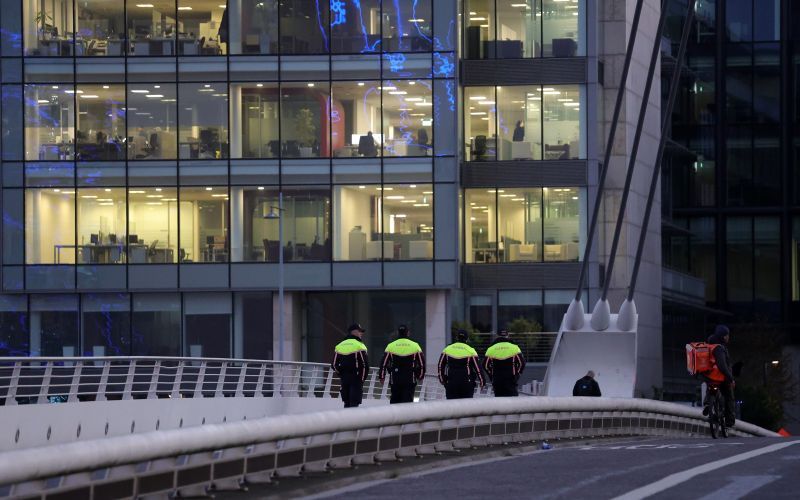
Police on the streets behind Dublin's Convention Centre.
Gardaí have been issued new motorcycles, patrol cars, and vans, along with new public order uniforms and equipment. The Presidency said the force has procured counter-drone detection and mitigation systems as good as or better than those of any other EU country.
Tensions were already running high before the leaders landed. Recent bomb scares hit a number of Irish media outlets, including RTÉ, and threats were directed at European airlines, including Aer Lingus and Ryanair.
No conclusive evidence has emerged, but suspicion has fallen on Russian hybrid warfare aimed at European states backing Ukraine. Ahead of last year's EPC in Copenhagen, the Danish capital's airport and several military bases were hit by unexplained drone incursions.
What the EPC actually is
French President Emmanuel Macron conceived the format in 2022, after Russia's full-scale invasion, as a way for EU and non-EU leaders to meet in a smaller, less scripted setting.
Critics dismissed it early on as a talking shop, since the summits produce no communique and no agreed action plan. Candidate countries feared it would become another waiting room on the road to EU membership.
Its stature has grown since. "Times of trouble require new opportunities for privileged dialogue," Sébastien Maillard of Chatham House told RTÉ.
Much of the real business happens in the Leaders' Lounge, where heads of state mingle without the usual retinue of civil servants. The format also allows for quiet bilateral talks on thorny disputes, from Armenia and Azerbaijan to Turkey and Cyprus and Serbia and Kosovo.
Thursday's thematic discussions run under an overarching banner of a Europe that is strong, secure and connected, covering economic security, competitiveness, AI, soaring energy costs and defense.
Dinner at the National Gallery, then the hard part
The Taoiseach greeted leaders from 9.40am, with the first plenary opening at 11.30am. A closing plenary and joint news conference follow in the late afternoon, with Swiss President Guy Parmelin, who hosts the next EPC in the spring, joining Martin and Costa.
Leaders then head to the National Gallery for dinner and entertainment, again without officials in tow.
The work does not stop when the plates are cleared. An informal European Council meeting takes place at the same venue on Friday, and 24 formal ministerial council meetings remain on Ireland's presidency calendar.
Deep divisions persist over funding for Ukraine and the size of the next long-term EU budget. Kyiv faces funding needs of €70 billion next year, and German Chancellor Friedrich Merz has unsettled colleagues by suggesting Berlin may not fund the seven-year budget if eastern beneficiaries opt out of supporting Ukraine.
Two years in the planning, the summit is a showcase Dublin cannot afford to fumble.

Comments