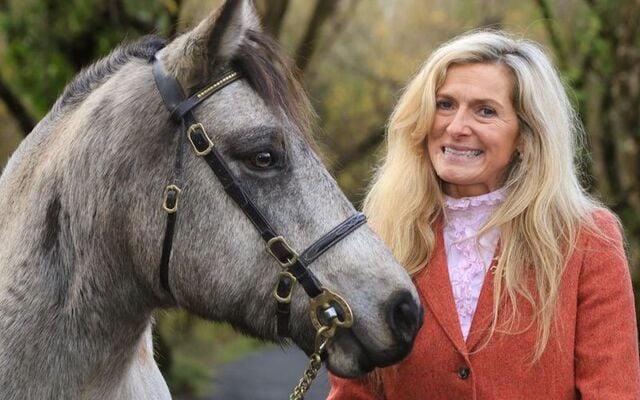
On any quiet Connemara morning when the mist lifts off Diamond Hill, you’ll find Cathy Snow among the beauty of nature, her eyes following a herd of Connemara ponies as they move freely through the parkland.
‘They’re the nearest thing possible to having them in the wild,’ she says. ‘They love to be out, to roam. It’s where they belong.’ For Cath – breeder, judge and lifelong custodian of Ireland’s beloved native pony – this is more than work, it’s a way of life, a calling carried through generations.
Born and bred in Clifden, she grew up surrounded by ponies and the people who loved them. ‘We’ve always been connected to the Connemara pony,’ she reflects.
'Since the beginning of the century, my family has shown them, bred them, judged them. It’s been part of who we are.’ That deep connection has now culminated in a true labour of love – the opening of the Connemara Pony Heritage Centre at Connemara National Park, a celebration decades in the making, honouring a breed that helped shape a people.
Cathy’s life has always revolved around ponies. After studying equine science in Dublin, she returned home to manage the herd at Connemara National Park, a role she has held for over 20 years.
'It’s a small herd, but a wonderful one,’ she says. ‘They’re part of the landscape here, living much as they always did – hardy, surefooted and free.
'They love to have space to roam and then they’ll feed on gorse or heather. If they get a chance to go down to the sea to pick seaweed they might, because there’s iodine in that. They’re really good at knowing what their bodies need.’ During the summer, visitors can meet these ponies up close.
‘I’ll take in a mare and a foal and let them socialise with the visitors – so often I see children who are absolutely blown away that they can pet a pony on the nose,’ Cathy smiles.
‘The ponies love it too – it’s good for them to socialise, to meet people. It works both ways. People get to see their temperament, how kind, how gentle they are. It’s a privilege to share that.’
Her husband, Martin Coyne, also works at the National Park, and together with park manager Eugene Finnerty and a dedicated team, they’ve turned a shared vision into something tangible.
The Heritage Centre, perched overlooking the display paddock at the foot of Diamond Hill, tells the story of the Connemara pony from its humble beginnings to its worldwide fame.
View this post on Instagram
The Snow family’s story with the pony stretches deep into the past, a story of resilience, custodianship and love for the land. Cathy’s great-great-great-grandfather James Decourcy left for America after the Famine, returning years later with enough money saved to buy a farm.
'His dream was always to have Connemara ponies,’ Cathy says. ‘I often say Connemara ponies make your dreams come true. His dream was to breed them, mine was to build a home for their story, and now it’s happened with the centre.’
Her family has been entrusted with the care of stallions through the Connemara Pony Breeders’ Society for generations, a revered role Cathy refers to as a custodianship, that’s both an honour and a duty. ‘Those custodians were pillars of the community,’ Cathy explains.
‘People depended on them to keep their mares in foal. It was how families survived, selling the foal each year to feed the other animals. That tradition still means so much to me.’
It’s a heritage she continues proudly. Her mother was the first woman from Clifden to be listed as a Connemara Pony Society judge, while Cathy herself became the youngest person ever accepted. Today, she judges internationally, bringing her expertise – and her pride – to competitions around the world.
Now, her daughter Camilla, who is studying law in Galway, is also part of that legacy, the third generation of women in the family devoted to breeding and caring for Connemara ponies. ‘They really do form bonds,’ she says softly. ‘They know you, trust you. They’re part of the family.’
She adds that these stoic animals can live for well over 30 years, and easily adapt to all kinds of climates and cultures. ‘Everywhere I go across the world, people adore our native pony,’ she says.
‘I’m just so proud of them.’ The Connemara pony was once the lifeline of rural families in the west, and Cathy paints a vivid picture of their role in daily survival.
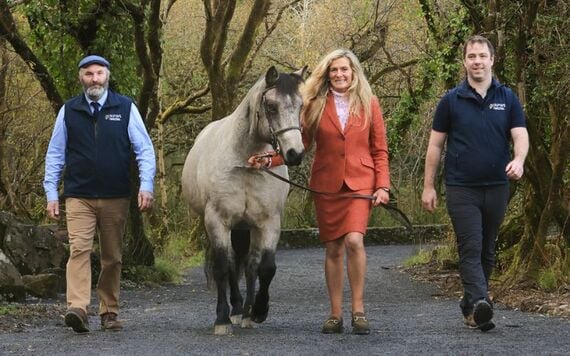

Martin Coyne, Connemara National Park, Connemara pony, Honey Bee, Consultant Cathy Snow, and Eugene Finnerty, National Parks Manager at Connemara National Park, pictured at the official opening of the new Connemara Pony Heritage Centre at Connemara National Park in Galway. PIC: Martina Regan via Connemara Pony Heritage Centre
‘In the past, people around here had small farms so they couldn’t afford big horses,’ she explains. ‘The Connemara was easy to keep, strong and clever. The land here is rough – bog, rocks, seaweed, everything slippery – but they were sure-footed, could take on anything.
‘They brought seaweed from the shore to fertilise the land, turf from the bog to keep the family warm, hay from the fields, fish from the piers to market. They were our transport. People depended on that pony, they loved that pony.’
That legacy of service has shaped the pony’s temperament that we see today. ‘They work with you,’ Cathy shrugs. ‘You form a partnership. When you walk down to the stable, they’re neighing for you – yes, maybe for the food,’ she laughs, ‘but also because they know you. They remember.’
Her stories tumble out in affectionate detail, of a stallion who carefully stepped over hens on the road or of her daughter Camilla playing under their bellies as a child.
'They were so good to my kids,’ she smiles. ‘They’re so clever and intuitive. When children are learning to jump, the pony will mind them, balance with them. They’re just remarkable creatures.’
The new Heritage Centre, years in the planning, now stands as a living tribute to this remarkable breed. Overlooking the National Park’s display paddock – home to seven ponies descended from those once kept at Áras an Uachtaráin, having been gifted by the former Irish president Erskine Childers to the Irish State – it offers visitors an immersive journey through the history and spirit of the Connemara pony.
Through photographs, storyboards, film and interactive headsets, visitors can trace the pony’s path from the rocky fields of Connemara to the international show ring.
‘We had an older gentleman come in recently,’ Cathy recalls. ‘He must have been in his 80s. He put on the headset, and suddenly he was riding a pony on the beach again, just like when he was a boy. That’s what it’s all about. The Connemara pony connects people across time.’
The new centre, she says, is accessible for everyone, young and old, horsepeople and the lay person. ‘Even if you know nothing about the Connemara, you can learn the basics,’ she says. ‘If you grew up with one, it’ll bring back memories. It’s a celebration, a tribute to them as our native breed.’
Today, Cathy runs her own stud, Moorland Connemara Ponies, with around 20 ponies and new foals each year. ‘It’s an addiction,’ she admits with a laugh.
‘This year we had seven foals. I’d have as many as I could to be honest.’ She’s proud of her show record too – her ponies have won multiple All-Ireland Broodmare Championships and top honours at the Clifden Show, the mecca of the Connemara pony world. Every August, the small town comes alive for the week-long festival that draws breeders and enthusiasts from around the globe. ‘There are 17 Connemara pony societies worldwide,’ Cathy notes.
‘Representatives from all of them come to Clifden. We’re all speaking the same language, the language of the Connemara pony. It’s incredible.’
But even as the breed thrives internationally, Cathy is passionate about preserving the original traits of the pony. ‘The traditional Connemara was a smaller, stronger pony who was incredibly sure-footed with strong legs,’ she says. ‘We have to protect the traditional type, under 148cm. That’s the pony that worked these hills, that carried our people. We can’t lose that.’
Beyond its strength and beauty, Cathy believes the true gift of the Connemara pony lies in its empathy. Cathy also oversees the Connemara Therapeutic Riding centre, which supports children and adults through equineassisted therapy. ‘They have emotional intelligence,’ she says.
‘They’re wonderful with children, and for people with additional needs. They are patient, calm, understanding. There’s something in their nature that connects with people.’
It’s this that makes them a pony for all generations. ‘You can start as a child learning to ride, and you can trust them completely,’ says Cathy. ‘Then when you’re older, not as agile and maybe more fragile, you can come back to riding and they’ll look after you just the same.’
The idea for the Heritage Centre was actually born decades ago, Cathy reveals. ‘I remember being a young girl and thinking how wonderful it would be to have a place devoted to the story of the Connemara pony,’ she recalls.
But life, of course, took over – university, work, marriage, raising her two children. But the dream never left her. ‘I even applied for an EU award years ago, for women starting businesses, and I got it,’ she says.
‘But it wasn’t the right time. Then, as I got older, I thought, if not now, when?’ With the support of the National Park, Cathy’s vision came to life, a tribute to the ponies and the people who shaped them, set in the very heart of Connemara.
‘It’s amazing to stand here now and see it,’ she says. ‘It feels like the circle is complete.’
For opening hours and details about the new Connemara Pony Heritage Centre at Connemara National Park, see national parks.ie.
* This article was originally published on Evoke.ie.



Comments