In reality, many of the most effective improvements are relatively simple. A safer home starts with identifying everyday risks, maintaining essential equipment, and making sure everyone in the household knows what to do when something goes wrong.
From fire prevention to electrical safety, a few practical habits can significantly reduce avoidable risks. Here are seven straightforward ways families can improve safety at home.
1. Install Smoke Alarms in the Right Places
Fire can develop quickly, particularly while people are sleeping. A properly installed smoke alarm can provide an early warning when smoke is detected, giving occupants more time to respond and leave the building if necessary.
Smoke alarms should generally be installed according to local requirements and the manufacturer's instructions. Bedrooms, areas outside sleeping rooms, and different levels of a home may require particular attention. The exact number and placement will depend on the layout of the property.
Installation alone is not enough. Smoke alarms should also be tested regularly, kept free from excessive dust, and maintained according to the manufacturer's instructions.
2. Connect Smoke Alarms in Larger Homes
A single alarm may not provide the same level of awareness throughout a larger house. If a fire begins in a distant room, occupants elsewhere in the property may not hear an alarm from that location clearly enough.
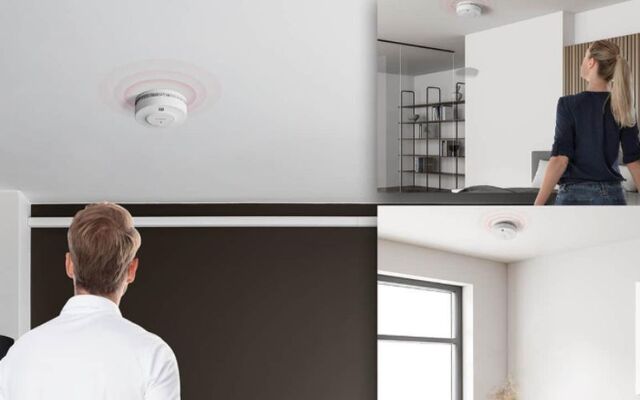
Interconnected smoke alarms offer one possible solution. When compatible alarms are connected wirelessly, detecting smoke with one unit can cause other linked alarms to sound as well.
The X-SENSE SD19-W wireless interconnected smoke alarm is designed specifically around this principle. According to the current manufacturer specifications, compatible SD19-W units can be wirelessly interconnected, with up to 24 units supported in one network. The system uses a radio-frequency connection rather than requiring the alarms to be connected through a household Wi-Fi network.
This can be particularly useful in multi-storey homes, where an alarm in a basement or upstairs bedroom may otherwise be difficult to hear from another part of the property.
3. Check Electrical Equipment Regularly
Electrical appliances are part of almost every modern household, but damaged equipment and inappropriate use can create unnecessary risks.
Cables should be checked periodically for visible damage, particularly around plugs and areas where wires are frequently bent. Appliances that become unusually hot, produce an unusual smell, or show other signs of malfunction should not simply be ignored.
Extension leads and power strips should also be used responsibly. Connecting too many high-powered appliances to the same outlet can place unnecessary strain on the electrical system.
It is also sensible to follow the manufacturer's instructions for appliances rather than modifying equipment or using damaged accessories.
4. Be Careful With Cooking and Open Flames
The kitchen is one of the most important areas to consider when thinking about household fire prevention. Cooking should not be left unattended, particularly when using high temperatures or cooking with oil.
Flammable objects such as paper towels, packaging and kitchen cloths should be kept away from hot surfaces. If cooking oil catches fire, water should never be poured onto it because this can cause burning oil to spread rapidly.
Candles and other open flames require similar attention. They should be placed on stable surfaces away from curtains, paper, furniture and other combustible materials. Most importantly, candles should not be left burning when nobody is present.
5. Make Heating Equipment a Priority
Heating equipment can become a safety concern when it is positioned too close to combustible materials or used incorrectly.
Portable heaters should have adequate clearance around them and should be used according to their instructions. Items such as blankets, curtains, clothing and furniture should not be placed directly against heating equipment.
Homes that use fireplaces, wood-burning stoves or other combustion-based heating systems also need appropriate maintenance. Professional inspection and servicing can help identify problems before they become serious.
Carbon monoxide is another consideration in homes with combustion appliances. Because the gas cannot be detected by sight or smell, households using such equipment should consider whether a dedicated carbon monoxide alarm is appropriate for their circumstances.
6. Prepare a Family Emergency Plan
Technology and safety equipment are important, but people also need to know what to do when an emergency occurs.
Families should discuss the safest ways to leave the home and identify suitable exits. Children should be taught basic emergency procedures in an age-appropriate way. Everyone should know that once they have left a property during a fire, they should not go back inside.
It can also be useful to establish a meeting point outside the home. This makes it easier to determine whether everyone has safely evacuated.
An emergency plan does not need to be complicated. What matters is that household members understand it before an emergency happens.
7. Test Safety Equipment Regularly
A safety device can only provide its intended warning if it is functioning properly. For this reason, regular testing should become part of normal household maintenance.
The SD19-W, for example, includes a self-test function that checks the alarm periodically. Its current specifications also list a 10-year sealed lithium battery, meaning the battery is designed to last for the unit's stated battery life rather than being routinely replaced by the user. When the battery reaches the end of its life, the complete unit should be replaced according to the manufacturer's instructions.
The device also uses a photoelectric sensor and continuously samples the surrounding air. X-Sense lists an operating range of 4.4°C to 37.8°C and an operating relative humidity of up to 85% non-condensing.
Even when a device has automatic testing features, householders should still pay attention to warning signals and follow the manufacturer's maintenance recommendations.
Safety Does Not Have to Be Complicated
Making a home safer is less about purchasing the largest number of devices and more about combining sensible prevention with reliable safety equipment.
Smoke alarms should be installed appropriately and checked regularly. Larger homes may benefit from interconnected alarms so that a warning can be heard in multiple areas. Electrical appliances should be maintained, cooking and open flames should never be treated casually, and heating equipment should be used responsibly.
Just as importantly, every member of the household should understand the basic emergency plan.
Simple actions such as these can make a meaningful difference. A few minutes spent checking a smoke alarm, reviewing an evacuation route, or inspecting a damaged electrical cable may seem insignificant during an ordinary day. In an emergency, however, those preparations can become extremely important.



Comments