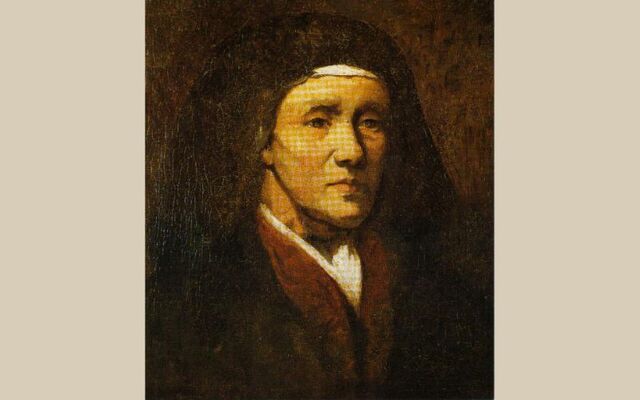
Nano Nagle quietly defied the Penal Laws and built a movement of compassion that reached far beyond Cork. Her schools, her care for the poor, and the religious order she founded made her a lasting figure in Irish Catholic history and a humanitarian whose legacy still travels the world.
Nano Nagle was born in 1718 into a wealthy Catholic family in Ballygriffin, County Cork, at a time when Irish Catholics were denied basic rights and education. Her family did have the means to send her to France, where she was educated in a Benedictine convent, but the contrast between privilege and poverty would eventually shape the direction of her life.
One story repeated by her biographers describes a young Nano returning from a night of Parisian entertainment and seeing poor people waiting for early Mass. That moment stayed with her, and after returning to Ireland she turned away from a life of comfort and toward service, later echoing the family motto “NOT WORDS, BUT DEEDS.”
Back in Cork, Nano began her most important work in the 1750s. She opened her first school in a small cabin with 35 girls, and within a few years she had established several schools for boys and girls, teaching reading, writing, arithmetic, faith, and practical skills to children who otherwise had few chances in life.
What made Nano Nagle remarkable was not only that she educated children, but that she did so at a time when it was illegal to educate Catholics in the way she was doing. She visited the schools daily, took responsibility for religious instruction, and spent her evenings among the sick and dying, earning the name “Lady with the Lantern” for walking Cork’s dark streets to bring comfort and help.
Read more
Her concern extended to people society often ignored. According to the Nano Nagle Birthplace account, she helped emigrants bound for the West Indies, opened a home for older destitute women, and planned a refuge for girls and women trapped in prostitution, a dream cut short by her death from tuberculosis in 1784.
Nano understood that her work needed to continue after her death, so she founded the Sisters of the Presentation of the Blessed Virgin Mary in 1775. The Presentation Sisters later described her as the foundress whose vision was for “those most poor and abandoned,” and her own words captured the breadth of that vision when she said, “My views are not for one object alone.”
That legacy has not faded. The Presentation Sisters say her mission has been carried around the world in many ministries, and the wider Catholic Church formally recognized her cause when Pope Francis declared her venerable on October 31, 2013. Being deemed venerable is an official recognition that a person lived a life of heroic virtue. It is an early but significant step in the canonization process, which is the path to being declared a saint.

Comments