When Glasgow detectives finally searched the presbytery in Possilpark in March 1973, they found three boxes stacked beneath the curate's bed holding 630 sticks of gelignite, 150 detonators and an Aer Lingus bag stuffed with IRA intelligence papers. The curate himself, a Sneem-born priest named Father Bartholomew Burns, had been driven off less than thirty minutes earlier, and no Scottish court would ever get its hands on him.
Editor's note: The following piece has been shared with IrishCentral from the American Irish Historical Society's (AIHS) Treasures of Time, stories from the collections and archives of the American Irish Historical Society in New York City.
Last month, we celebrated the 110th anniversary of the Easter Rising on April 24th, 1916. Though this rising was considered a failure, it was during the weeks following that the move towards 1923 Independence was made possible. After the devastating events of the rising and the loss of leadership through execution, the cause of Irish freedom seemed hollow and hopeless. By killing the most vocal revolutionaries, the message was clear: those who spoke about Irish freedom would be silenced by any means necessary.
After the events of April and the brutal executions throughout May, it would be a challenge to find new guidance towards the path of Irish freedom. On a more personal level (though still political), there came also the question of who would be remembered and how. Both in Ireland and across the diaspora, commemorations of the Easter Rising spread rapidly. By driving to the County Court House in Mineola, you can even see a statue memorializing the Rising here in New York. Other groups throughout the diaspora will meet yearly to read out the names of those lost in the Rising.
Though this tradition of memorializing has become increasingly common, it was a dangerous pursuit in the early days of post-Rising Ireland. But despite the danger and risk to one’s personal and familial safety, the desire to preserve the history of Irish freedom pursued. Looking as early as June 1916, we can see in our collections at AIHS the hope to move forward by not forgetting the pains of the past.
One manuscript in our special collections contains a copy of a poem, composed in June 1916 by an anonymous prisoner held at Knutsford Prison in Cheshire. Those imprisoned in Knutsford (known colloquially by many at their time as the Knutsford Hotel) were usually captured without trial and charged as a danger to the state.
The poem below is an example of Irish prison writing from this period, with a sense of memorializing the Rising behind its intention:
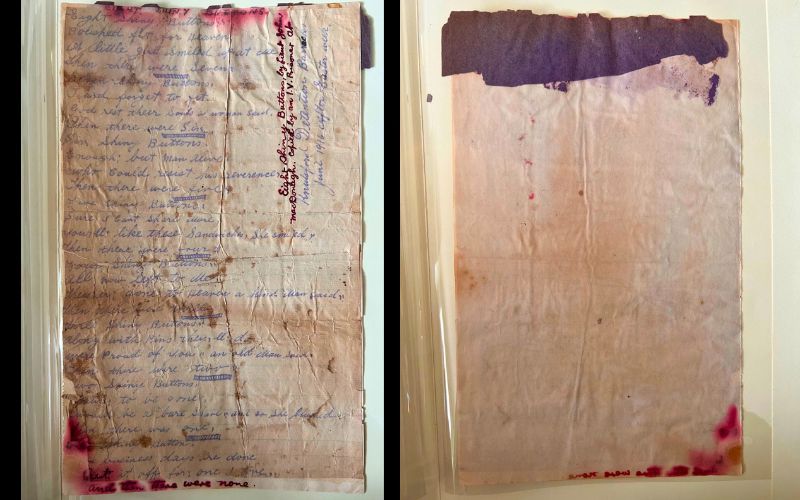

Eight Shiny Buttons, copied by I.V. Prisoner, June 1916. (AIHS)
Though the poet ascribed this piece in the right-hand side to Lieut. John MacDonagh, we understand this to mean Irish poet Thomas MacDonagh (1 February 1878 – 3 May 1916).
MacDonagh was one of the seven leaders of the Rising and was executed roughly a month before this poem was copied. We believe this poem to be a work of MacDonagh’s not only for his tie to the Rising, but for the existence of an early draft of the piece that can be found in the archives of the National Library of Ireland:
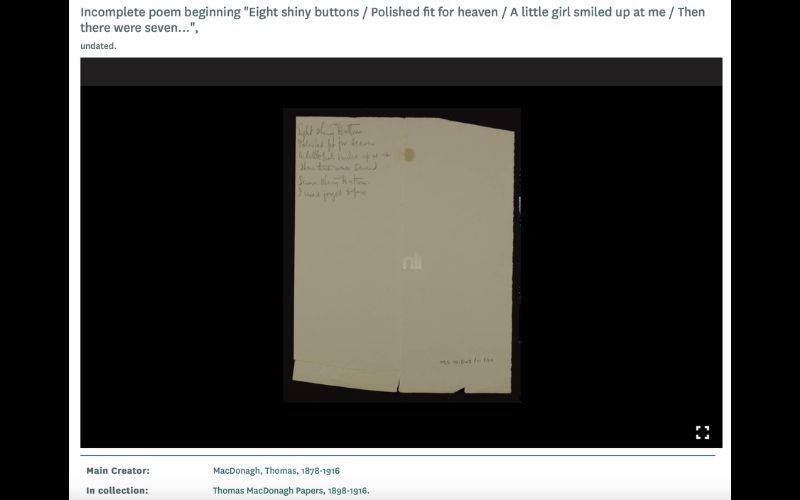
Incomplete poem beginning "Eight shiny buttons"... (National Library Ireland)
Before we continue, please take a moment to read the poem in full.
Poem transcription:
“Eight shiny buttons
Polished fit for Heaven,
A little girl smiled up at me
Then there were seven.
Seven shiny buttons,
I used forget to fit,
God rest their souls, a woman said.
Then there were six.
Six shiny buttons.
Enough; But none alive
Who could resist his reverence,
Then there were five.
Five shiny buttons,
Sure I can’t share more,
You’ll like these sandwiches, she smiled,
Then there were four.
Four shiny buttons,
All now left to me
They’ve gone to Heaven a kind man said”
Then there were three.
Three shiny buttons
Along with pins they’ll do
We’re proud of you” an old man said
Then there were two.
Two shiny buttons,
now, to be gone
It would be a bare shame” and so she glanced,
Then there was one.
One shiny button
Business days are done
Cut it off for; one a time,
And then there were none.”
At the top of the page, we see both the title of the poem, “Eight Shiny Buttons,” repeated twice, and the description, “by Lieut. John MacDonagh. Copied by an I.V. Prisoner at Knutsford Detention Barracks, June 1916 after Easter week."
Similarly to the 1970s prison writing of later revolutionaries like Bobby Sands, the writings of Knutsford Hotel provide us with a unique view into the activities of the Rising. Naturally, many of the prisoners were directly involved in the Rising prior to being captured--though others were punished simply for their ideas. For those who had been connected to the leaders of the Rising prior to the May executions, the writing produced at Knutsford gave an opportunity to preserve the ideas and the people behind the Rising.
MacDonagh’s poem is clearly a variation on the common nursery rhyme that later developed into the poem "Ten Little Soldier Boys," featured prominently in Agatha Christie’s 1939 mystery novel, "And Then There Were None." The rhyme has become controversial over the years, particularly for its earlier racialized lyrics and role in American minstrelsy. This version, however, does not seem to hold any offensive or even comedic tone. Instead, it shows the story of the Rising as a sudden and tragic loss, with the soldiers or “buttons” dropping away until none are left.
Interestingly, the drafted poem by MacDonagh (undated, but clearly earlier as he was still alive) almost predicts these deaths before they occur. In this, we can see MacDonagh’s understanding of the gravity of his cause. Death was an expected risk.
The anonymous remembrance within Knutsford Hotel shows that his work was not meaningless. June 1916 sets the stage for a continued movement that would ultimately lead to independence. As those prisoners looked around themselves at their circumstances, their losses, their memories…they were able to look forward to a future they saw worth fighting for.
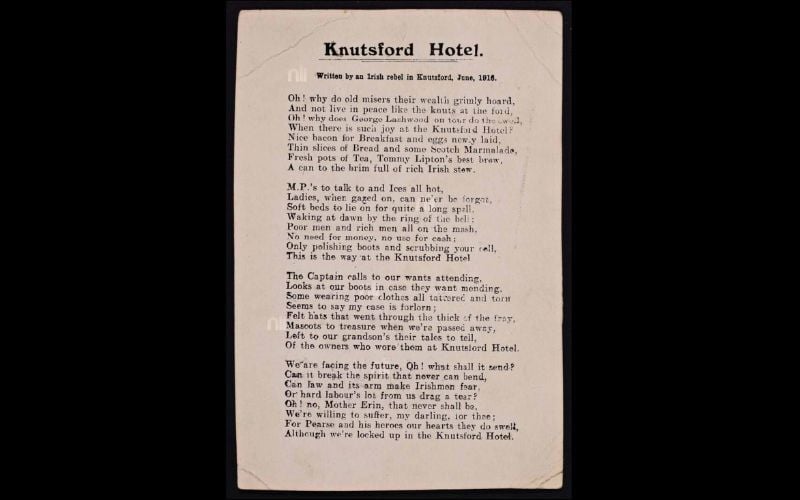
Knutsford Hotel: Written by an Irish Rebel in Knutsford, June, 1916. s.n., 1916. National Library of Ireland.
This column is adapted from the blog of the American Irish Historical Society (AIHS). Read the full stories at AIHSNY.org/blog.
Founded in 1897 and located on Museum Mile in New York City, the American Irish Historical Society (AIHS) preserves and promotes the history and cultural legacy of the Irish in America through its archives, art collections, and public programs. Learn more at AIHSNY.org.

Comments