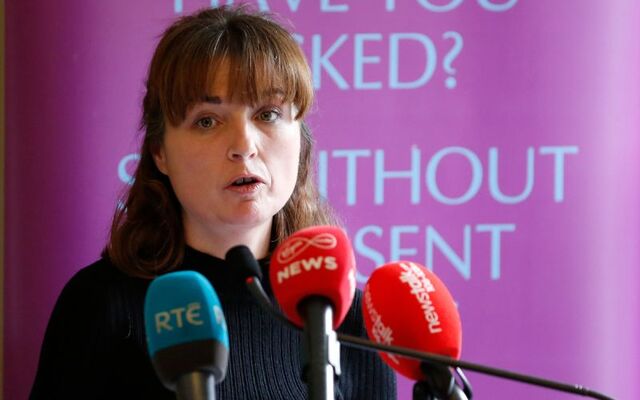
Back in 1991, Lavinia - who was the first woman in Ireland to waive her anonymity in a rape case - was full of the same hopes and dreams as any other 19-year-old. That imagined future was taken from her on New Year's Eve in the most brutal of ways when she was raped by her ex-boyfriend, William Conroy.
The legacy of that night tragically remains - now in her early 50s, Lavinia remains forever changed. While the bruises and scars may have faded, she is a frail five and a half stone as a result of a battle with anorexia since the attack, though when I mention the word "attack", she corrects me quietly but firmly.
"It was rape," she says. "It was like my whole mind was completely stripped. I could never get rid of that feeling of dirt."
Recently honoured with the Irish Tatler Woman Of The Year award, and mentioned in the Dáil during the International Day For The Elimination Of Violence Against Women this week, Lavinia is again being recognised publicly, just as she was in that watershed moment on "The Gerry Ryan Show" three decades ago when she said "my name is Lavinia" - four words that shocked a nation into action.
"I just wanted to have a happy, normal life," says Lavinia, who grew up as the second eldest of five daughters. "A career in childcare, a nice house, a husband, a family. That's what I wanted."
View this post on Instagram
Her life story was taken from her. She never got to wear a wedding dress, although at least there was one positive chapter, when she became a mother to a "miracle" baby boy in 2001 after doctors said she would never conceive.
But safety is something that still evades Lavinia, whose life was ripped apart as she made her way home after New Year's Eve celebrations in Kilkenny on that fateful night. All these years later, this basic human need is still a huge concern for all women in Ireland.
Lavinia has detailed her own harrowing story many times before and again today she revisits that open ground close to the River Nore on December 31, 1991. She wants people to know the reality of rape and everything it takes from a person.
Physically, the rape was violent, her head smashed against a rock. Her virginity was lost in the most brutal way, resulting in intimate, "life-changing" injuries that left her with 30 stitches and struggling to walk. She was bruised and battered. She remembers believing she would die at Conroy's hands.
"At one point - and I think every woman and girl who has experienced such brutality might agree - I was almost hoping he would just finish it, whatever it was he was hoping to do," she says. "I just wanted it to end."
Psychologically, she says that she was also "stripped". "Rape is horrific, it tears up your body, mind and soul and even your will to survive," she says.
In the months that followed, her agony did not subside. She became a national name, however reluctantly, when she and her sister phoned "The Gerry Ryan Show" to express their devastation that Conroy, though convicted, had his sentence adjourned for a year.
View this post on Instagram
The judge said he was giving him "a chance as a human being" and Conroy ultimately received a suspended sentence. For Lavinia, it was a life sentence of a different sort, another violation in a judicial system - and society - that protected the perpetrator.
"There was more available to him - an incredible lawyer, a voice. I just had my mum really," she says of her beloved mum Mary, who is still her biggest support.
"He had a lot of people vouching for his decency - the priest, the teacher. That was the mentality in people's minds: 'why is she doing this to him? Why is she ruining his life? He comes from a good family, he's involved in the GAA.' That mentality still exists."
When Conroy's suspended sentence was confirmed 19 months after the rape, Lavinia went into shock. "I just felt like an afterthought in the whole thing," she says. "It wasn't about me, it was about him - all his character references and witnesses - and I was expected to just show up in court and stay quiet."
Her fight to be heard led directly to historic change. Her personal appeals to the then Minister for Justice Padraig Flynn helped bring about the Criminal Justice Act 1993, which introduced victim impact statements and allowed the DPP to appeal unduly lenient sentences.
But the real watershed moment happened when she spoke to the late Gerry Ryan. "It was the most simple question - 'what's your name?'" she recalls. "I wasn't thinking about waiving anonymity, I wasn't interested in legal jargon, I just knew something had gone deeply, terribly wrong. In all those months in court, no one had asked me my name. It was like I wasn't a human being, I was a number."
Read more
Three decades later, we have language about consent. We have marches and conversations and initiatives to curb rape and violence. But Lavinia speaks for us all when she says that for all our apparent progress, she does not believe Ireland is moving in the right direction.
Research shows the number of female rape victims here is almost three times the EU average. Dublin Rape Crisis Centre reports record levels of disclosures, with last year the highest in its 46-year history. We can argue that these figures, while shocking, are showing that we are talking about rape openly, which is leading to more incidents being reported, but Lavinia says this is missing the point.
"There's a blockage, something is being lost in translation and at times it feels like we are right back at the beginning," she says. "If anything, we have somehow become more accepting of violence. Statistics are a fraction of the true story. There's an epidemic of violence, but are we doing enough to stop it? Is there enough of an incentive there to get those figures down? No."
She believes that a major part of the problem is that rapists and potential rapists "are not afraid of the judicial system". She also notes our significant backlog of rape trials, which leads to a high rate of cases collapsing as victims withdraw.
"Conviction rates are still low, sentences are too lenient and we are not informing people of how women actually feel," she says. "Their fear, the normalisation of how we safeguard ourselves against violence every day, how rape is not an isolated act of violence, it destroys a life - this message is clearly not getting through.
"It needs to be more direct, more graphic," she says. "We are not bringing victims or survivors into schools and colleges and saying, 'this is the reality of rape here. Let me draw you a diagram of it,'" she says, anger in her voice.
I point to Ireland's Zero Tolerance plan or, more recently, the plan to introduce Jennie's Law, a new publicly accessible Domestic Violence Register of Judgments.
"We all need to be on the one hymn sheet here and it doesn't need to be all bells and whistles," she says. "We should all be invested in safety and it starts in homes and it starts in schools. I still feel we are putting all the responsibility on women and girls to keep themselves safe so they won't be raped, creating that fear in them.
"What about chatting to the men and boys, you know, about respect and kindness? Honestly, be as blunt as to say, we have remarkable women and girls in this country and they are afraid so stop raping us," says Lavinia, before pausing. "It has to be really clear and saying that doesn't cost anything."
The rise in women waiving their anonymity in rape trials troubles her, not because she regrets her own decision, but because she believes the focus is misplaced. "If I was to ask you Blathnaid's rapist's name or Gisèle Pelicot's husband's or most men involved in high-profile rapes, would you know?' she asks, and my resounding silence speaks volumes.
"There's all this talk of shifting blame. But you know my name. You know the names of the women who waived anonymity. Ours are not the names that should be seared in public memory. It's the rapists' names," she explains. "Theirs are the names that we shouldn't be able to get out of our heads."
Help is available from the Dublin Rape Crisis Centre at drcc.ie and a 24-hour free, confidential helpline on 1800 778 888.
* This article was originally published on Evoke.ie.


Comments