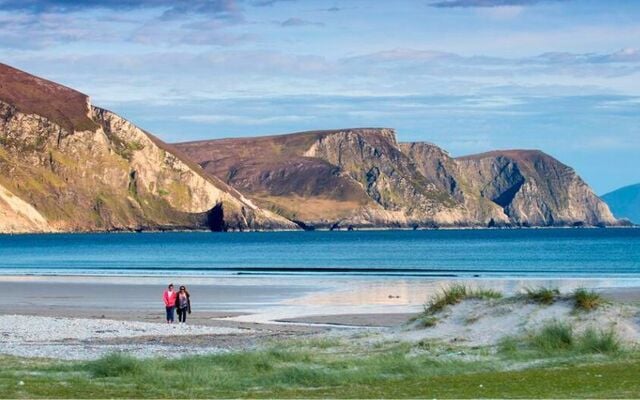
Editor's Note: Mayo Day, the annual celebration of all things County Mayo, returns in 2026 on Saturday, May 2. In observance of the big day, here are IrishCentral's recommendations for the best places to visit in Co Mayo.
Named after the plain of the yew trees, Co Mayo stands proud on the shore of the Atlantic Ocean and, as with any of the counties along the Wild Atlantic Way, offers some incredible views over the water, as well as a memory of the past at every turn.
It’s hard to pick our top tourist attractions in Co Mayo, but read on to see our favorites!
Croagh Patrick
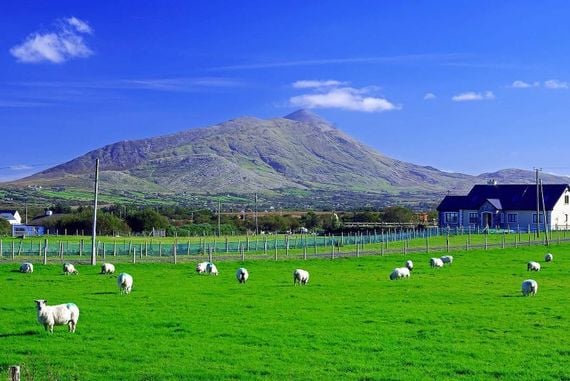

Croagh Patrick. (Ireland's Content Pool)
One of Ireland and Mayo’s most famous landmarks, Croagh Patrick (sometimes referred to as the holiest mountain in Ireland) is located just outside of the beautiful and vibrant town of Westport and is known as the place where St. Patrick spent 40 days and 40 nights praying and fasting during his years as a missionary in Ireland.
The mountain has been a place of pilgrimage for 5,000 years. Originally, pilgrimage to Croagh Patrick was part of a pagan ritual during which people were thought to have gathered there during the harvest season. The tradition has continued interrupted to today through Ireland's transition from a pagan to a Christian country.
Pilgrims climb the 2,500 ft mountain to the church at its peak every day of the year, but thousands of visitors can be expected on the last Sunday of July, or “The Reek” as it’s locally known. They begin their pilgrimage to the top with mass at St. Patrick’s statue at the mountain’s base.
Croagh Patrick is not just for Christians, however, but for anybody who finds their religion, or lack thereof, in the beauty of nature. A tough undertaking, take your time climbing to the summit and make plenty of stops to rest and gaze out over the Mayo countryside and the magnificent views over Clew Bay.
Located at the base of the pilgrim's path up the mountain is the Croagh Patrick Visitors Center, Teach na Miasa, run by the Walsh family. The center is built on a roadway named “Bóthar na Miasa," or “Road of the Dishes,” so called as it is said that the monks of nearby Murrisk Abbey washed their utensils in the stream which runs alongside.
Opposite the center is the National Famine Memorial, a dramatic sculpture depicting a "Coffin Ship" with skeletal bodies in the rigging. It was unveiled by President Mary Robinson in 1997. The population of Co Mayo was among the worst hit during the Great Hunger.
You can learn more about Croagh Patrick here.
Keem Beach
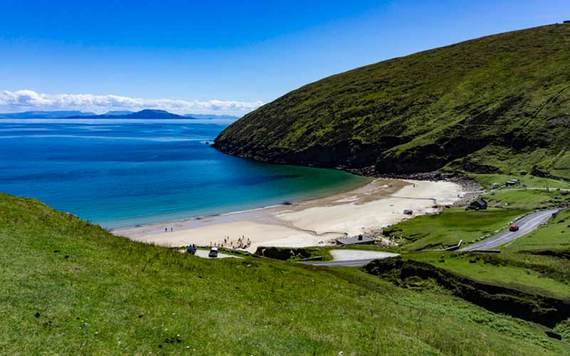
Keem Beach. (Getty Images)
The secluded Keem Beach, located approximately 10km west of Keel village on Co Mayo's Achill Island, is regularly included in "best of" lists around the world - and it's not hard to see why.
The Blue Flag Beach with a water rating quality of "excellent" is a small, sandy, and rural, sheltered by cliffs that support a rich amount of plants and animals.
The main activities at Keem Beach are swimming and surfing, but the beach is also used by a limited number for sailing, canoeing, water skiing, jet skiing, scuba diving / snorkeling, and fishing. The beach is lifeguarded during the bathing season.
Natural beauty abounds at Keem Beach, which has a stepped valley to the rear, made up of boulders and stones. Two freshwater streams flow into the sea from the surrounding land at Keem Beach. The beach is bordered on both sides
by steep cliffs, to the north by the slopes of the Croaghan Mountain, and to the south by a spar called Moyteoge Head.
In addition to its natural beauty, Keem Beach has a rich history. The area was once a hub of the island's fishing industry, and the ruins of a 19th-century coastguard station can still be seen on the hill overlooking the beach. The beach was also used as a landing spot for transatlantic cables in the early 20th century, and visitors can learn more about the island's history at the nearby Achill Island Heritage Centre.
You can learn more about Keem Beach here.
Westport and Westport House
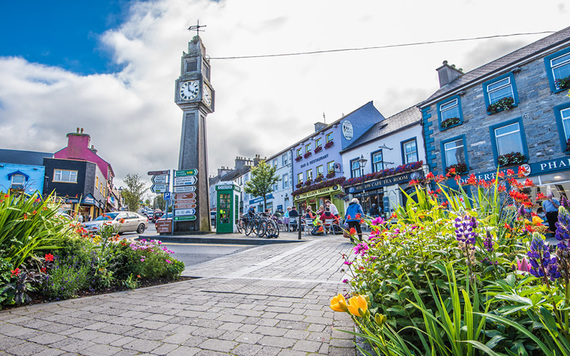
Westport. (Ireland's Content Pool)
After the almost four-hour average round-trip up and down Croagh Patrick, visitors are sure to have worked up an appetite large enough to enjoy the many bars and restaurants lining the streets of the nearby town of Westport.
This charming little town has stolen the heart of many a traveler with its brightly colored shop fronts and energetic feel.
But make sure to make your way to Westport House, which is considered to be one of Ireland’s most beautiful historic homes open to visitors. It was built by the Browne family, who are direct descendants of the famous 16th-century Pirate Queen – Grace O’Malley.
While it's a spot for history buffs, Westport House today also features caravan and camping sites, a glamping village, an adventure park, events, and an interactive gaming zone.
More information: WestportHouse.ie
The Great Western Greenway

Great Western Greenway. (Ireland's Content Pool)
If you’re sick of observing the country through your car window, the Great Western Greenway is the ideal option for you, allowing you to step out and stretch your legs on the longest off-road walking or cycling experience in the country.
The 26-mile (42km) greenway stretching from Achill Island to Westport will shake off the cobwebs. You can take on the full trail or take it in one of the three sections: between Achill and Mulranny, Mulranny and Newport, or between Newport and Westport.
Named as a European location of excellence, this traffic-free trail follows the route of the renowned Westport to Achill railway, which closed just 42 years after it was built. It was hoped that the rail line would bring prosperity to west Mayo by attracting travelers eager to explore the towns and sandy beaches, but it never met those expectations, mainly because of the further development of roads out west through the 1930s. The last train ran on the line in the autumn of 1937, and it lay unused until developed into the Greenway.
The Greenway will take you past many of Mayo’s top attractions, including Croagh Patrick, the Céide Fields, a deserted famine village in Achill, the National Museum of Country Life, and the Ballycroy National Park. Further, there are some top-class hotels along the trail, making it possible to take a few days to explore the whole trail by foot or on rented bicycles, which can be found in any of the four main towns listed along the way.
More information: Greenway.ie
Knock Shrine
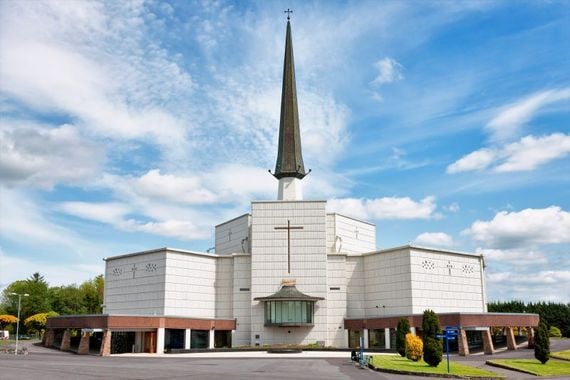
Knock Shrine Basilica. (Getty Images)
The Knock Shrine is internationally renowned as a place of prayer and pilgrimage after 15 locals claimed to see religious apparitions in the 19th century.
On August 21, 1879, Mary McLoughlin, housekeeper to the parish priest of Knock, and her friend Mary Byrne were astonished to see the outside south wall of the church bathed in a mysterious light, with three figures standing in front of the wall. The figures were said to float a few feet above the crowd, and Byrne quickly gathered the other 13 witnesses who were to attest to the miracle.
Although the claim was quickly condemned as a cruel joke by local Protestant policemen, pilgrimages to Knock began as early as 1880, and visitors began to report miracles and healings taking place during their stay there.
Since then, Knock has been transformed into a compound of prayer spanning 100 acres and containing five churches.
The tradition of visiting Knock continues today, despite Ireland's increasing secularism. Visitors can take advantage of guided tours that will bring them through the beautifully landscaped grounds, as well as places of interest such as the Apparition Chapel and original Gable Wall, Papal Cross, Basilica, and Chapel of Reconciliation, passing on a greater understanding of the apparition.
The Shrine also contains a museum that captures the unique story of Knock by setting the scene of life in Ireland in the 1870s and retelling the stories of the witnesses through their own handwritten letters.
More information: KnockShrine.ie
The Céide Fields
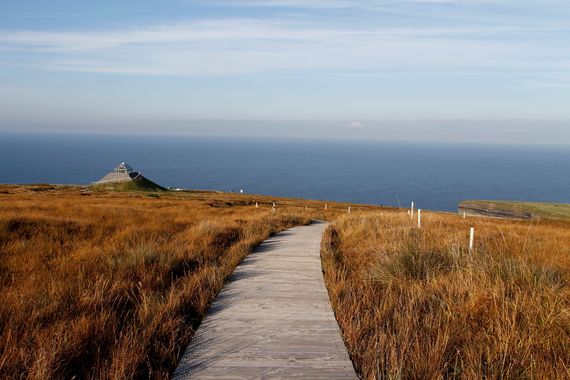
The Céide Fields.
There are few places in Ireland where the feeling of being surrounded by the truly ancient is more profound than at the Céide Fields in Belderrig, Co Mayo, home of the oldest known field system in the world.
Located along dramatic 360-foot high cliffs and looking straight out onto the Atlantic Ocean, the Céide Fields (or Achaidh Chéide, meaning “flat-topped hill fields”) is a remarkable Neolithic site first discovered in the 1930s.
It was while he was cutting turf that the local schoolmaster Patrick Caulfield first started coming across large numbers of stones deep down in the bog. In later years, Caulfield's archaeologist son Seamus returned to the site of the stones to investigate further. He discovered cultivated fields, houses, and tombs using iron probes normally employed for finding ancient trees under areas of deep bog.
The farmland is believed to date from around almost 6,000 years ago, the oldest of its kind in the world, and has greatly helped research of the Neolithic period circa 3,500 BC.
Since its discovery, an award-winning interpretive visitor center has been built near the site, featuring a 4,000-year-old ancient tree unearthed from the nearby bogland in the entrance hall. The building itself has been heralded as a fantastic piece of architecture, totally in keeping with its rural environs.
More information: CeideFields.com

Comments