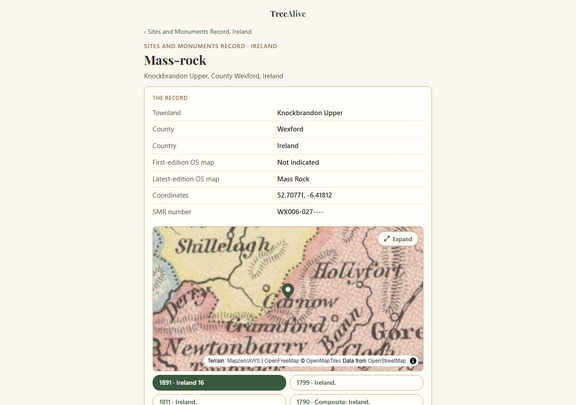
Irish diaspora who know the name of the townland their family left, but not much else about it, have a new free place to start looking. A genealogy site called TreeAlive has built a page for each of the 151,307 records in the Sites and Monuments Record, the national inventory of Ireland's archaeological sites, and placed each one on whatever historical map sheets still cover the ground.
The site's founder, Sam Morrison, said the idea began with a problem familiar to anyone who has tried to picture an ancestral place from a modern map. "This started as a frustration about maps," he said. "A family lives in one place for two generations, and the map you can pull up today shows a road and a housing estate."
The National Monuments Service publishes the register as open data, and every page on the site carries the Service's own text unchanged, credits it under its CC BY license, and links back to the original record. Of Morrison's copy, taken on September 13, some 140,428 records have a location attached, and those pages show the spot on each map sheet that covers it, every sheet named and dated. The oldest are general maps of Ireland from the 1750s and 1790s, including the 1753 "Mappa geographica Regni Hiberniae," with later sheets coming in closer.
"Irish research comes down to the townland, and the Sites and Monuments Record is the national inventory of what stands, or stood, in each one," Morrison said.
What the register holds is far more everyday than the word monument suggests. "Most of it is ordinary life," Morrison said. His copy contains around 26,000 ringforts of the rath type, the farmsteads of early medieval Ireland, and 6,637 fulachtaí fia, the Bronze Age burnt mounds usually read as cooking places. There are 4,853 souterrains, 1,249 crannogs and 998 bullaun stones.
Read more
Some of it is heavier going. The register lists 1,486 children's burial grounds, the cillíní where unbaptized infants were buried outside consecrated ground into the 20th century, along with 305 mass rocks, 44 Penal Mass stations, 258 sweathouses and 114 sheela-na-gigs, across 470 classes of record in all.
There are two ways in, and neither requires an account. Anyone with a family tree file can upload it, and the site places every ancestor on a map from their own years, then lists the register records within ten miles of each Irish place, nearest first, with the distance from where those people were born or married. Morrison is careful about what that does and does not prove.
"I don't tell anyone their ancestor stood at a monument," he said. "It's just what was recorded near the places they actually lived."
Anyone with only a townland name can skip the upload, open a county, choose a class of record and read the entries listed by townland. "I'm building a townland search box now so that path can start from the name itself," Morrison said.
The Irish pages are free to read at treealive.com/heritage/ie. Wales and Northern Ireland followed Ireland onto the site, and the American layer draws on historical marker texts from 24 state programs and National Register listings for all 50 states and the District of Columbia.


Comments