More than 400 tourists, including 33 Britons, were among thousands caught in the monster flash flood that swept away whole villages.
A deadly 30ft wall of rock, mud and freezing water wiped out everything in its path, throwing up clouds of debris.
Witnesses thought that they were seeing explosions caused by a military invasion. Hundreds are feared dead in the catastrophe which left the Rasuwa valley, 130 kilometres north of Nepal’s capital Kathmandu, engulfed in mud with only the tips of homes and vehicles visible in some areas.
A tour operator confirmed that the two Irish were among its customers who were unaccounted for. Ram Kumar Adhikari, the manager of Alpine Eco Trek, which offers guided tours, said the pair, as well as 12 UK citizens aged between 13 and 65, and four South African nationals, were missing.
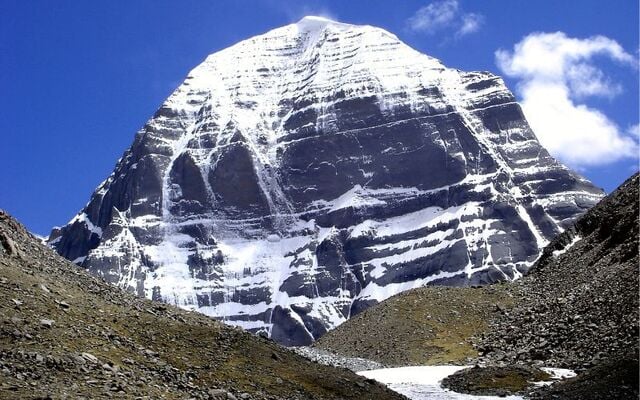
He said the group were last heard from at the Gyirong border crossing at 8.40am Nepal time but, just 15 minutes later, a wave of mud and rubble swept down the Lhende river and engulfed the border crossing. The fate of the 17 tourists who were on a nine-day trek to Mount Kailash in Tibet – a sacred site for Hindus and Buddhists – is unknown.
Kerry based explorer and mountaineer Pat Falvey has described the devastating floods on the Nepal-Tibet border as 'apocalyptic'https://t.co/5zUseoNbn8
— RTÉ News (@rtenews) August 27, 2026
Mr Adhikari said: "The group leader and guide were in constant contact and told us that the team had reached the Chinese immigration office at 7am. Our group leader and guide remained online until 8.40am, so we assumed they had crossed immigration. There is no internet access on the Chinese side, so we had no reason to be immediately concerned. Then we received news of the massive flood.
"You can see [in the video] people running in the footage, and some of them could be members of our group. I feel so sad. We are just thinking about what to do next. We are in pain at the moment, deep pain."
Four of his Nepalese tour guides, aged 38, 35, 45 and 29, are among the missing. A rescuer interviewed by China’s state broadcaster said they had been trying to establish contact with the Gyirong border crossing but "so far there haven’t been any results".
Read more
Experts believe a 4.4-magnitude quake triggered an ice avalanche, which in turn blocked the Lhende River, water then built up behind the blockage before bursting downstream, with devastating consequences. The unstoppable torrent of water, mud and rocks laid waste to the valley, flattening homes and picking up an entire bridge spanning the Trishuli River.
Whole villages were washed away, said stunned Nepalese officials.
The full scale of the horror will not be known for days. Sunil Sharma, a tourism board spokesman, said 133 of the missing tourists were from India. Also missing were 47 from the United States, 34 from Australia, 33 from Britain and 24 from Canada, he said.
At least 62 missing Nepali citizens were among hundreds of locals trekking in the Gosaikunda lake in Rasuwa, coinciding with the local festival of Janai Purnima on Friday, Sharma added. Nepal police spokesman Abi Narayan Kafle told the Associated Press that at least 28 police officials were missing.
Terrified families were seen scrambling up the region’s mountainous terrain to flee the onslaught of mud. In one harrowing video, filmed on a school bus, children screamed as their driver tried to get them away.
Kalpana Malla told the BBC: "My family members were swept away by the flood in front of my eyes. My father, my mother, my sister and her kids were swept away. There was no chance at all."
Suman Chalise, a 34-year-old teacher, said: "I witnessed the flood sweep away eight or nine trucks, along with houses and people. It was absolutely heart-wrenching."
In hard-hit Nuwakot district, upper floors of buildings, slathered in mud, were all that could be seen after the torrent surged by. Debris hung from tree branches and wires, vehicles were buried and stunned survivors were left caked in mud.
Shreedhar Neupane, a local journalist, told the Daily Mail: "It was sheer panic. I saw thick, muddy slush flowing in a river where clean water once ran. I saw people swept away. I saw houses collapse and wash away. I saw strong bridges carried off by the water. I saw a river that usually flows down in the valley overflow its banks and rise right into human settlements.
"Until yesterday, people drank from this river to live. Today, I saw the painful reality of the river swallowing those very people."
Raju Bhadel, 56, said: "I got a call from my brother-in-law. They were crying and said their entire house had been swept away."
Keshav Prasad Baral, 68, said: "My wife is still somewhere beneath the mud. She’s gone."
"There is devastation everywhere we look," said Tula Bahadur in Rasuwa.
"Settlements next to the river have been completely swept away. Five of my relatives are missing."
Read more
Officials said at least 157 people were dead – a toll that is certain to soar. Nepal’s prime minister Balendra Shah vowed "all the means and resources" of the nation would be used to help victims. Nepali officials said 341 foreign nationals were unaccounted for.
Last night, rescuers were fighting to reach the devastation but were hampered by near-impossible conditions. One told Chinese media it would take hours to reach stricken areas because of the five-foot-deep sediment blocking roads.
The Nepal Army dispatched 14 helicopters and disaster response teams, but the waters made it difficult for them to land close to the worst-hit areas.
In Tibet, on the Chinese side of the border, military commander Chen Xi said "various loaders and excavators are being used to clear a path" but he warned: "The mountain slopes around us could collapse at any time because the road runs along steep cliffs and there may also be a risk of another mudslide."
The Kathmandu-based International Center for Integrated Mountain Development said the "exceptional speed and magnitude of the flood wave" meant that in just moments the level of the Trishuli River rose by an incredible nine meters.
Read more
Experts said the ‘snout’ of an entire glacier in the snow-capped Himalayas appears to have been dislodged, sending iceberg-sized chunks cascading down the hills to block the Lhende river, a tributary of the Trishuli.
Millions of tonnes of water then built up behind the blockage – until bursting downstream with devastating consequences. Before -and-after satellite imagery shows lush green mountainsides now buried under brown debris and sediment.
Last night, there were fears that a second flood might send Nepal, Tibet, and neighboring India into further chaos. Flood alerts were issued in the populous northern Indian states of Uttar Pradesh and Bihar, which border Nepal.
The Department of Foreign Affairs here said it was "closely monitoring the situation" in Nepal.
Minister Helen McEntee said her department "stands ready to provide consular assistance to any Irish citizens affected". She said Irish citizens requiring assistance can contact the Embassy of Ireland in India at +9111 4940 3200.
View this post on Instagram
Additional reporting by Sam Greenhill, Ryan Hooper, Vivek Chaudary and Perkin Amalaraj.
* This article was originally published on Extra.ie.




Comments