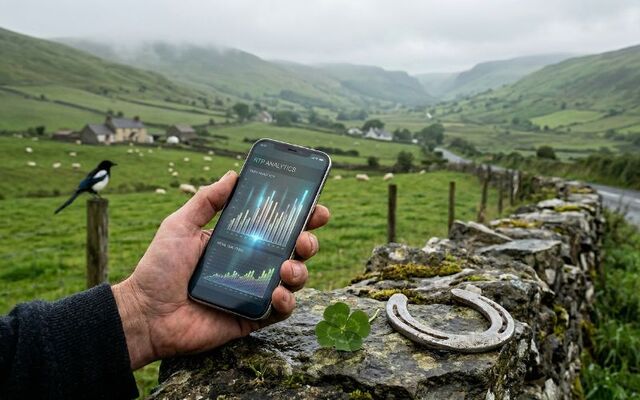
It suggests a world where fortune favours the bold, where a four-leaf clover might actually turn the tide of a bad day, and where the inexplicable magic of the universe holds more sway than a spreadsheet. We have long been a people who salute magpies and avoid walking under ladders, maintaining a healthy respect for the unseen forces that supposedly govern our fate.
However, modern Ireland tells a different story. The misty hills of folklore are now crisscrossed by fibre-optic cables, and the Silicon Docks in Dublin stand as a testament to a new kind of faith: a belief in data. As we increasingly rely on algorithms, analytics, and hard statistics to navigate our lives, one has to wonder if we are losing the very thing that made our culture so unique. In a world demanding certainty and calculated outcomes, is there still room for the romance of chance?
Historically, Irish life was deeply intertwined with the supernatural. This was a complex system of "piseogs" –superstitions and rituals designed to manage risk in an unpredictable world. Farmers wouldn't dare disturb a fairy fort for fear of bad crops, and fishermen had strict taboos about what could be mentioned at sea. These were a way of imposing order on chaos, a cultural framework that acknowledged that some things were simply out of human hands.
The transformation of Ireland from an agrarian society to a technological powerhouse has fundamentally altered how we make decisions. The modern Irish mindset is increasingly analytical. We don't trust our gut feeling on a mortgage; we consult comparison websites and interest rate forecasts. This shift toward evidence-based decision-making has undoubtedly made us more efficient, but it has also stripped away some of the whimsy that defined our national character.
This thirst for certainty extends beyond business and into our social consciousness. We are constantly quantifying our existence, from the steps we walk to the hours we sleep. The ambiguity that once allowed myths to flourish is being illuminated by the cold light of data.
Nowhere is this shift more evident than in how we approach our leisure time. In the past, having a "flutter" was an act of pure hope – a romantic engagement with fate where you paid your money and took your chances. Today, entertainment is dominated by probability and strategy. Modern enthusiasts are far less likely to rely on a lucky charm or a hunch; instead, they study form, analyze trends, and look for statistical edges.
This evolution is particularly visible in the gaming sector, where the blind optimism of the past has been replaced by calculated assessment. Players today want to know the mathematics behind the game. For example, those exploring options in the digital space often review CasinoBeats's expert analysis of high RTP games to make informed choices rather than relying on the 'luck of the Irish.'
This analytical approach mirrors broader trends in how we view national issues. Even in the realm of politics, the conversation has moved from emotional rhetoric to hard numbers. Recent reports indicate that trends show rise in support for Irish unity among Northern voters, a conclusion drawn from demographic data and polling analytics, not nationalism. We are becoming a people who trust the graph more than the speech.
The question remains: can we have both? Can we be a nation of data scientists who still salute the lone magpie? It is possible that our obsession with data is simply the modern evolution of our old coping mechanisms – a new way to try and control the uncontrollable. Yet, there is a risk that in explaining everything, we enjoy nothing.
There is evidence that the old ways haven't entirely vanished. Despite our modern exterior, surveys from the last decade noted that supernatural, superstition, and other news sources found roughly 52% of adults in the region still held superstitious beliefs, such as avoiding ladders. This suggests that beneath the veneer of logic, the old pulse still beats.
As we move forward, the challenge for Ireland is to use data as a tool without letting it become a cage. We can appreciate the efficiency of the algorithm while still leaving the door ajar for the unexpected. After all, reflecting on Ireland in 2024: Assessing the state of the nation reminds us that while statistics can describe who we are, they cannot fully capture the spirit of the place. We must ensure that in our rush to measure the world, we don't lose the magic that makes living in it worthwhile.