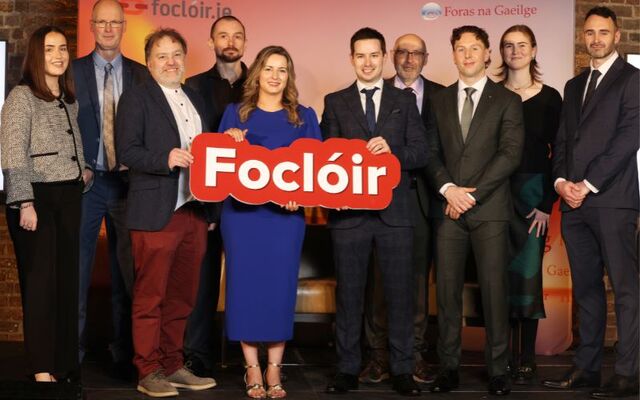
A groundbreaking new monolingual Irish dictionary by Foras na Gaeilge, the body responsible for the promotion of the Irish language throughout the island of Ireland, was launched this week by President of Ireland Catherine Connolly.
An Foclóir Nua Gaeilge, "The New Irish Dictionary," is the first comprehensive monolingual “Irish-Irish” dictionary. It provides people with a new way to understand, use, and learn the Irish language - without relying on dictionaries in English or in other languages.
Until its publication, anyone trying to understand an unfamiliar Irish word or phrase typically had to look it up in an Irish–English dictionary and understand it through the lens of English.
An Foclóir Nua Gaeilge is now available to access free of charge online at Focloir.ie.
Commenting on the new Irish dictionary, President Connolly said: “A contemporary monolingual dictionary is an essential resource in any living language, in which the language itself and its uniqueness are defined in its own words and by its own community, instead of constantly being defined through the medium of another language.
"This new dictionary places the Irish language and Irish speakers on an equal footing with other modern languages and communities. Irish-language dictionary resources are now a model of best practice for other minoritised languages around the world.”
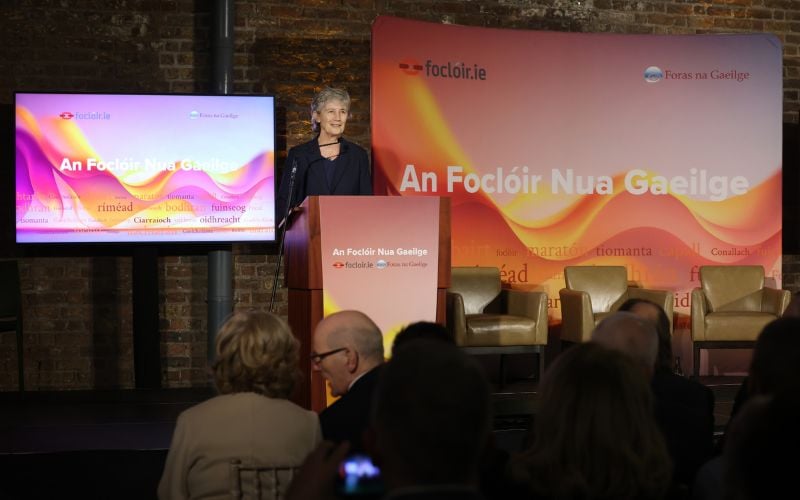

December 9, 2025: President of Ireland Catherine Connolly at the launch of An Foclóir Nua Gaeilge, the New Irish Dictionary.
Seán Ó Coinn, CEO of Foras na Gaeilge, said: “For generations, Irish speakers who encountered unfamiliar Irish words were forced to translate them into English and then search for definitions in English dictionaries. This tedious process not only created unnecessary barriers to learning but also shaped how Irish speakers understood the world – through the lens of English.
“The new monolingual Irish dictionary changes this paradigm. Instead of asking 'What’s the English for X?,' speakers will now be empowered to ask 'What does X mean?' in their own language.
"This shift has the potential to transform the teaching and learning of Irish at all levels — from young children discovering new vocabulary for the first time, to advanced speakers seeking deeper linguistic insight.”
The An Foclóir Nua Gaeilge project is principally funded by Ireland's Department of Rural and Community Development and the Gaeltacht in Dublin, and the Department for Communities in Belfast, with additional support from the Department of Education in Dublin.
Work on compiling An Foclóir Nua Gaeilge began in September 2022, with Foras na Gaeilge chief dictionary editor Pádraig Ó Mianáin and dictionary programme manager Cormac Breathnach leading the project.
An initial tranche of 20,000 entries, comprising 40,000 word senses, is now live on Focloir.ie. The main phase of the dictionary project is scheduled to be completed by August 2027, by which time it will comprise 30,000 entries and 80,000 senses.
Pádraig Ó Mianáin, chief dictionary editor of An Foclóir Nua Gaeilge, said: “The publication of this monolingual Irish dictionary is a significant step in the ongoing development of dictionary resources in Foras na Gaeilge.
"We have observed increasing demand for a monolingual dictionary from our users worldwide, and we are delighted to finally take the first step in meeting this need.
"We look forward to adding to and developing the dictionary over the remaining two years of the project.”
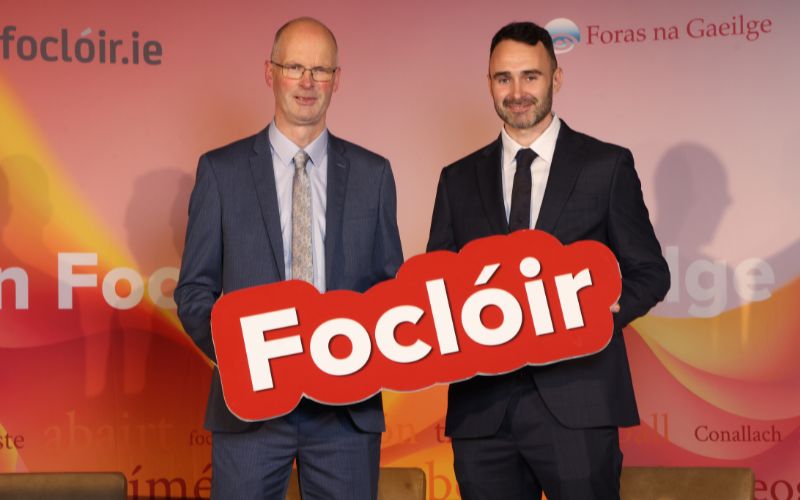
December 9, 2025: Pádraig Ó Mianáin and Cormac Breathnach at the launch of An Foclóir Nua Gaeilge, The New Irish Dictionary.
Unique features of An Foclóir Nua Gaeilge
Foras na Gaeilge has highlighted several features of the monolingual Irish dictionary that make it the first of its kind:
It reflects Irish as a living language by including real-world, everyday, contemporary usage, aiming to reaffirm current good practice in the standard language as well as recognising common dialectal forms.
It includes definitions of foreign words that are in common use in the Irish language, such as ad hoc, al fresco, baguette, cappuccino, and aide-de-camp.
Many phrases, idioms, and proverbs have dedicated entries and definitions.
It not only meets the needs of advanced Irish speakers but also gives helpful grammar and pronunciation guidance for those less sure about how to use and pronounce words and phrases.
The dictionary aims to provide guidance where needed as to the intricacies of Irish grammar, more than would ordinarily have been provided in previous dictionaries. This is done through various means, such as usage notes, grammar information within entries, or widespread use of examples that illustrate different points of grammar.


Comments