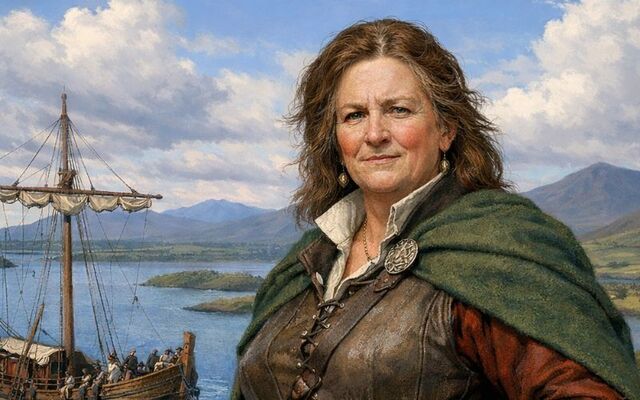
This third installment in a five-part series by writer, producer, and actor Keelin McCool, who is currently in development with the period drama feature "Mama Pirate," traces the world that forged Gráinne Ní Mháille into one of Ireland’s most formidable figures. From marriage and kinship to sea power and political instinct, it shows how she transformed inheritance into authority and built a legacy that still commands attention centuries later.
Despite the evidence in English state papers and in her castles that still stand, some still think Gráinne was more legend than fact. Was it because she operated in a century when women had little autonomy? Or was it because her feats and courage were so extraordinary that they defy belief--or could it be that in this century, we are still struggling to give women their due? She was a rare bird, even by the standards of a violent age, so maybe the more useful question is not whether she existed, but how she built her power in the first place.
She was, it’s true, born into privilege--her father was head of the Ó Máille clan, one of the dominant maritime families on the west coast of Ireland at the time, so she would have grown up watching how her clan’s livelihood worked: by trading, toll-taking, control of the waters around her home. But growing up around power is not quite the same as turning it into a lifetime of authority.
Readers today may want to reduce a woman pirate to a novelty in a man’s world. But to ignore her would be to dismiss a legacy that she built through calculated grit. It came out of her decisions about alliances and property; who would fight for you; whether people believed you could protect their interests, and how to go about expanding them. Those skills, and her ability to exploit her circumstances, are what really define her.
Shaving her head as a youngster and stealing away on her dad’s ship, if the famous story is to be believed, might be the first sign of a leader with courage. Spending her teen years with her father, learning the ropes and the ways of negotiation: when to threaten, and when to retreat—helped shape what she was to become. She also learned how to read the stars, the wind, and the hidden channels of Clew Bay--which meant that anyone trying to take that livelihood away from her was in for a daunting challenge.
Her first marriage to the pugnacious Dónal an Chogaidh Ó Flaithbheartaigh, an arranged union she was pressed into, nonetheless united the O’Malleys with another formidable family. In Gaelic Ireland, elite marriage was not just domestic—it was political and economic. Daughters of leading families brought dowry, standing, and connections, and marriage could extend influence into new territory as well as bind powerful houses together. Gaelic women could hold certain forms of property on their own, so marriage was not just about being absorbed into a husband’s household. It could also act as leverage through the female line.
It was not a marriage of domestic bliss—her newly adopted family had a combative reputation: “Oh! God! Deliver us of the ferocious O’Flahertys!” is recorded to have been inscribed on the gate leading into the city of Galway. Donal, who was on course to be O’Flaherty chieftain, yet died by the sword in one of his frequent skirmishes, became an event that compelled Grainne to lay down her knitting and return to the sea and to the center of affairs to secure the clan’s
livelihood. What is striking is that she faced little resistance from the rest of the O’Flahertys, who seem to have decided that resisting her was not worth the cost and accepted her leadership.
This may very well have been the period when Gráinne began to consolidate power in her own right, without the liability of a combative husband. She moved from the O’Flaherty stronghold in Galway to her own turf and quickly became a thorn in the side of the English, who were not ready to confront someone with such a deep knowledge of the waters around Ireland and the resolve to defend it.
Her next marriage also appears to have been strategic--she saw Richard Bourke’s castle as conveniently situated to her needs. Although technically the marriage only lasted a year--after which she reportedly ousted him from his own abode as Brehon Law gave her the right to do--they continued to work as partners. They had a son and worked together in battle and matters of diplomacy, leading Lord Sidney, the designated “Lord Deputy” of Ireland, to refer to her as a most famous feminine sea captain, "...for she was as well by sea and by land well more than Mrs. Mate with him".
Still, alliances and marriages don't build a legacy as remarkable as this. She had up to 200 men follow her for decades--proof of the durability of her command. She instilled loyalty. She could protect territory. She could extract revenue from strangers that dared trespass in her waters. She made herself useful to allies--and difficult for enemies. In English records, she was “the nurse to all rebellions in the province for forty years” and “a most notorious woman in all the coasts of Ireland.” They may not be compliments, but they are acknowledgments of her fierce influence.
Grainne’s nerve and steadiness was her political capital. She used marriage, kin, property, her own leadership and practical sense to make herself difficult to ignore. She understood the rules well enough that when the English were pushing aggressively into Ireland, she was not about to stand down. The legend may have come later—but she was also without equal in her own time.
Read more
* Keelin is a writer/producer/actor. As co-producer of the gender equality in Hollywood documentary, "This Changes Everything", she enlisted Meryl Streep, Shonda Rhimes, Cate Blanchett, and others to participate. She is currently in development with the feature "Mama Pirate". For more, stay up-to-date on the project on Instagram @MamaPirateFilm.


Comments