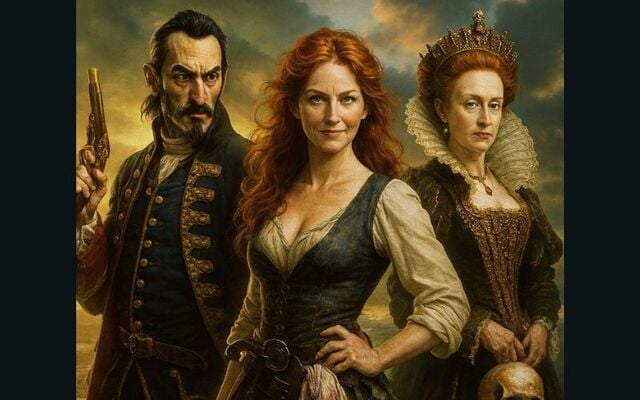
In the first installment of this five-part series, writer, producer and actor Keelin McCool, currently in development with the period drama feature "Mama Pirate", traces the world that forged Gráinne Ní Mháille into one of Ireland’s most formidable figures. From the shifting waters of Clew Bay to the clash between Gaelic independence and English rule, her story reveals how a woman became powerful enough to challenge a crown built to overlook her.
In the 16th century, an era when women held little formal power over land, law, or political life, Gráinne Ní Mháille commanded a fleet of ships along the jagged western coast of Ireland. She navigated the treacherous maze of Clew Bay without charts or modern instruments, guided only by the tide and her experience.
Had she been a man, her story would have been on every screen and bookshelf long ago. However, the history books weren't written for people like her. The world she came from was shaped by a fierce maritime independence - a spirit not unfamiliar in Ireland, and one I recognized in my own family’s involvement in the fight for independence in the early 1900s. It became the foundation I returned to while developing "Mama Pirate", the feature based on her life.
Clew Bay, in County Mayo, is dotted with a collection of small islands and channels, whose depth is twice a day, every day, due to the Atlantic tide. To those unfamiliar with the deep-water runs, it can trap and disorient. From these waters, the O’Malley family did more than survive. Her father, Eoghan, operated routes along which he transported wine, iron, animal hides, and more between Ireland, Scotland, France, and Spain.
The clan levied "sea-tolls" on any vessel passing through their territory, their swift galleys maneuvering with ease as they relieved trespassers of their cargo. Control of passage meant control of the profit - a system Gráinne mastered as a child, long before it was contested by the English Crown.
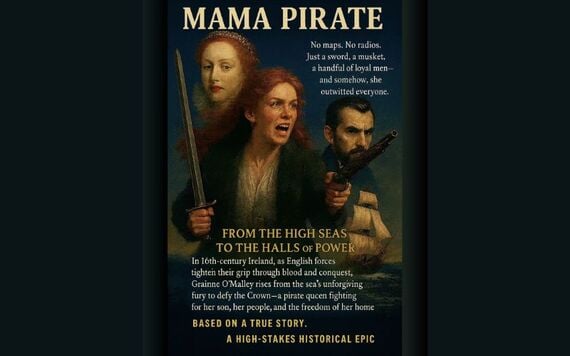

The poster for "Mama Pirate".
Power in Ireland in the 1500s still resided with the Gaelic clans. Under the ancient Brehon laws, land was held by the community, not by any one individual. A sophisticated legal system settled disputes through negotiation and restitution, maintaining social balance. Through the system of tanistry, a successor was elected from within the ruling family based on their ability to lead and protect the clan, rather than simply by birthright.
A woman's legal standing in Ireland at this time would never have existed in Tudor England. They could initiate divorce, keep their dowries, and sign contracts under their own names. They could keep their own property, even in marriage. Authority was worked out together in fields and tower houses, not administered by a bureaucratic machine across the sea.
Read more
In England, property was administered differently: through primogeniture, whereby estates were inherited by law by the eldest male heir, which kept them intact and powerful. A widow’s claim could be limited to a "dower third," which could be a fraction of the estate, and which she would lose altogether, in most cases, if she remarried. Her status in life depended solely on terms set by the males in the family, which often left her and her children destitute.
As the Tudor state increased its presence in Ireland, these two incompatible systems collided. Under Henry VIII’s policy of "surrender and regrant," Gaelic chieftains were pushed to cede their ancestral lands to the Crown, then receive them back under English titles, such as “Earl” or “Baron”. While it seemed on the surface to assert their authority, it was in fact a legal Trojan Horse; it stripped communal clan rights and turned the land into property granted by the King--revocable and legally bound to a state office in London.
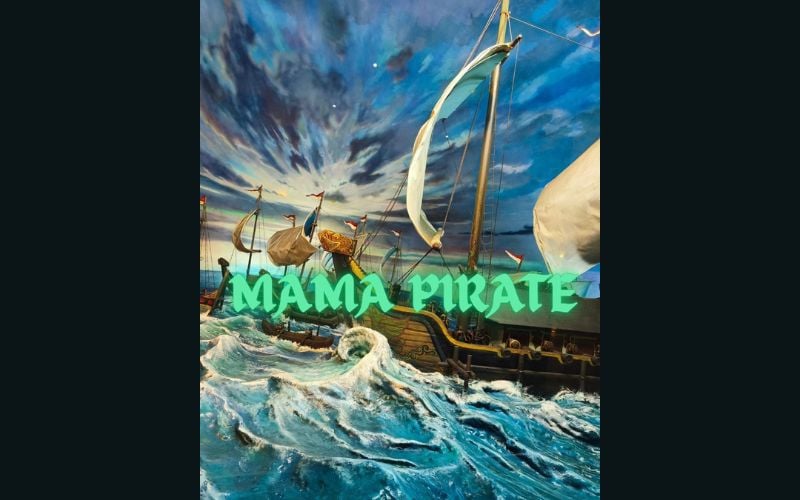
"Mama Pirate".
In practice, the shift was an agonizing creep of theft and accounting. Land that had been defined by song and language for centuries was now being measured and recorded by surveyors. Property lines were drawn where there had never been any. Boundaries broke up grazing pastures that had always been shared. A terrain that had reflected memory and kinship was now a series of entries in a ledger, enforced by the Lord Deputy’s soldiers.
By the late 1500s, this process fell into the hands of the "New English": private enterprise, military officials, and "joint-stock" syndicates seeking to plunder and profit. These opportunists, or "adventurers," regarded Ireland as a resource to be harvested for timber, cattle, and land. Figures like the pugnacious Sir Richard Bingham, the Governor of Connacht, represented and enforced this new power, replacing Henry’s earlier strategy of persuasion with a colonizing engine that prioritized profit.
Read more
This shift was accompanied by increasing violence as authority moved across the sea. The justifications manufactured in the 1500s - that the Irish were "turbulent" or "uncivilized" for not following English law - formed the long-term basis for subjugation. The logic proved very durable: two centuries later, Charles Edward Trevelyan, the official overseeing famine relief, could still rely on these long-held prejudices. He described the Irish as having a "selfish, perverse and turbulent character," and cast the starvation of millions as "the direct stroke of an all-wise and all-merciful Providence."
Yet in her own time, Gráinne Ní Mháille was not the type to yield to aggression. Shaped by her family’s maritime legacy, she became a thorn in the English Crown - and emerged as a defiant figure important enough to be recorded in the English state papers - not merely as an exception, but as a figure so far outside the expectations of her era, that history has struggled to define her.
Next: the maritime world she mastered - its vessels, its routes, and the coastal knowledge that made power possible.
* Keelin is a writer/producer/actor. As co-producer of the gender equality in Hollywood documentary, "This Changes Everything", she enlisted Meryl Streep, Shonda Rhimes, Cate Blanchett, and others to participate. She is currently in development with the feature "Mama Pirate". For more, stay up-to-date on the project on Instagram @MamaPirateFilm.


Comments