For much of the 20th century, Irish identity in Britain was negotiated carefully.
It was not erased. It was managed.
The signs saying “No Irish, No Blacks, No Dogs” are now museum pieces. What lasted longer was the instinct for discretion. Accents softened. Jerseys worn selectively. Culture preserved in kitchens, parish halls, and the back rooms of pubs.
It was not shame. It was survival.
The children and grandchildren of that generation, alongside first-generation Irish, are building differently.
Across Britain, Irish cultural organisations are being founded or revived in places that were never traditional diaspora strongholds. Not just Kilburn or Cricklewood, but commuter towns and suburban cities where Irishness once lived quietly inside family homes.
Chelmsford, in Essex, is one of them.
A year ago, Chelmsford Irish did not exist.
Today, it is a structured cultural organisation serving the Irish diaspora in Essex and East London. It has no paid staff, no permanent venue, and no institutional backing. It was built entirely by volunteers, through a founding committee known as ChI-Co.
Ní neart go cur le chéile.
Chi-Co members right to left: Marie Bird, Bríd O'Donohue, Elaine Finn Davies, Kerry Fabri & Paula Purssord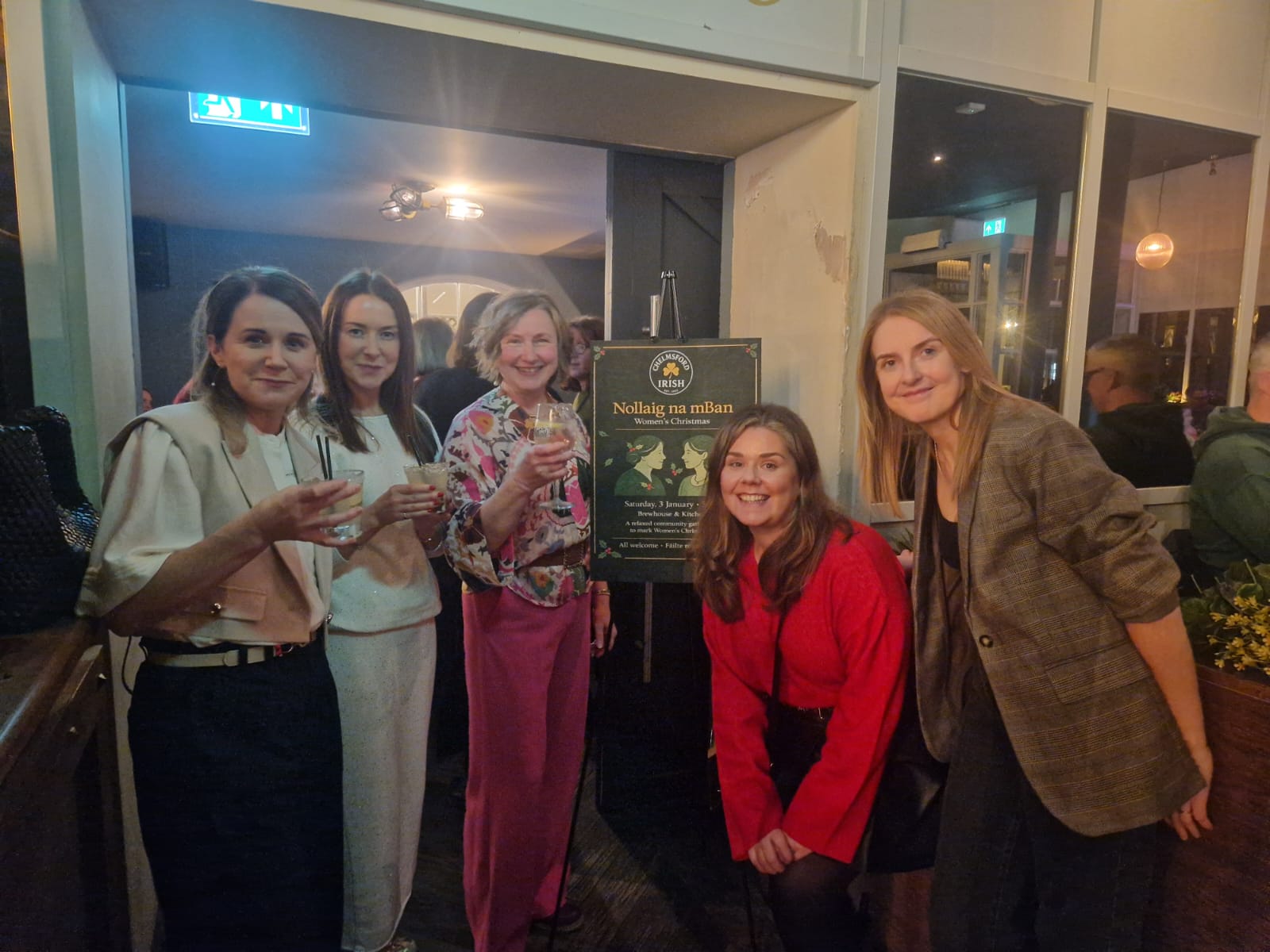

 21
21
21
21
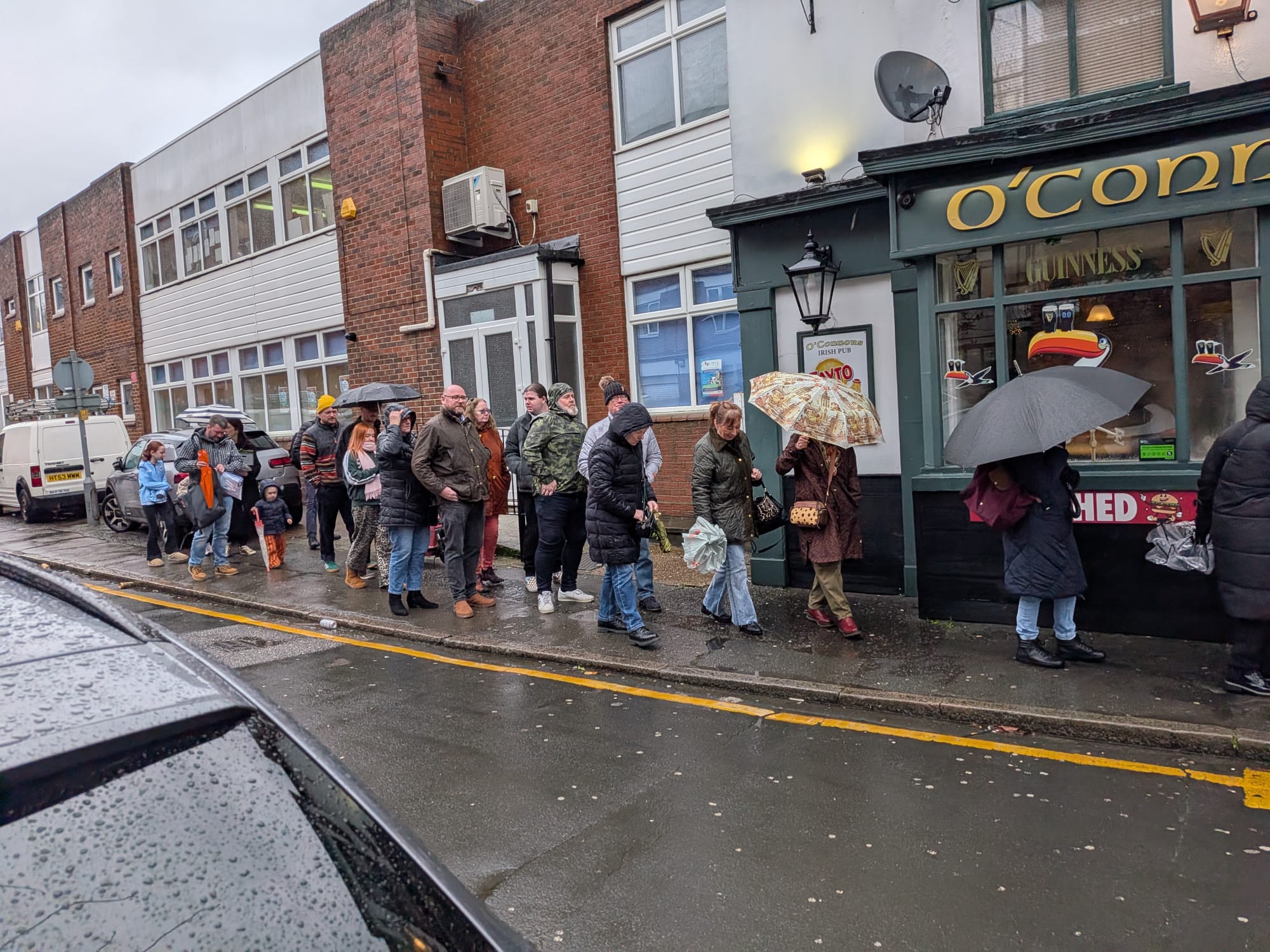
The people who built it
ChI-Co is chaired by Dr. James Hoctor. Its Secretary is Elaine Finn Davies. Its Treasurer and Irish Language Rep is Doiminic Bell. Its Events Officer is Marie Bird. Its Culture Officer is Kerry Fabri. Its Music Rep is Bríd O’Donohue. Its Sports Rep is Darren Mulcahy.
Seven people. No budget. No office. No precedent in this city.
The organisation’s Honorary President is Hughie Breen, born in Ayrshire to Irish immigrants and a fixture of Essex Irish life for more than 40 years. His presence connects what Chelmsford Irish is building to a longer, quieter history of Irish life in this part of England — the generation that came first, kept the culture alive, and made everything that followed possible.
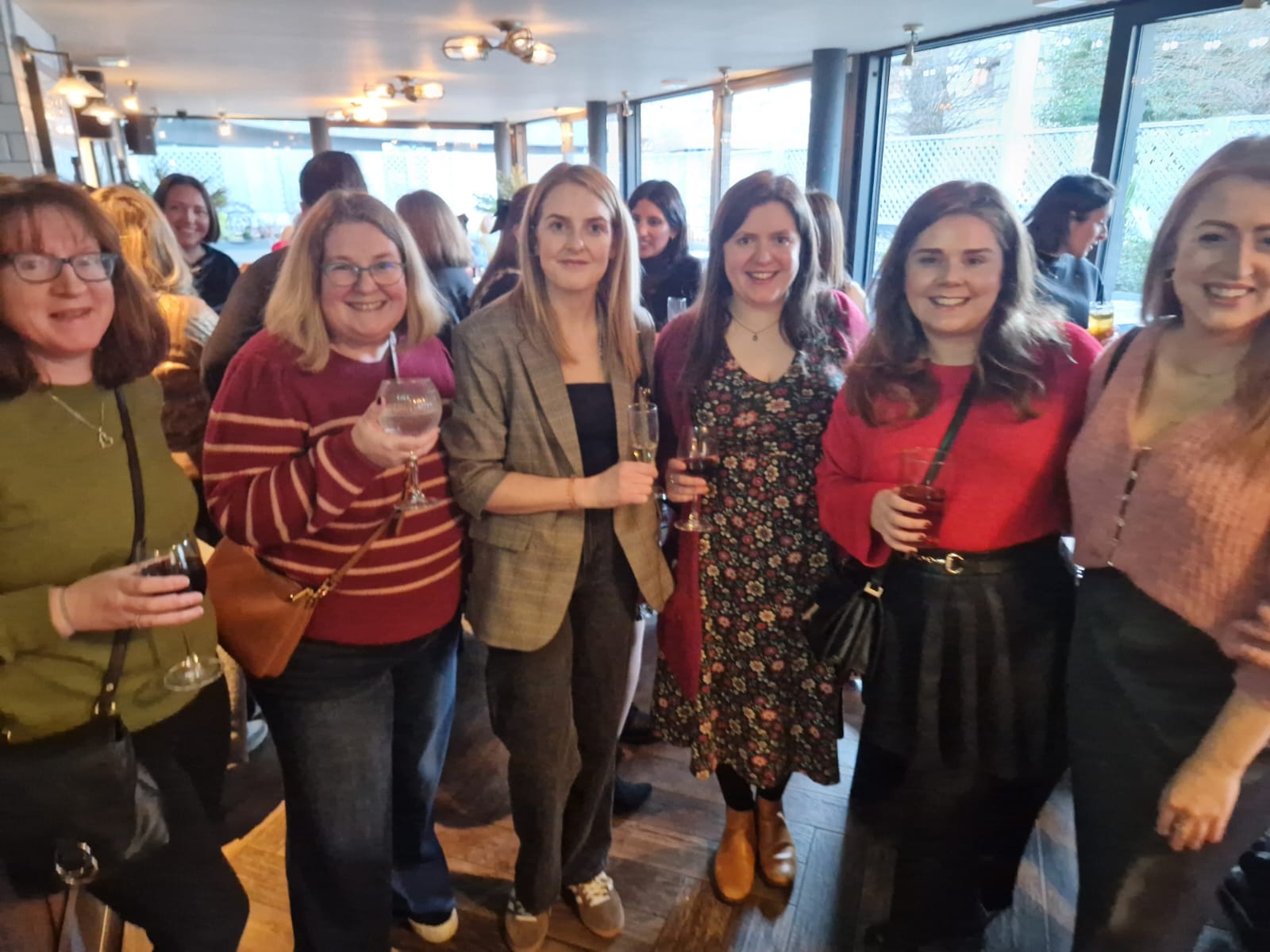
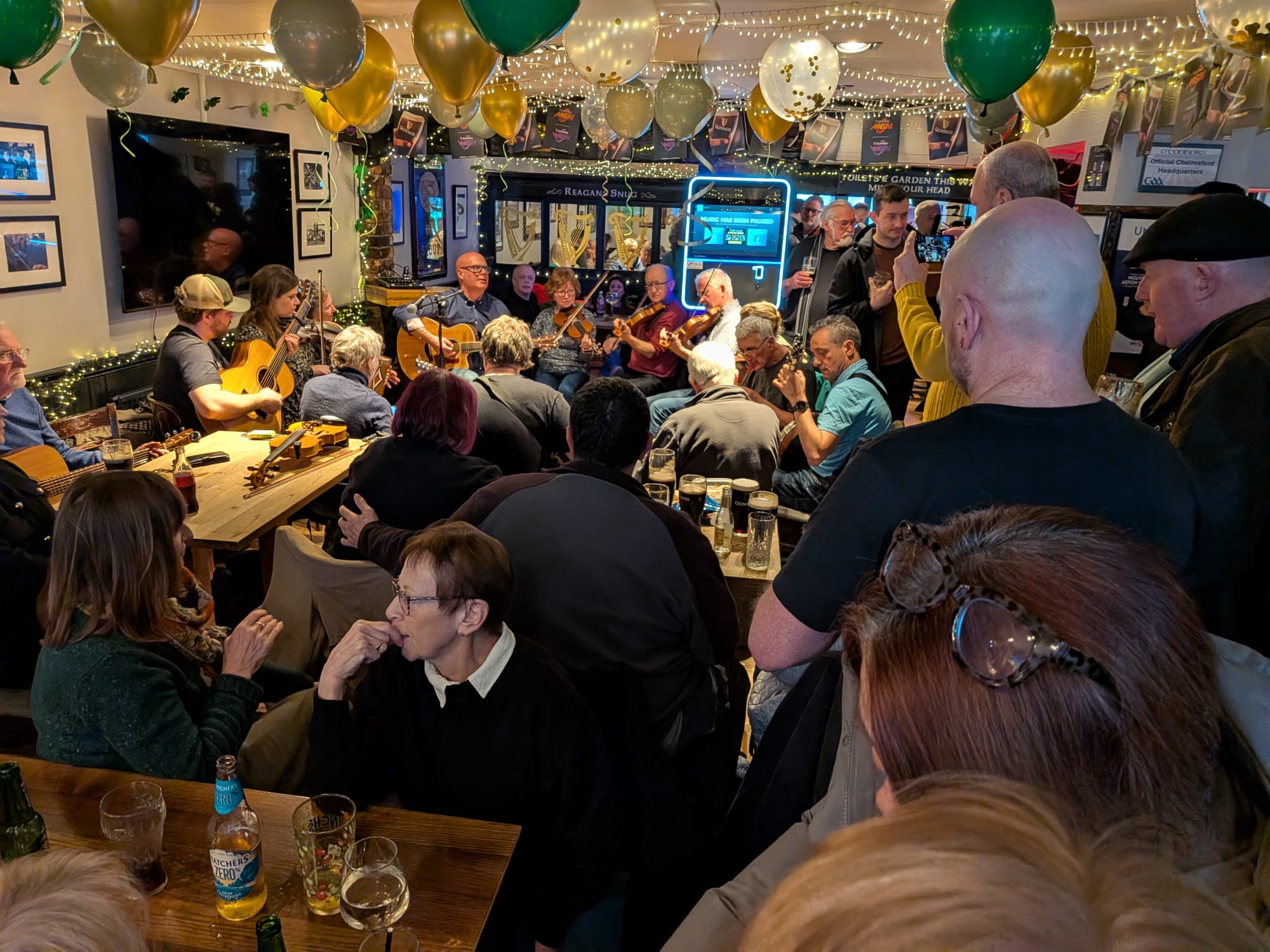
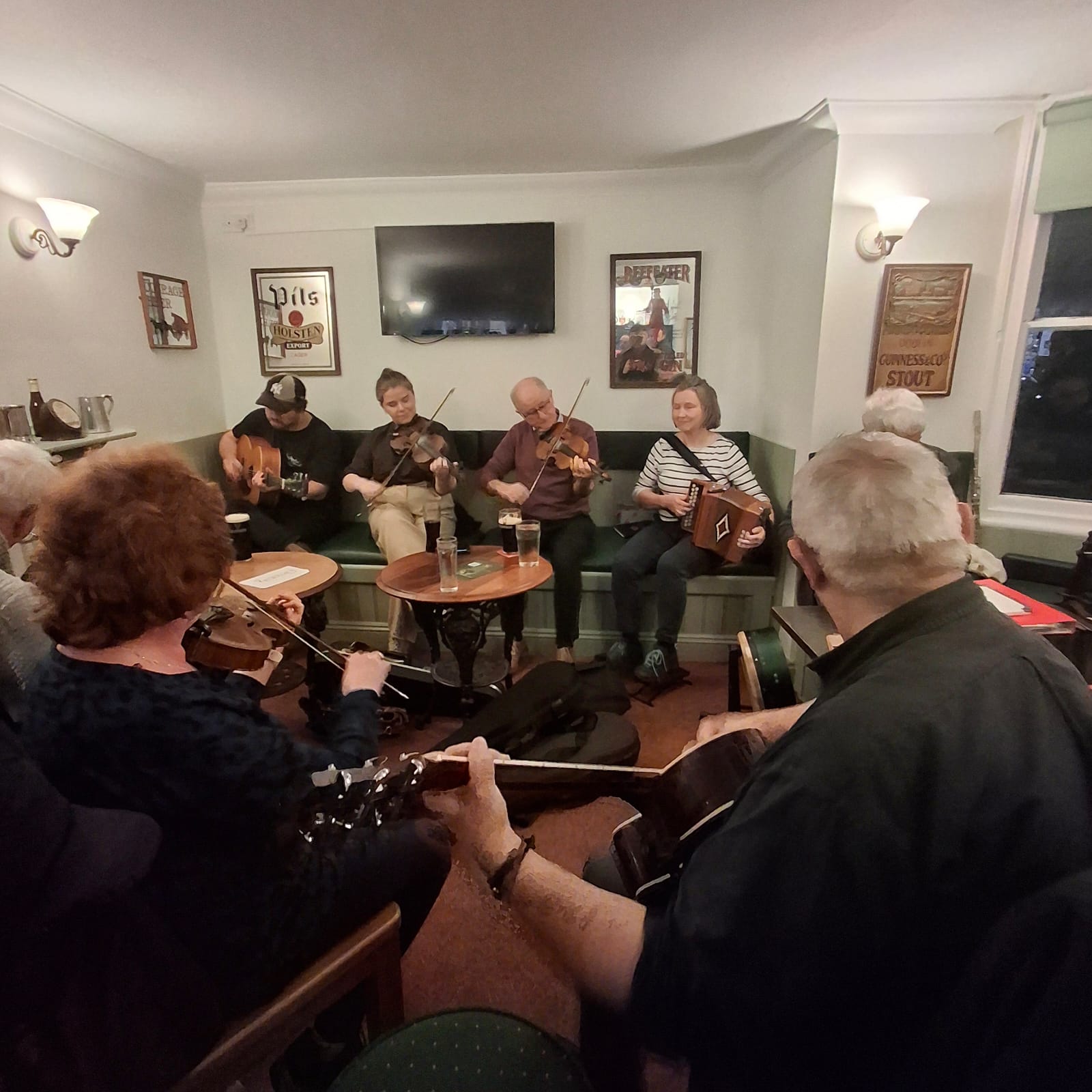
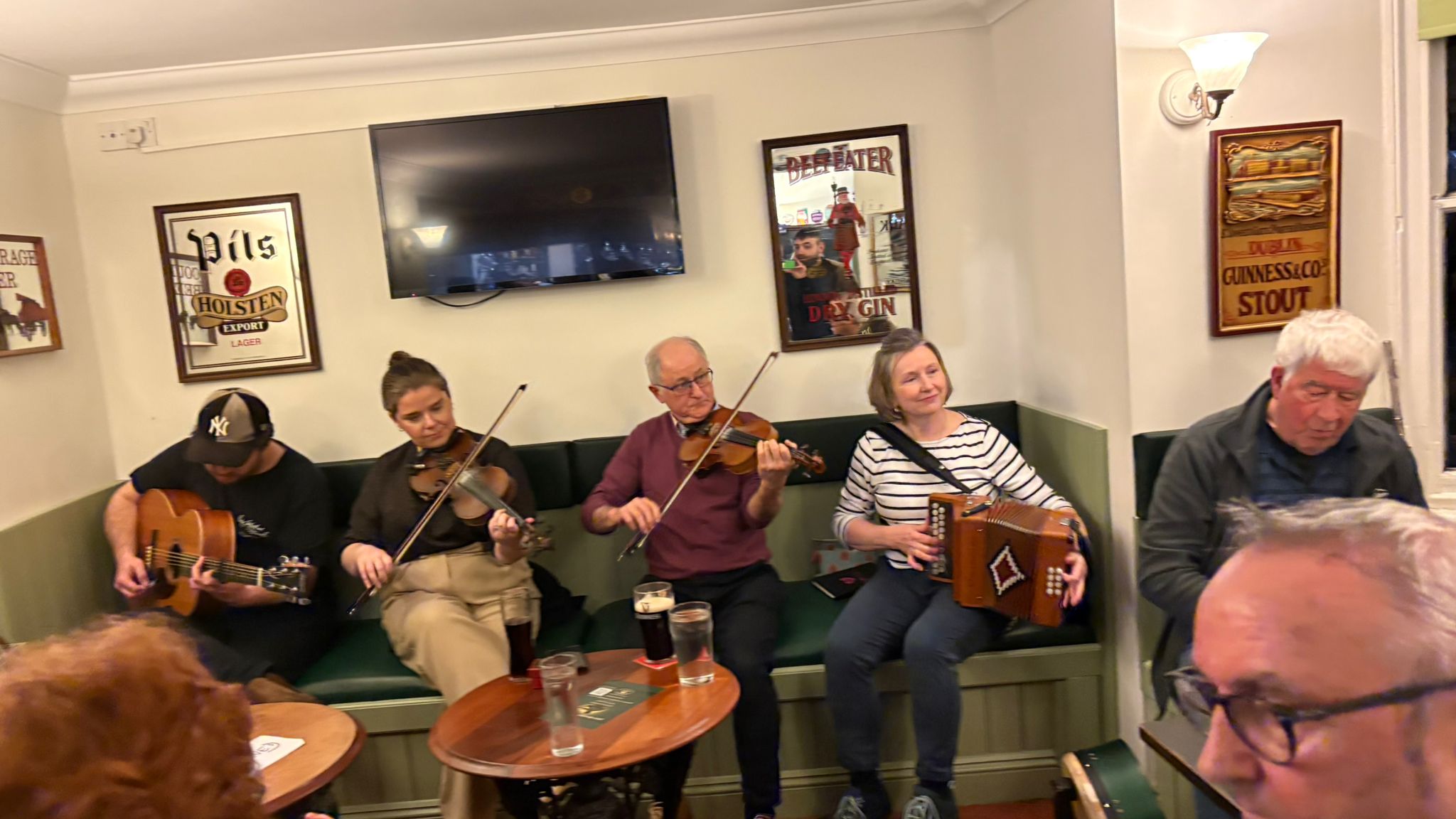
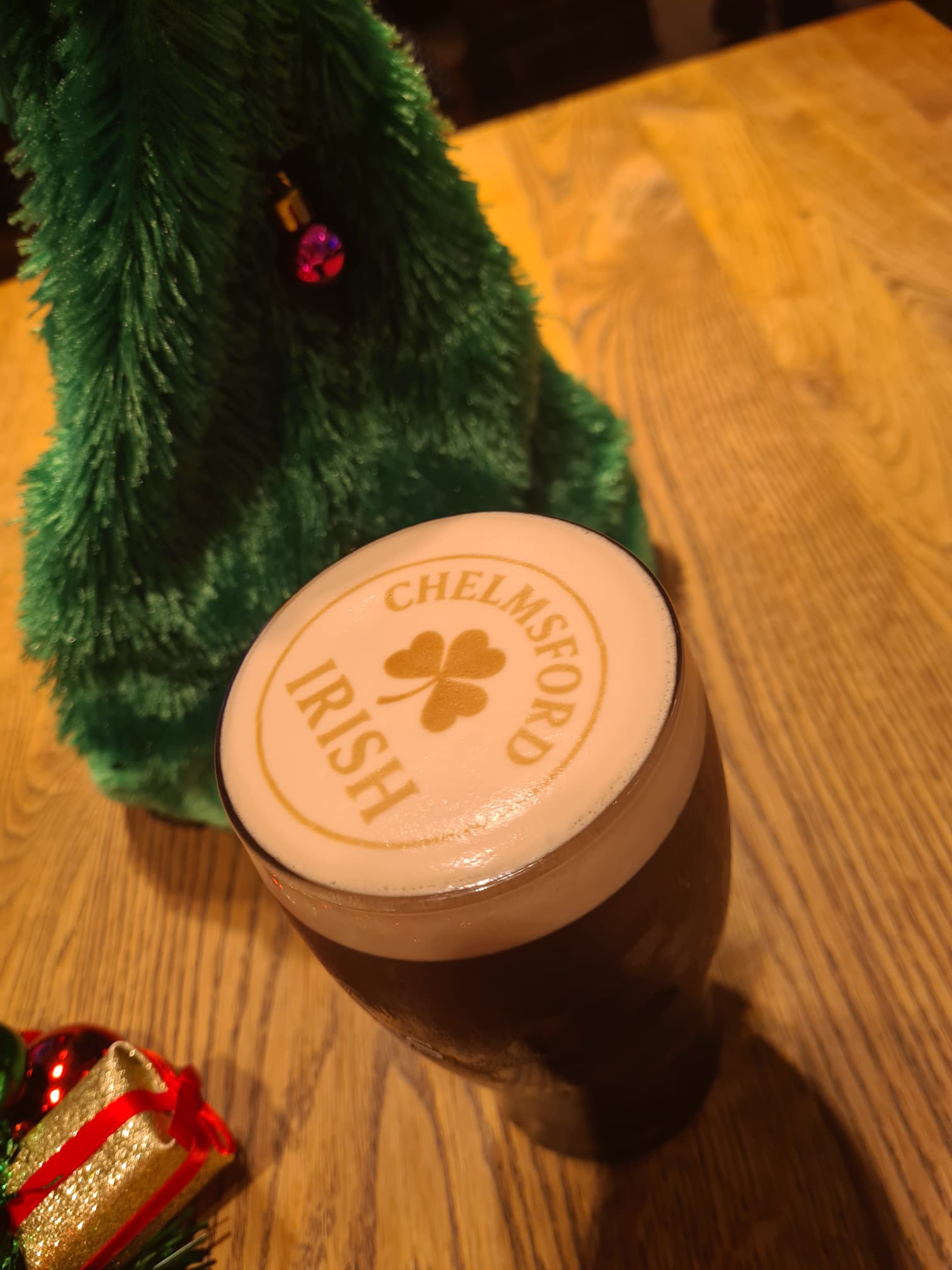
It began as a small traditional music session, started by Bríd and Elaine, both immensely talented musicians who wanted somewhere to play. Within 12 months it grew beyond its original room. There are now two regular sessions. The first remains at O’Connor’s. The second has just launched at the Sir Evelyn Wood, known affectionately to locals as Kitty O’Shea’s, after Katharine O’Shea, the Essex-born sister of Sir Evelyn Wood, who became the wife of Charles Stewart Parnell. Irish connections in this part of England run deeper than most people realise.
Nearly 5,000 people follow Chelmsford Irish online, with individual posts reaching more than 50,000 views.
But the numbers are not the point. The structure is.
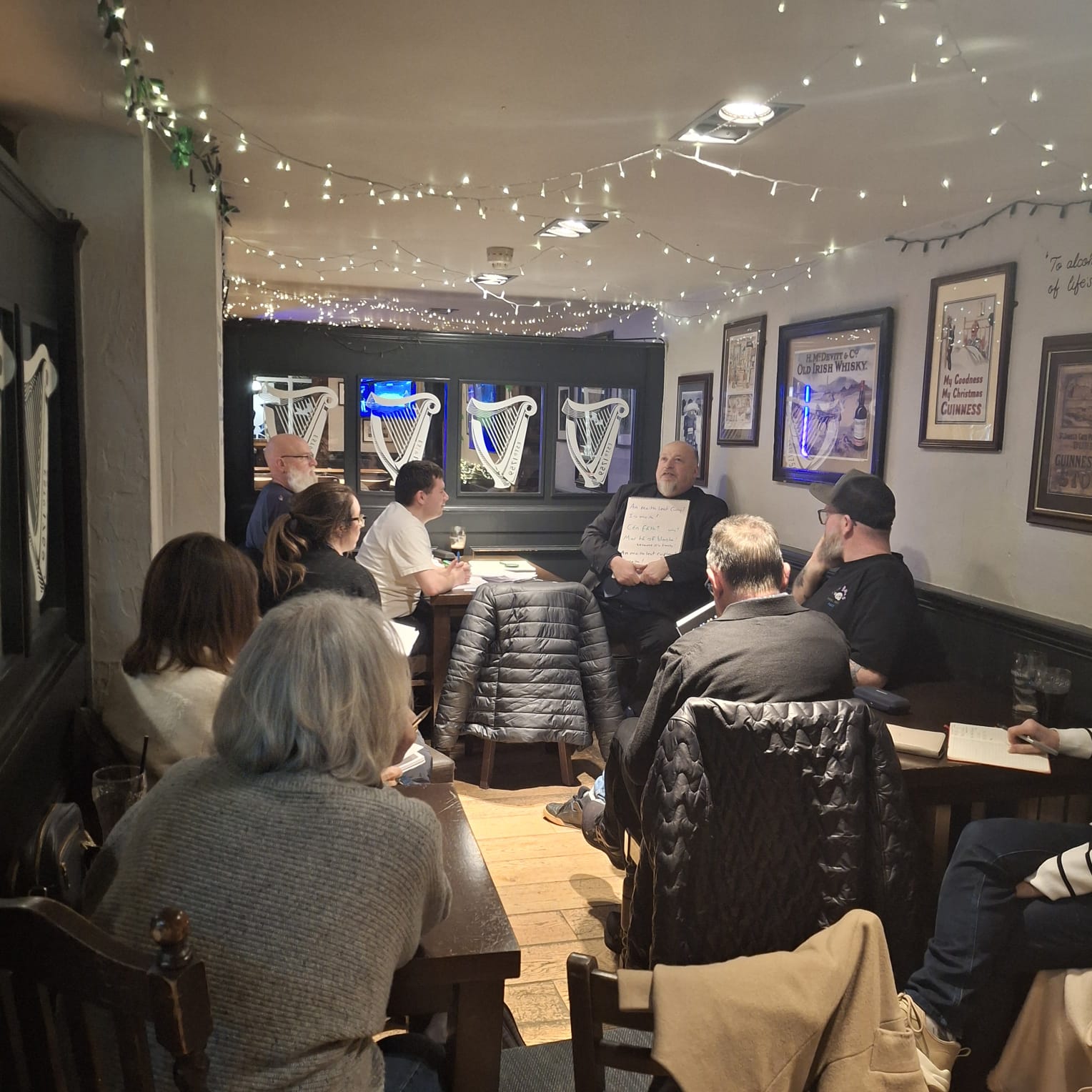
Anniversary session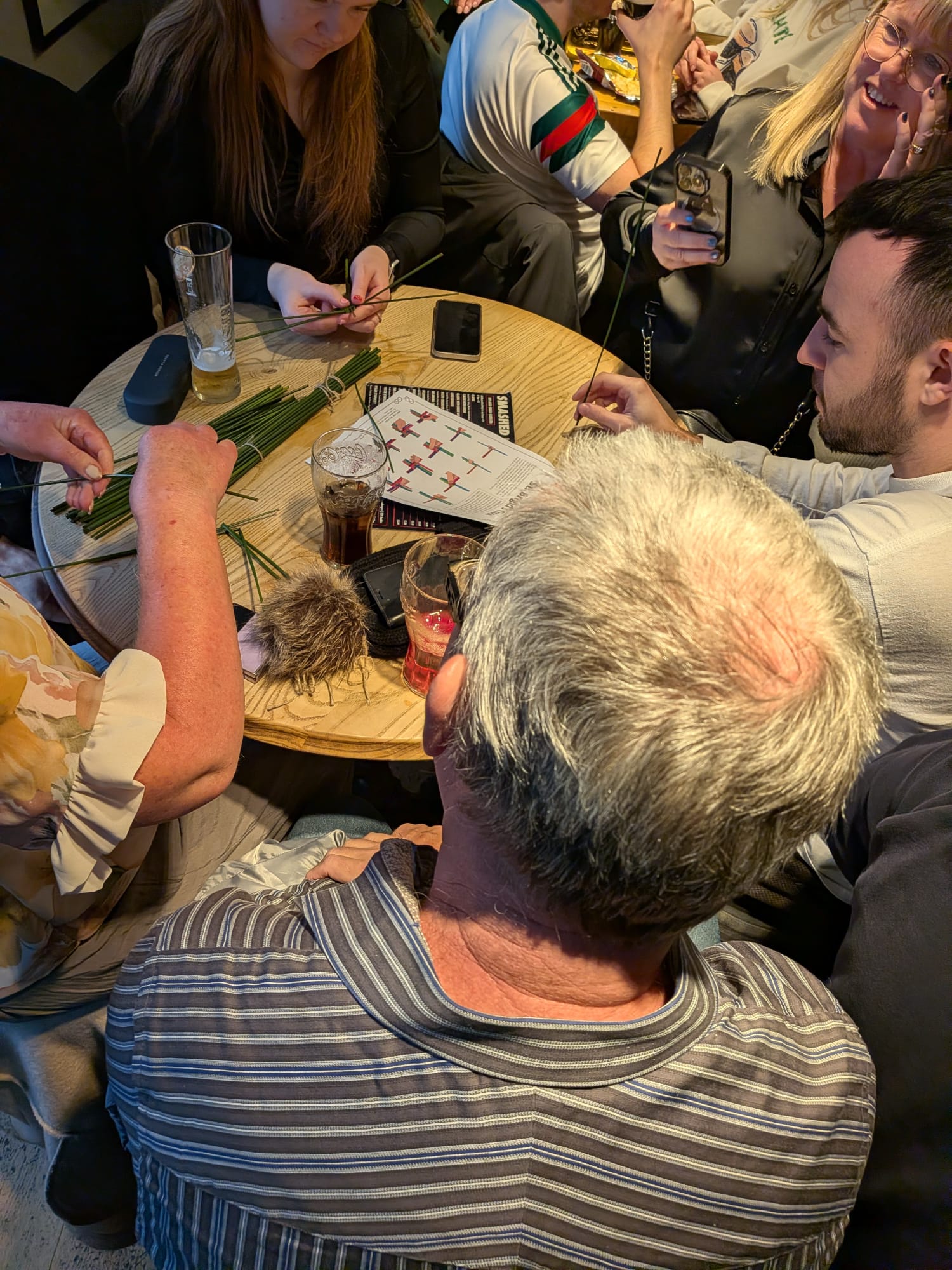
What was built
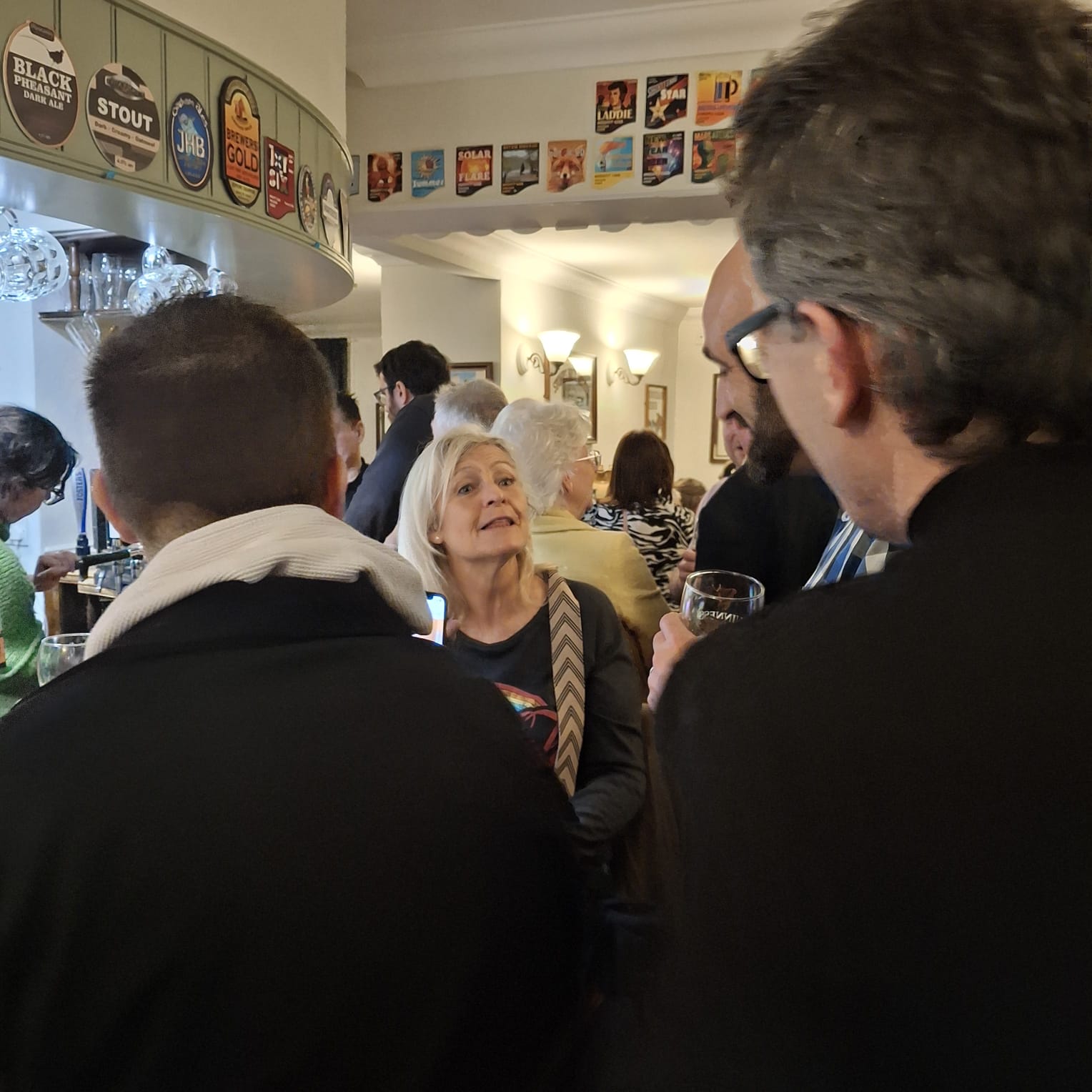
Walk into a Chelmsford Irish session and you will find three generations in the same room. First-generation immigrants who carried the music across the Irish Sea. Their British-born children, raised between two identities. And their grandchildren, born and raised in Britain, choosing to be Irish without apology.
They grew up in Britain, many holding both passports. But belonging was never straightforward. Not quite British enough for Britain. Not quite Irish enough for Ireland. Caught between two identities, they wore their Irishness carefully.
These children and grandchildren, alongside the first-generation Irish, are building differently
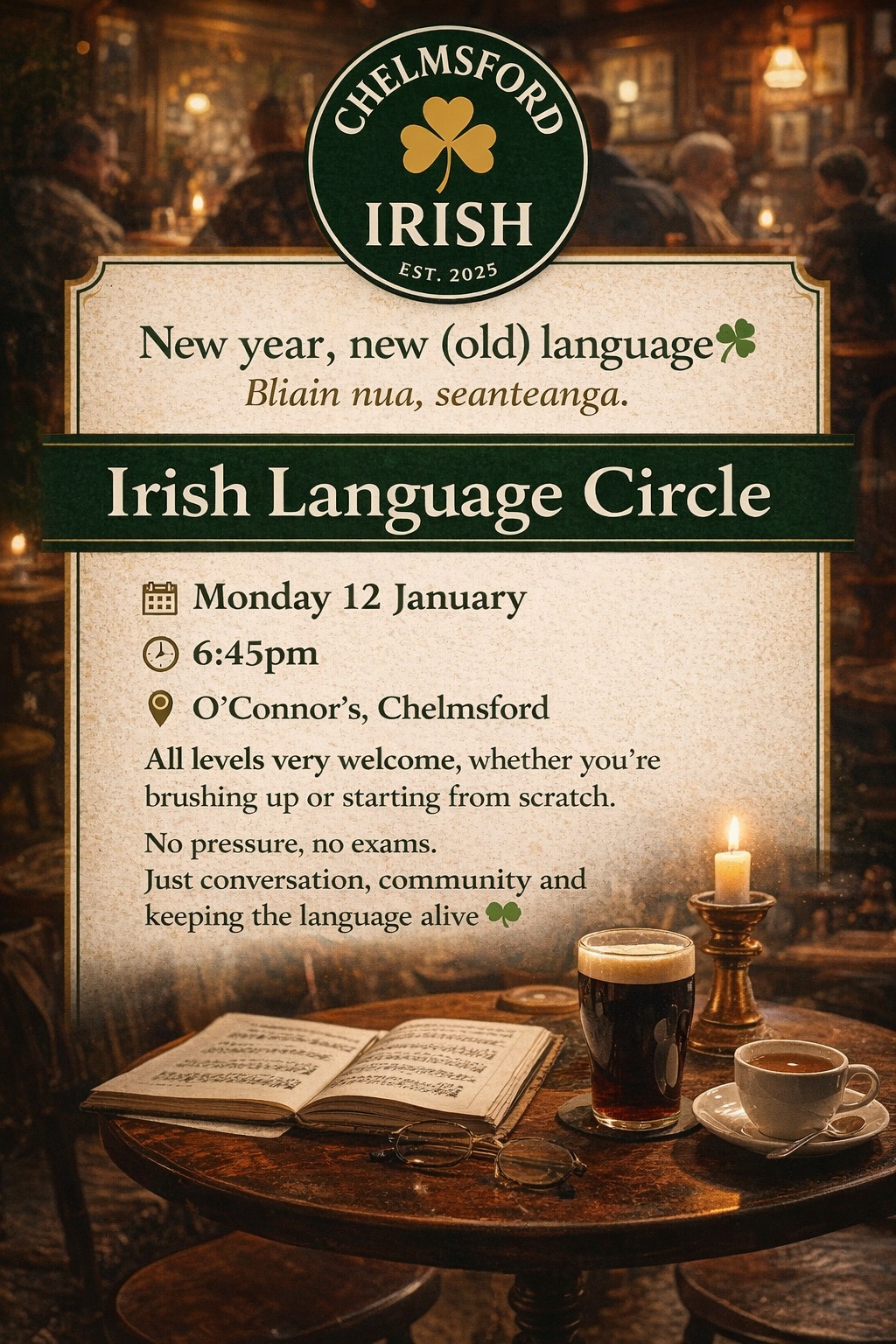
A fortnightly Irish language circle now meets under the guidance of a qualified teacher, organised by Doiminic Bell. A more experienced group of speakers meets on a weekly basis, led by Nicky Browne. The language was not an afterthought. It was a statement of intent.
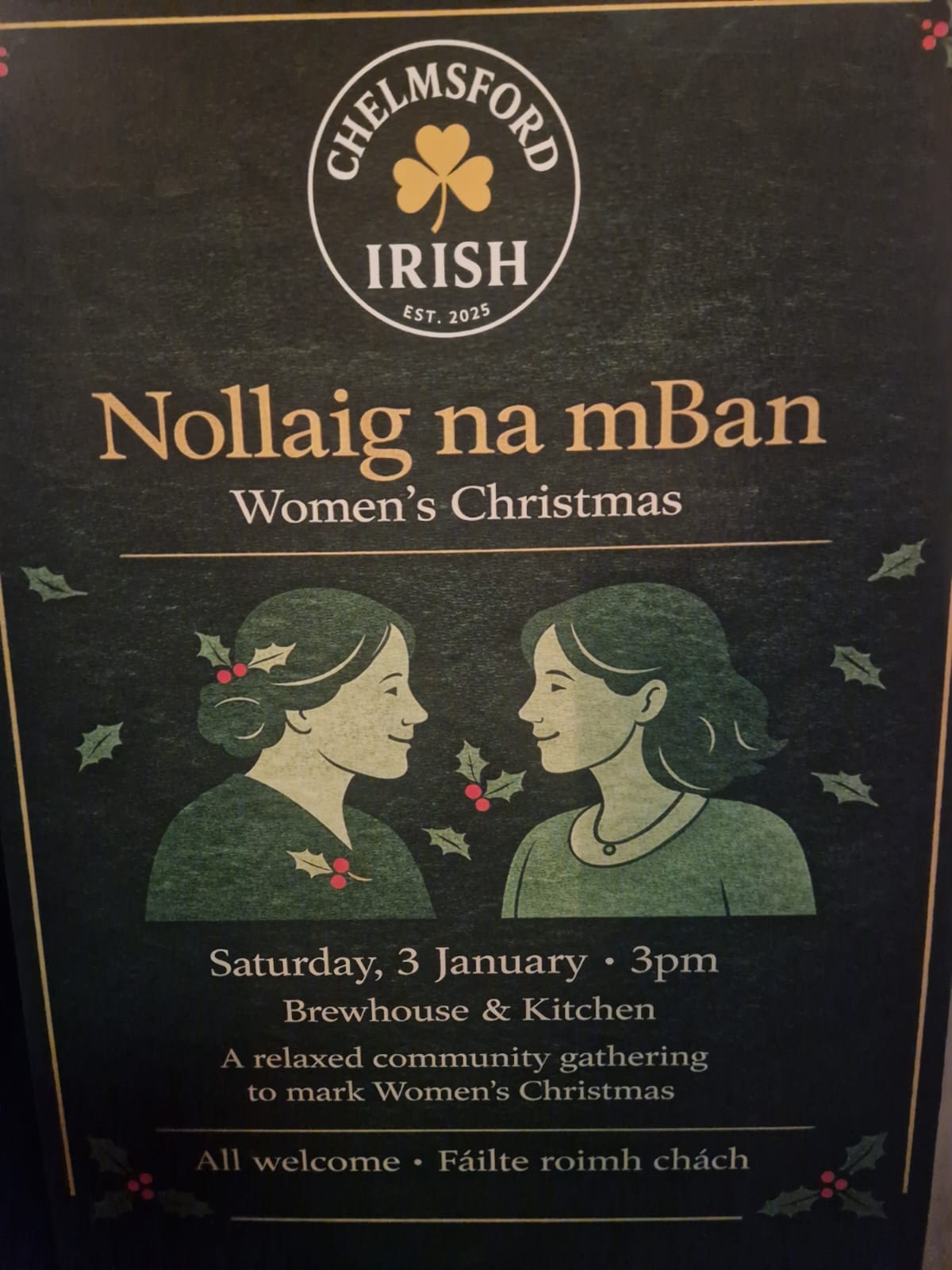
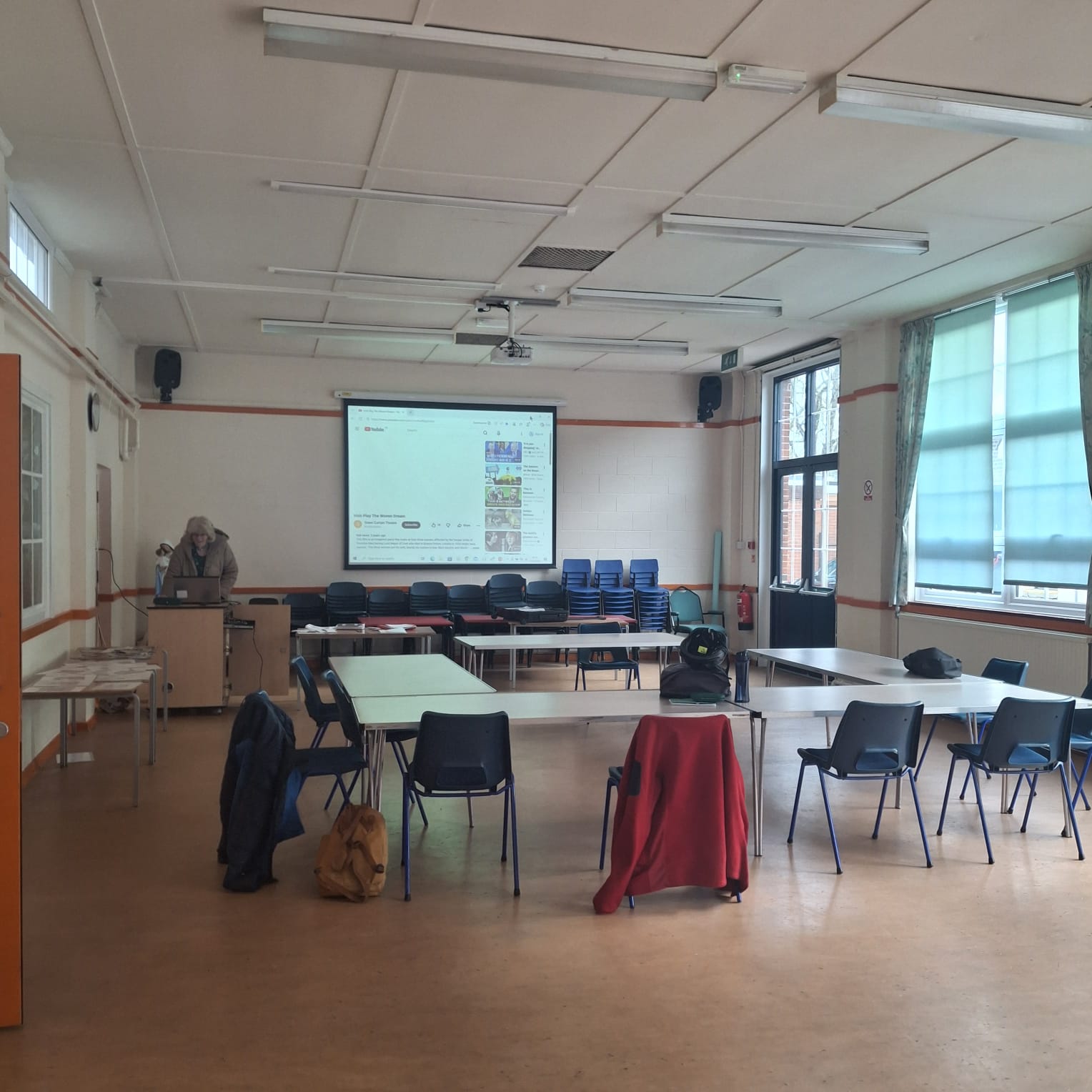
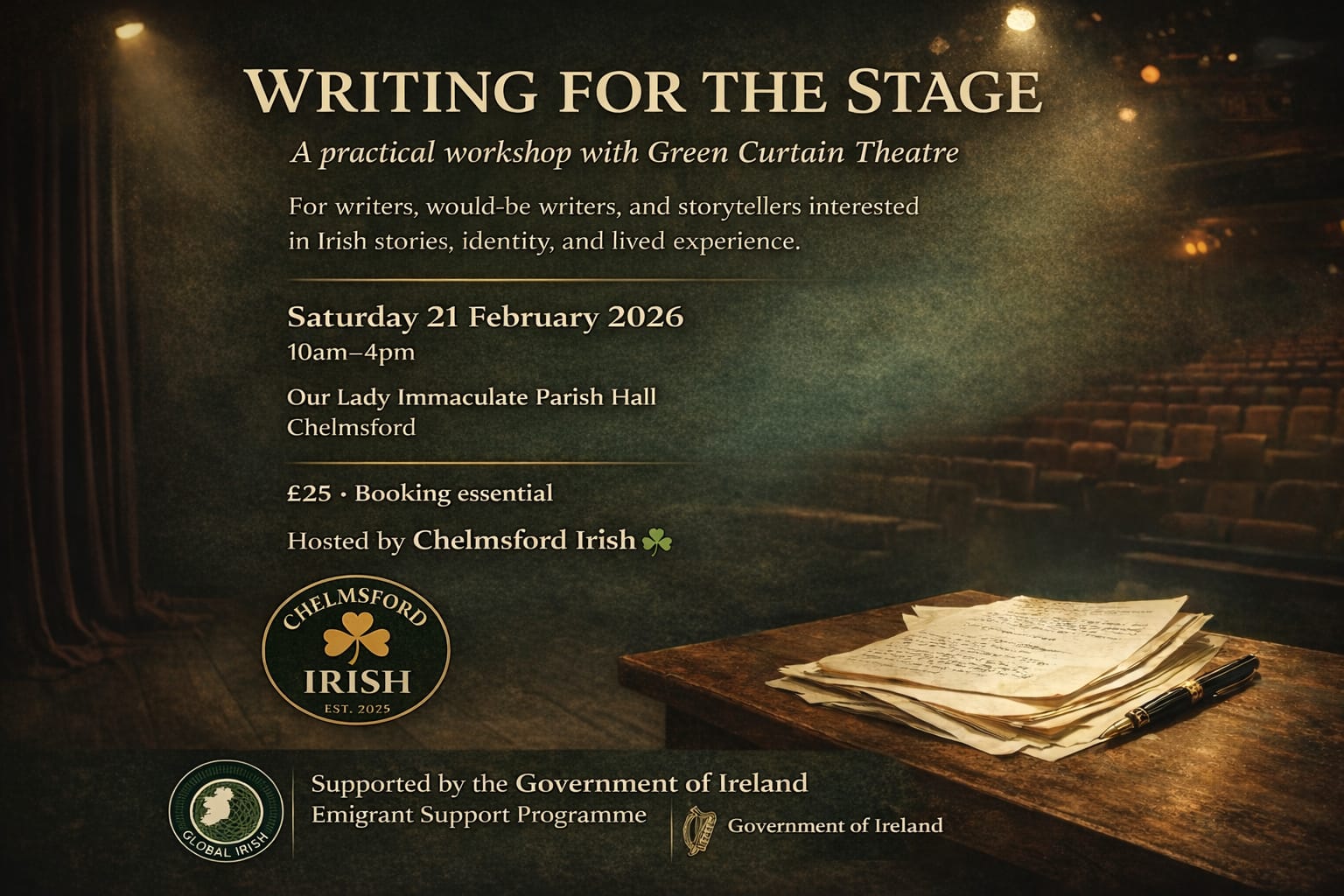
A writing workshop recently ran in partnership with Green Curtain Theatre, shaped by Culture Officer Kerry Fabri. A Nollaig na mBan gathering honoured the women of the community in early January. A Christmas session raised thousands for the local GAA club. Events Officer Marie Bird brought her warmth and precision to both.
In the 7th century, a monk trained in the Irish monastic tradition at Lindisfarne sailed south to bring the Irish church to the East Saxons. His name was Cedd. He built his church at Bradwell-on-Sea, on the Essex coast, in a building made from the stones of a Roman fort that still stands today. Shaped by the scholars of Iona and Lindisfarne, almost certainly a speaker of Irish, he left a mark on this corner of England before England as we know it existed.
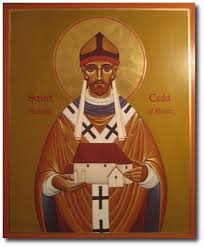
ChI-Co chose his name carefully.
The St Cedd’s Céilí Band, formed through Chelmsford Irish, will compete at the regional stage of Fleadh Cheoil na hÉireann this year. The journey from an informal session to national competition in under 12 months reflects the seriousness of purpose. This is not hobbyism. It is institution-building.
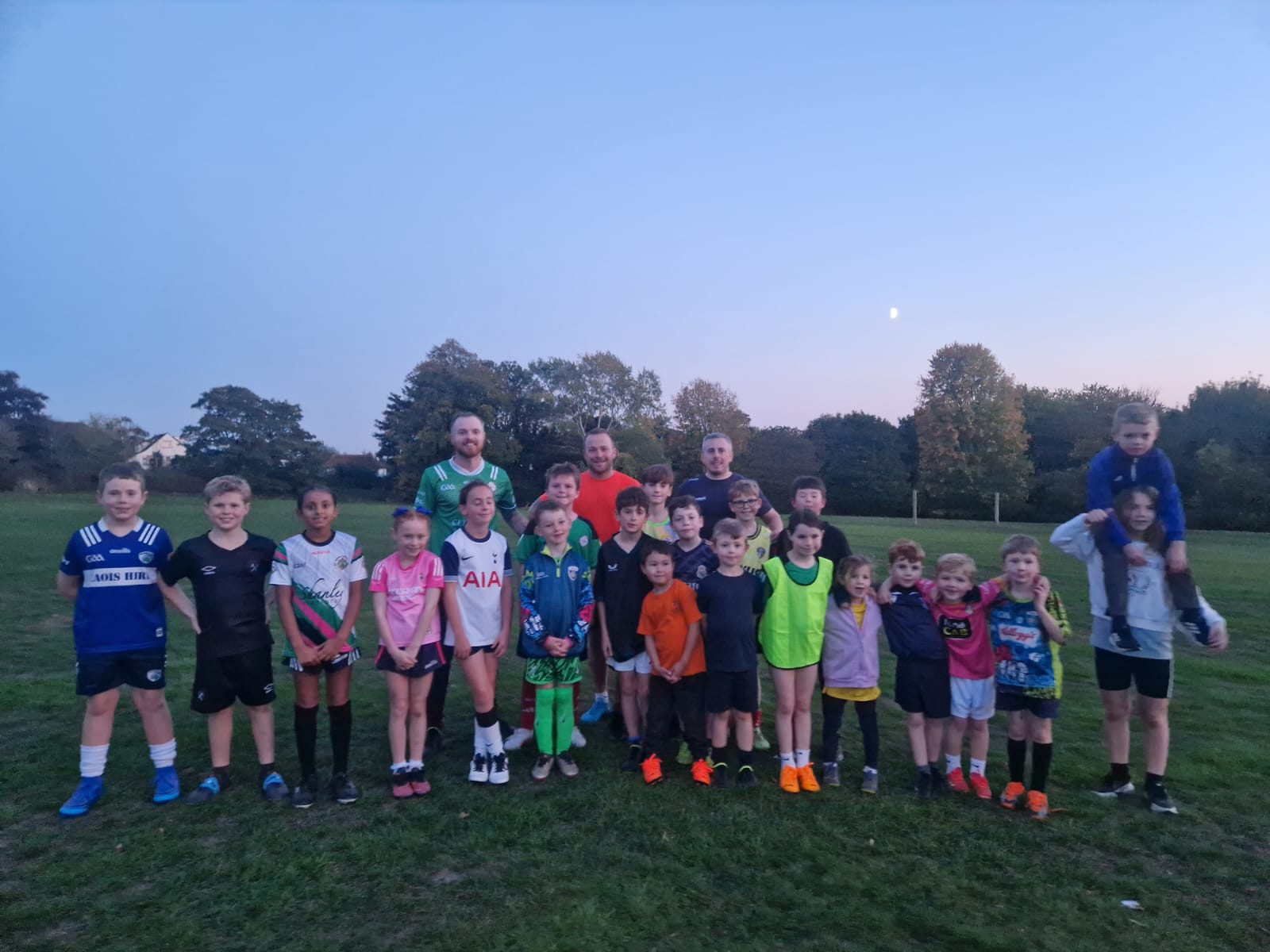
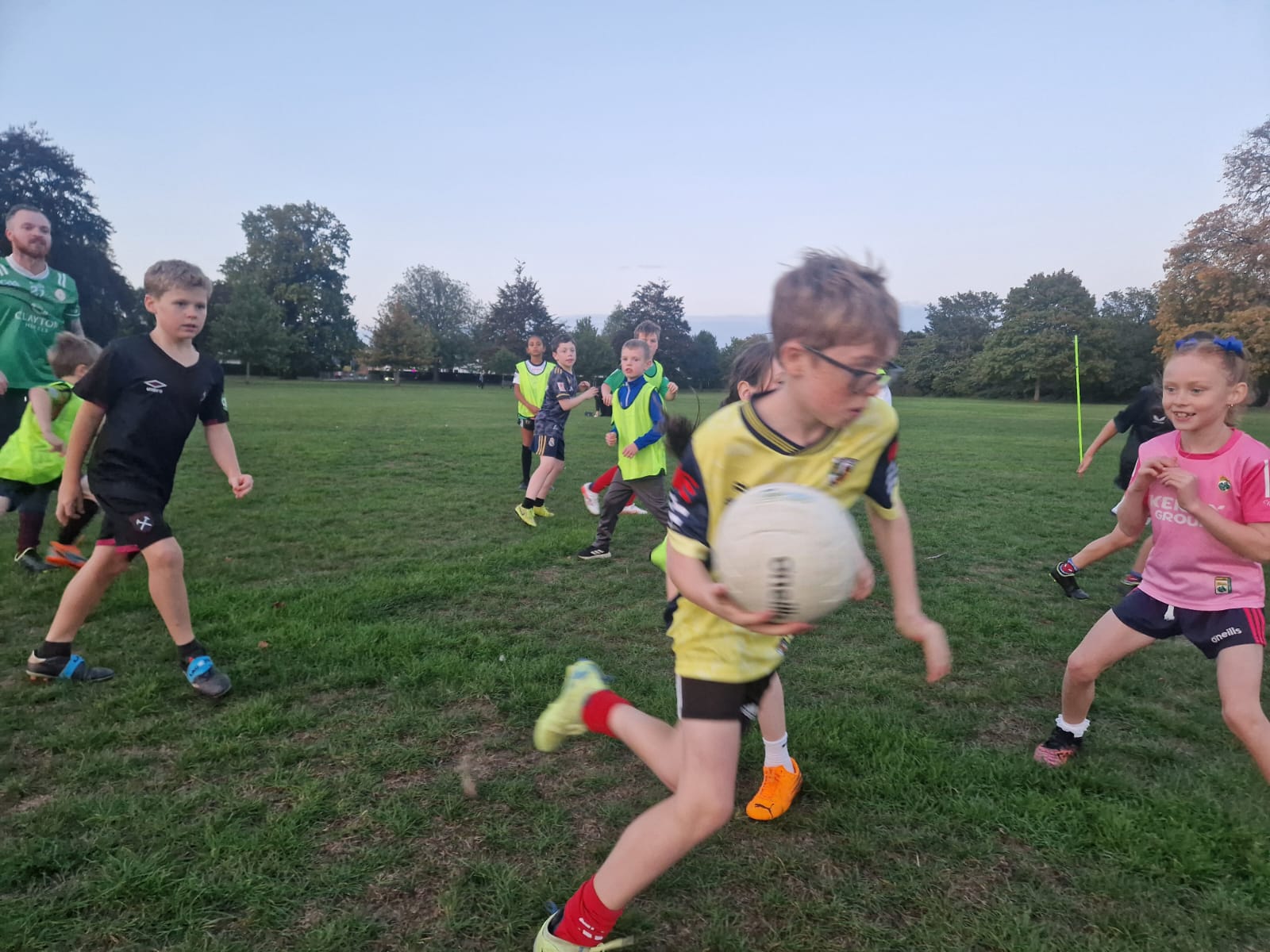
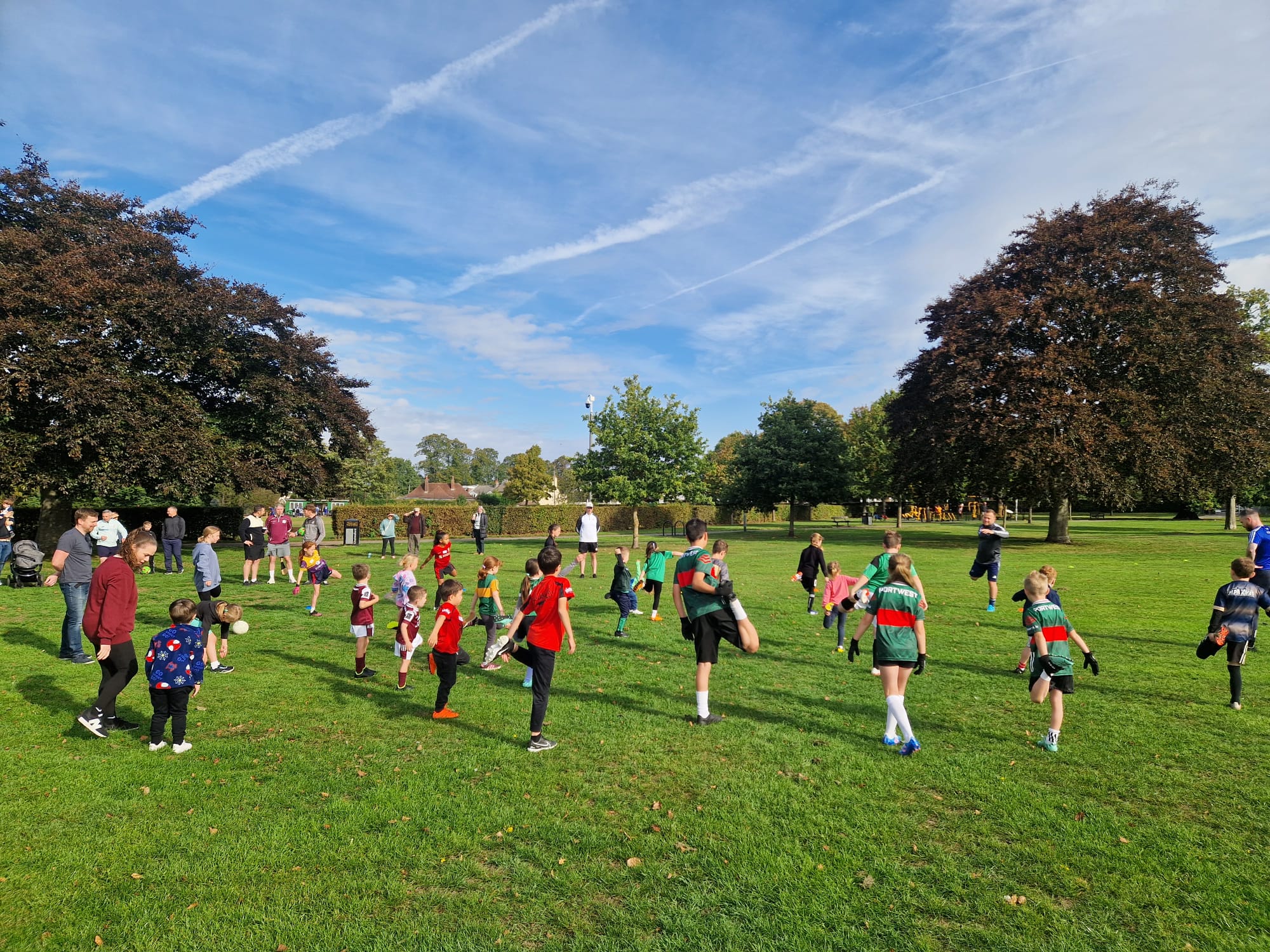
Under the leadership of Darren Mulcahy, Joe Byrne, and Martin O'Donoghue, St Cedd’s GAA now exists as an independent club with its own committee structure, set to field multiple underage teams in competition in 2026. The Gaelic Athletic Association now has a presence in Essex. Children who may never live in Ireland are learning Gaelic games on English soil.
What the community said
ChI-Co ran a community survey recently. It generated hundreds of responses in under a week. The answers were not primarily about logistics. They were about belonging.
“In the 1980s my parents were committee members of the Chelmsford Irish Association, which ran Christmas and St Patrick’s dances at the Shire Hall. What you have achieved in 12 months is momentum that would easily surpass the interest and attendance in those previous events.”
The Irish community in Chelmsford is not new. It existed before, built something, went quiet, and is now back with more energy than ever.
Another respondent had lived in the same city for 50 years before finding the group. “A long overdue social connection with my Irish neighbours,” they wrote. Fifty years. In the same city. Strangers until now.
Others described the experience of finding Chelmsford Irish after years of distance from any Irish cultural life. “My parents were both a bit neurodivergent, we didn’t really socialise with our community. I visited [the sunday session] and listened to the beautiful music but it really brought home how much I had been isolated from the community in my upbringing. I can’t speak the language and I only know a few tunes. I felt uplifted and sad at the same time.”
Uplifted and sad at the same time. The joy of arrival, shadowed by the grief of what was missed. It is the defining emotional experience of the second and third generation, and it was named precisely by someone who had never had the language or the tunes, but felt every note.
For others, the priority is the generation to come. “It’s a connection to home, a way to teach my children about their heritage and a way for them to socialize and become friends with others with similar backgrounds.” And: “Connection for my children and I to our Irish traditions. An opportunity to be, have fun and enjoy my own, prioritise and look after my own unapologetically.”
One response, brief and complete, described Chelmsford Irish as “a voice for the Irish people of Essex.” Not a social club. Not a night out. A voice.
And then this, which captures something larger than one organisation in one city: “A sense of community and pride, recognition of those that never were able to feel as free being Irish.”
Never as free.
That phrase is the key to understanding what is happening here.
What it tells us
Modern Irish identity in Britain is educated, ambitious and culturally confident. It does not need caricature to make itself legible. It does not rely on nostalgia. It seeks permanence.
“I’ve grown increasingly in touch with my Irish heritage in the last 10 years,” wrote one survey respondent, “and to have a group in my home town has been invaluable. Our stories are all different but the central string is Ireland and the Irish.”
What is happening in Chelmsford is not unique. Similar organisations are emerging across Britain. Language classes are filling. GAA clubs are forming in counties where none existed before. The confidence is generational, and it is real.
The Irish in Britain today are secure enough to be visible. Integrated enough to build publicly. No longer required to lower their voice.
Aristotle wrote that human beings flourish not in isolation but through participation in a shared civic life. Diaspora communities understand this instinctively. Without institutions, identity dissipates. With them, it transmits.
The Irish in Britain built institutions before. The parish halls. The county associations. The GAA clubs in Ruislip and across London. The Irish centres in Birmingham and Leeds that were community anchors for a generation of immigrants. Many of those institutions aged and quietened as the communities they served assimilated and dispersed.
What ChI-Co has understood, and what the survey responses confirm, is that the need did not disappear with the institutions. It went underground. It waited. And the children of those who assimilated, secure in their British lives but increasingly aware of something missing, are now rebuilding.
Not in the image of what existed before. In the image of who they are now.
A language circle, not a language class imposed on children who would rather be elsewhere. A writing workshop alongside two monthly trad sessions. A Nollaig na mBan celebration alongside a GAA club. The full range of Irish cultural life, expressed with confidence and without apology.
Saints and scholars. Not leprechauns and stereotypes.
The long view
St Cedd came to Essex in the 7th century and left something that endured for 14 centuries. The Irish have been part of the fabric of Britain ever since, in one form or another. They softened their accents and kept their culture alive in kitchens and parish halls and the back rooms of pubs, passing something down to children who never felt quite British enough for Britain, nor quite Irish enough for Ireland, and who felt the absence of something they could not always name.
Their children and grandchildren are building again. In public. With confidence. With a GAA club fielding underage teams, a céilí band heading to Fleadh Cheoil na hÉireann, a language circle meeting fortnightly, and a community that is done being quiet about who it is.
What a start-up cultural organisation in one English city tells us about modern Irish identity in Britain is this: the quiet is over.
Is ar scáth a chéile a mhaireann na daoine. We live in each other’s shadow, in the best sense of that phrase.
Tá an obair ar siúl. The work continues. ☘️
Chelmsford Irish is run by its volunteer committee, ChI-Co: Chair Dr. James Hoctor, Secretary Elaine Finn Davies, Treasurer and Irish Language Rep Doiminic Bell, Events Officer Marie Bird, Culture Officer Kerry Fabri, Music Rep Bríd O’Donohue, and Sports Rep and Chair of St Cedd’s GAA Darren Mulcahy. The organisation’s Honorary President is Hughie Breen. Follow the organisation on Facebook, Instagram, and TikTok.
This article was submitted to the IrishCentral contributors network by a member of the global Irish community. To become an IrishCentral contributor click here.


Comments