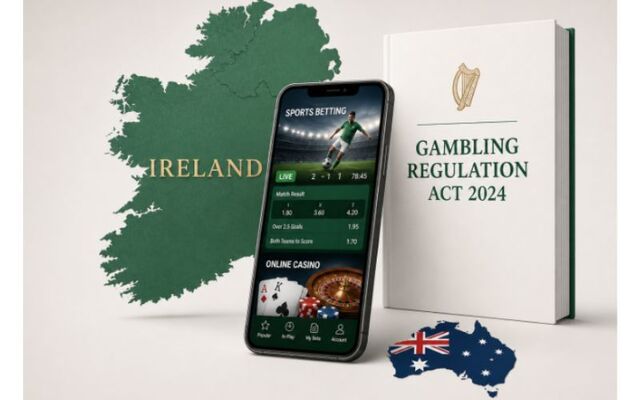
People were already betting online, playing casino games on phones, and using offshore brands long before the State had a proper modern system for all of it. Now that system is arriving.
The Gambling Regulatory Authority of Ireland is open, key parts of the Gambling Regulation Act 2024 are being rolled out, and betting licenses started moving under the new framework in February 2026.
Australia shows why Ireland’s route matters
Australia is the first comparison worth making because it shows how messy the split can get. Online wagering is legal there when run by licensed operators, but online casino-style products are banned for Australian customers. That means casino games, online pokies, online poker, and in-play betting sit outside the allowed online model.
That does not mean demand disappears. It usually means offshore sites fill the gap. These offshore sites usually offer Australians more games, more bonuses, and more flexibility, but players are not under local protection. That means choosing the right site matters a lot! Reading expert reviews is the best choice here. For example, Aussie Casinos is a site that lists and reviews all the safe casinos that accept Australians and helps readers sort through a market where access, rules, and safety do not always line up neatly.
Ireland is not copying Australia’s hard split. It is building a more direct gambling framework with a central regulator, phased licensing, stronger compliance rules, and clearer enforcement powers. That makes Ireland’s path more structured from the start, even if the rollout is still slow and complicated.
What Ireland’s new rules actually change
The big change is that Ireland now has a central gambling regulator with real reach. The old system leaned too much on older laws, tax certificates, and fragmented oversight. That made little sense once online gambling became a normal part of the market.
The new framework gives the GRAI power over licensing, compliance, enforcement, safer gambling measures, and illegal operators. The regulator can also push for court orders to block prohibited gambling activity and block payments linked to illegal gambling. That last part matters because online gambling enforcement is weak if money can still move freely.
There are also more serious penalties. The new law creates more than 30 criminal offenses, with some carrying custodial sentences of up to eight years. That tells operators the new system is not just a paperwork update.
The market is small, but the numbers are not tiny
Ireland is not the UK. It does not have the same population, scale, or betting volume. But the Irish market is still more serious than many people outside the industry realise.
Current forecasts put Ireland’s total gambling revenue at about €2.57bn in 2025. Casino games are expected to be the strongest segment, with about €1.42bn of that total. Online casino activity is also being talked about as a major growth driver, with mobile play and younger digital habits pushing more gambling activity online.
That gives Ireland an interesting profile. It is not a mega-market, but it is a high-value, English-speaking market with strong betting culture and a fresh regulator. That combination is exactly why operators are paying attention.
The UK is still bigger, but Ireland has the “timing”
The UK remains the obvious giant beside Ireland. It has a deeper operator history, a mature online market, and much larger revenue. Across Europe, the full gambling market reached €123.4bn in gross gaming revenue in 2024, with online gambling at €47.9bn, or 39% of the total. The UK remains one of the largest pieces of that wider picture.
Ireland’s advantage is timing. Britain has become tougher and more expensive for operators, especially after recent tax pressure. Ireland now offers a nearby English-speaking market with fresh rules and a regulator that says fees and social contributions will be proportionate to operator size and turnover.
That does not make Ireland easy. It just makes it interesting. For smaller and mid-sized brands feeling squeezed in Britain, Ireland may look like a cleaner second step than jumping into a completely different region.
What players should expect next
For Irish players, the most important change is more structure.
Licensing should make it easier to see which operators are allowed to serve the market. Compliance reports, safer gambling duties, and clearer rules should also make the difference between licensed and unlicensed sites easier to spot. The regulator is taking a phased approach, which means the full picture will not appear overnight.
The player experience may also change in smaller ways. Expect stricter identity checks, clearer account rules, tighter advertising controls, and fewer “free money” style promos. The new law includes broad language around inducements, and that may affect bonuses, VIP offers, and promotional mechanics. Operators will not want to test the line too hard until the rules are clearer in practice.
That might feel annoying to some players. But it should also reduce some of the mess that comes with weakly supervised markets.
Where Ireland compares well
Ireland has three things going for it.
- It already has a strong gambling culture. Horse racing, sports betting, and major betting brands are part of the local story. That gives the market a real base instead of forcing operators to build interest from nothing.
- The new regulator gives the market a clearer center. That helps players, but it also helps serious operators who want rules they can plan around.
- Ireland sits close to the UK market in language, habits, and operator experience. That makes it easier for UK-facing brands to understand than a market with totally different player behavior.
Those are real strengths. They are also why Ireland is being watched more closely now than it was a few years ago.
Where Ireland still looks tricky
The hard part is balance. If the rules are too soft, the system will not protect players properly. If the rules become too heavy, operators may avoid the license or push more players toward offshore sites.
That risk is not theory. The new regulator has strong enforcement tools, but Ireland is still a small and competitive market. Operators will look carefully at compliance cost, tax treatment, ad limits, bonus rules, and enforcement style before deciding how much money to put in.
Legal friction is also likely. Advertising rules and inducement bans are already areas where the wording may need real-world testing. That means the early years will probably involve guidance, disputes, and adjustments as the market learns how the new system works.
So, how does Ireland compare?
Compared with Australia, Ireland looks more open to a regulated online gambling model. Australia keeps online casino-style products outside the legal offer, which leaves more room for offshore confusion. Ireland is trying to bring more of the market under one regulator instead.
Compared with the UK, Ireland is smaller but fresher. The UK has scale, but also heavier pressure and lower operator patience. Ireland has the chance to build something more predictable if it keeps the rules clear and steady.
Compared with wider Europe, Ireland is not the biggest prize. But it may be one of the more interesting mid-sized markets because the rulebook is changing while online demand is already there. Europe’s online gambling share is still rising, and Ireland is now trying to shape that shift before the market becomes harder to control.
The real answer is simple…
Ireland’s market is changing from loose and dated to structured and supervised. That does not make it perfect. It does make it more serious.
If the regulator gets the balance right, Ireland could become a clean, competitive, player-safer market. If it gets too heavy, players and operators may look elsewhere.
This article includes insights from Bart Crebolder, a gambling writer and casino market analyst with hands-on experience reviewing online casinos across Australia and Europe.