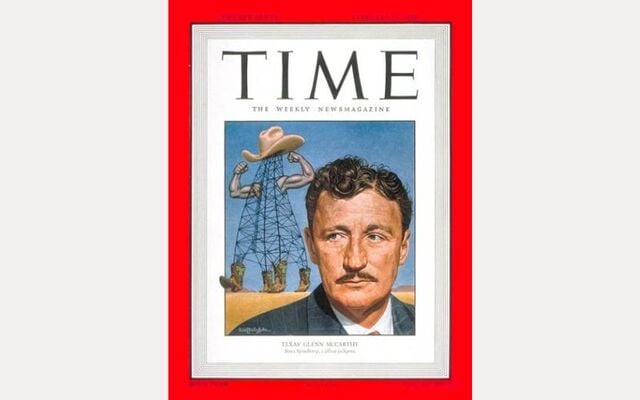
On March 17, 1949, the new hotel's glitter drew Hollywood names such as Kirk Douglas and Lana Turner, who admired shamrocked lights and what was then the world's largest outdoor pool, before the gala descended into mayhem. The night marked the high-water point of a flamboyant wildcatter who rose from a waterboy in Beaumont amid the Spindletop boom to amass vast wealth from wells around Anahuac and beyond, only to see fields run dry, debts mount, and the hotel later sold as his empire unraveled.
It is Saint Patrick’s Day, 1949. We are in the newly built Shamrock Hotel, the stage for what promises to be a spectacular occasion. Hollywood stars like Kirk Douglas and Lana Turner are here, admiring the Irish-themed lighting overhead. Most of the guests are calm and collected, but some are not - the mayor’s chair is stolen, a radio broadcast is cut off after someone swears too effusively, and someone even breaks their arm. Indeed, the mayor, incensed by the loss of his chair, later called the party “the worst mob scene I ever witnessed”.
Despite its name, however, the Shamrock Hotel is not in Ireland. We are instead in downtown Houston, Texas, invited to the hotel’s opening ceremony by its charismatic owner. Known as the Wildcatter, Glenn McCarthy has reached the big time. The son of an itinerant oilfield worker, McCarthy has become one of the wealthiest oilmen in the United States, worth about $200 million. Though he is beginning to age at this point – his curly brown hair has greyed – he certainly knows how to have a good time. Even the mayor can’t stop him from doing that.
Born in Beaumont, Texas, in 1907, Glenn McCarthy was destined for a life in the oilfields, even as a boy. At the age of eight, he began work as a waterboy for his father, a labourer in a nearby oil field, earning 50 cents a day. An accomplished football player but mediocre student, he entered the oil business after dropping out of college, buying two Houston fuel stations before his 23rd birthday. He married the daughter of a prominent oil tycoon, setting in motion a distinguished career in the industry.
Read more
McCarthy came of age at the opportune time for an aspiring oilman. In 1901, an oil well was found at Spindletop, near Beaumont, sparking a flood of investment into the town. The following year, Spindletop alone accounted for 94% of the state’s total production, while Beaumont’s population increased fivefold that same year. Companies like the Texas Fuel Company (Texaco) were set up in the town, making Texas the most oil-rich state in the country. By 1940, its oilfields were producing twice as much annually as California, its closest competitor.
A charming man, McCarthy was looked down on by his new father-in-law, who dismissed him as a social climber. Determined to prove him wrong, McCarthy went hunting for oil fields to drill. He struck liquid gold for the first time in Anahuac, a small town midway between Beaumont and Houston, shortly before his 26th birthday, from which he could extract almost 600 barrels of oil a day. His landholdings expanded rapidly – by 1949, he owned about 400 oil and gas wells, sufficient to put his net worth at $200 million (about $2.5 billion in today’s money).
McCarthy spent his wealth liberally. He built a mansion in downtown Houston and financed unsuccessful efforts to bring an NFL football team to the city. In 1949, he built the Shamrock Hotel near his mansion, flying in 2,500 shamrocks from Ireland for its opening ceremonies.
Eighteen stories tall, it was adorned with green décor and featured what was then the largest outdoor swimming pool in the world. In a further nod to his ancestry, he called the inhouse night club the Cork Club and employed a team of synchronised swimmers called the “Corkettes”, who delighted his famous guests. In all, about 5,000 people attended the hotel’s opening ceremony, costing McCarthy about $1 million in total.
Read more
Now well-established in elite American circles, McCarthy grew his business empire further. He co-produced the film “The Green Promise”, starring Natalie Wood, then just a child actor, and Walter Brennan, an Irish-American friend.
McCarthy's enchanting personality made him many friends – a 1952 Time magazine write-up reported how, after finding out that he needed $20,000 to finish his mansion, an oilman that McCarthy barely knew sent him a cheque of $50,000 with the note “Pay me when you can”.
Later that year, novelist Edna Ferber published Giant, a book about a Texan family, with one of its protagonists, Jett Rink, being based on McCarthy. In 1956, the book was adapted into a film, with Rink’s character being played by James Dean.
Flush with cash, McCarthy bought a 15,000-acre ranch in West Texas and invested in cattle, a radio station, banks, tabloid newspapers, steel mills, and even his own brand of bourbon. He also served as the chair of Eastern Airlines and was appointed President of the U.S. Petroleum Association. Unfortunately for McCarthy, however, the good times would not last forever.
In the early 1950s, his wells began to run dry, and low oil prices further reduced his revenues. By 1952, he owed $52 million to insurance companies, forcing him to sell the Shamrock to the Hiltons, an affluent family of hoteliers. He even sold off his mansion, moving to the small Texas town of La Porte.
Read more
With the assistance of his moneyed friends and a government loan, he eventually recovered financially, but his entrepreneurial streak was gone. He embarked on failed drilling ventures in South America before retiring from public life. He died in 1988, just long enough to see the Shamrock Hotel demolished. McCarthy’s high life had come to a crushing end.
In this essay, I have told the story of Glenn McCarthy, the Irish-American wildcatter of elite Texan society. He was one of many oilmen to shape its economic and political fortunes during the 20th century. H.L Hunt became the wealthiest man in the United States and used his money to fund the far-right John Birch Society, Clint Murchison operated oil and gas reserves across the state, financing his son’s founding of the Dallas Cowboys NFL team, and William G. Heltzel oversaw the construction of the Inch Line, which supplied American ships and aircraft with Texan oil during the Second World War.
Today, Texas is home to a new cadre of ultrarich business prospectors, including Elon Musk, Mark Cuban, and Stan Kroenke. These wildcatters lie at the vanguard of technological progress, media ownership, and sporting success, influencing all of our lives for good and for ill. As in McCarthy’s day, Texas continues to power the United States, but this time using renewables - it is the number one provider of both wind and solar energy in the country. Even without its Irish-American wildcatter, the party goes on.
This article was submitted to the IrishCentral contributors network by a member of the global Irish community. To become an IrishCentral contributor click here.



Comments