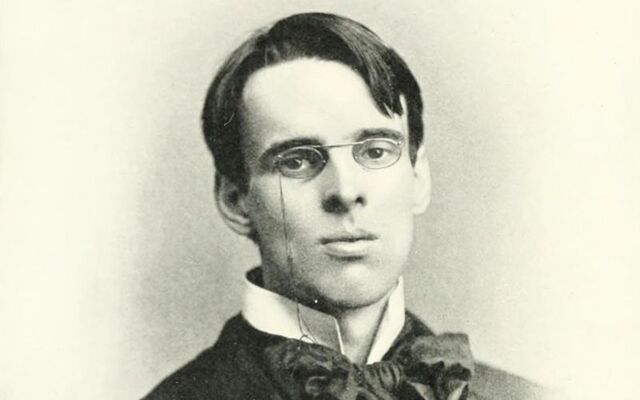
"The Lake Isle of Innisfree" may be one of the most memorized poems in the Irish canon, yet beneath its dreamy Irish landscape lies a striking connection to America. From Thoreau and Emerson to the Irish diaspora and Yeats’ own nationalist vision, the poem carries echoes of both sides of the Atlantic.
W. B. Yeats’ “The Lake Isle of Innisfree”: a poem so thoroughly Irish, yet with roots firmly planted in America. This poem about self-reliance, the beauty of nature, and the celebration of the land of Ireland seems simple — simple enough for generations of schoolchildren to memorize and recite. However, examining just one dimension of its nationalist theme reveals multiple connections to America. This poem shows unexpected, deep connections among the American experience, the Irish diaspora, natural and Celtic imagery, and Yeats’ nationalist ambitions for Ireland.
Before Ireland was officially its own country, when Irish immigrants in the United States were required to list “Great Britain” as their place of birth on passenger ship records and U.S. census reports, Yeats’ writings about Ireland had to be similarly nebulous. But this didn’t stop the young Yeats from pursuing his goal: expressing the values of Irish identity to help create the nation.
Among his earliest poems, “The Lake Isle of Innisfree” was printed in his 1893 volume The Rose. This poem was inspired by John Butler Yeats’ reading of Henry David Thoreau’s Walden to “Willie” when he was a young boy, and more immediately, by the tinkling of a fountain that the grown-up W. B. heard in a London shop window. The imagery in this poem is dreamy, twilit, and otherwise “Celtic,” yet other components of the poem make it stand out as a work that moves toward articulating a nascent national identity, parallel to the motives and ideas that animate the American experience.
First, we can’t ignore the title! Literally translated, the title island, in English, is “Island of Heather” (“Inish” = “Island,” “Fraoigh” = “Heather”); however, Yeats was certainly aware of a primarily Anglophone audience’s tendency to hear and see “free island” in the title.
Second, the poem’s rhythm and meter are natural and free, not adhering to standard, traditional guidelines for poetic form, as Jahan Ramazani notes. The poem flows naturally, as if spoken by someone who is aspirationally laying out his plans to return to nature, to an unspoiled life, unmarred by the dirtiness of modern civilization. Freedom in form, liberty in expression, expansive in imagination. Are we describing Ralph Waldo Emerson, Walt Whitman, and Langston Hughes — or Yeats?
Read more
Third, the retreatant speaking in the poem hopes to be self-sufficient on the island. And he has plans to make this happen! Today, we might say he’s avant-garde in his environmental awareness, desiring to build an eco-friendly abode and live on a sustainable microfarm, in harmony with the beans and the bees. Self-reliance is the name of the game; he will both go back to his roots and create something new.
Fourth, the speaker in the poem echoes the declaration of the Prodigal Son, in the well-known parable, “I will arise, and will go” (Luke 15:18), as the Innisfree speaker plans his homecoming to the island: “I will arise and go now.” The speaker’s resolve to “arise and go” appears twice in the poem: in the oft-recited first line, and in the first line of the final stanza. The poem ends with this individual giving us the most concrete reference yet to his placement on the pavement, as he “stand[s] on the roadway, or on the pavements grey.” The island is always present to him, but only in a dream. He cannot combine the real and imagined worlds; he must live in one and only long for the other.
I think it is significant to note that in the decades when this poem was written and first published, not only was the Irish cultural revival taking hold in Ireland itself, but its flames were being fanned by the Irish in America. Irish language classes and cultural societies had already gained a strong foothold by this time, following bold and grand schemes such as the Fenian Raids in Canada just a few years earlier. Perhaps Americans of Irish birth and descent would no longer be prodigal—the success of willing an Irish nation into existence would rely on buy-in from all its constituents, at home and abroad. Would they answer the call to arise and go?
Since this poem is based on a Walden-like notion, it is clear that the speaker seeks some sort of independence (the American impulse) and to forge his own path, in defiance of flawed contemporary conventions. The nationalistic references in this poem are coded, possibly because at this time, the nascent nation was so amorphous that being any more specific would have caused Yeats to fail in the expression of a universally Irish ideal.
But the seed was planted, and the bean rows would grow.
An American impulse, transformed by the Irish spirit. A masterful expression of the desire for freedom and a return to authenticity. Hopes and dreams, plans and action. The best of both sides of the Atlantic, all in a 12-line poem.
This article was submitted to the IrishCentral contributors network by a member of the global Irish community. To become an IrishCentral contributor click here.

Comments