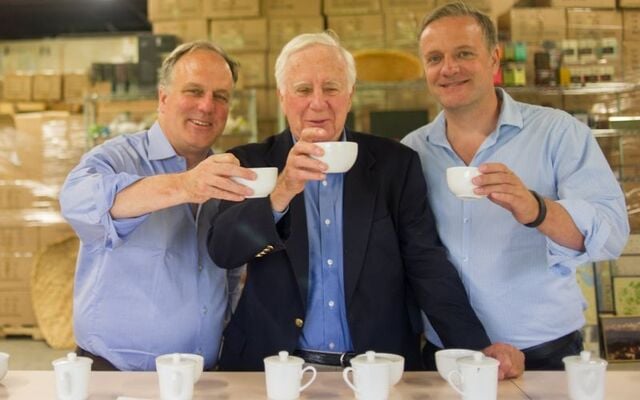
When John Harney founded Harney & Sons in 1983, he was a 53-year-old innkeeper working out of his own basement with five blends and little else to his name. More than four decades on, the County Cork-descended family behind the brand runs one of America's best-known tea companies, still led at 95 by John's widow Elyse, who chairs the Monday morning meeting.
There is no sign of coffee as Mike Harney settles in for our interview. He orders an Irish breakfast tea and speaks, unhurried, about how his father built a business from nothing, though it becomes clear soon enough that Mike has spent his own life helping the company evolve further. Tea is rarely far from his hand; he buys it, tastes it, checks the blends coming off the line, a ritual he has kept up for close to four decades now.
"I once joked with one of my interns on her first day by asking, 'Where's my coffee?' To which she was naturally confused," he says, laughing.
The Irish thread
The Harney family's arrival in the United States predates the Irish Famine, and Mike traces their roots to County Cork. Their Irish heritage remains a strong part of the family’s identity. A later generation settled in North Creek, in New York’s Adirondacks, where Mike’s grandfather grew up to become the first in the family to attend college, eventually earning a doctorate and going on to teach.
That academic thread skipped a generation, he tells me, surfacing again only when his father, John, decided at 53 to start over with little more than a handful of teas and a hard-won education in hospitality, a decision that would eventually become Mike's own inheritance.
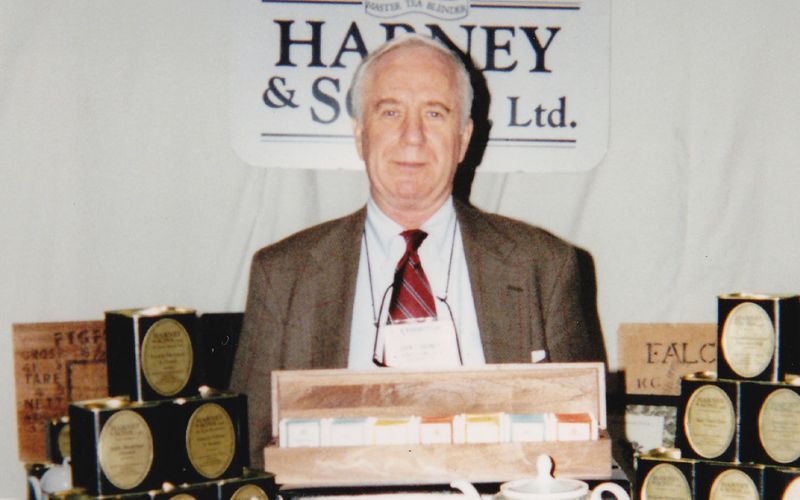

Founder of Harney & Sons, John Harney.
John, as Mike describes him, arrived at that decision by a circuitous route. Born outside Cleveland in 1930, sent to live with relatives after losing his mother young, and eventually landed with an uncle in Manchester, Vermont, who ran a string of country inns. It was there that hospitality first took hold of him, and there he met Elyse, Mike's mother, who later urged him toward Cornell's Hotel School once his service in the Korean War had ended.
John graduated in 1956, having needed a special dispensation from the school just to finish on time, and the friendships he made there outlasted the degree; he stayed close to Cornell for the rest of his life, a connection Mike says still shapes how the family thinks about the school.
Mike joined the company in 1988, and it is from that vantage, thirty-odd years in, that he now describes the business.
"Whenever she sold a house, there would be a little chunk of change, and she would give it to my father, and he would keep operating," he recalls of his mother's real estate career, which quietly kept the family afloat through Harney & Sons' leanest years.
By the time Mike came on board, annual sales still fell well short of a million dollars. Today, the company runs as a family affair he can map out without pausing: his brother Paul beside him, his wife Brigitte running the shop in Millerton, New York, their sons handling the café, the photography, the website, the company's dealings abroad. After John died, Mike and his brother Paul were both made vice presidents.
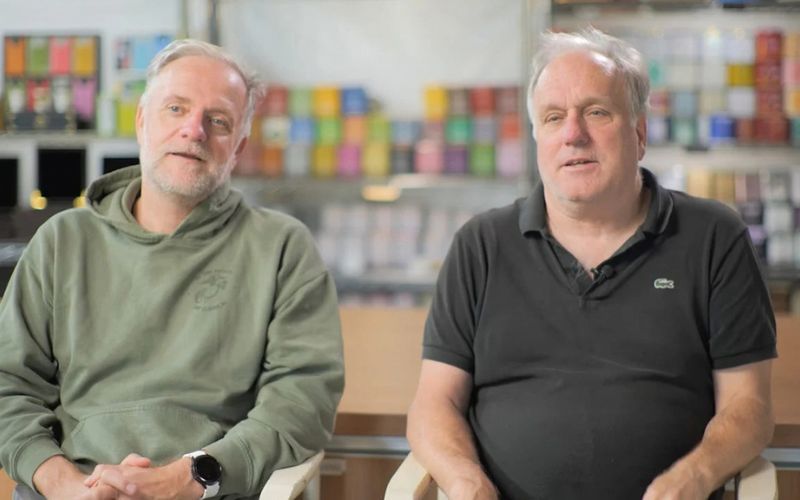
Paul and Mike Harney.
“Rather than do something like on the English throne, where they kill the other person,” Mike jokes, they decided their mother, Elyse, would be the most neutral choice for president. At 95, she still leads the family’s Monday morning meeting.
A basement in Connecticut
He tells the company's origin story with evident affection for its unlikeliness. In the 1970s, his father was running the White Hart Inn in Salisbury, Connecticut, when he fell in with Stanley Mason, a Londoner whose family had three generations in the tea trade behind them. Mason persuaded the inn to serve something better and taught John the fundamentals. Years later, the inn was sold, and no fortune to show for it, John founded Harney & Sons in 1983 out of the family basement, with a small roster of teas built on what Mason had taught him: Assam, English Breakfast, Earl Grey, Darjeeling, and Ceylon.
“We have the same basic recipe that Stanley taught my father all those years ago.”
Mike walks me through the three pillars his father built the business on, and clearly still relies on: the hotel relationships forged during John's years in hospitality; a place on the shelves at Williams Sonoma, won after a chance call from its founder, Chuck Williams; and the toll-free number 800 TEATIME, secured in an era when long-distance calls still gave people pause.
He has a gift, too, for pointing out his father's odder triumphs, among them a licensing arrangement to supply Britain's Historic Royal Palaces, a detail Mike still finds wry given the family's Irish roots. The reputation eventually traveled well beyond Millerton: Bon Appétit named John its Food Artisan of the Year, and the U.S. Tea Association made him Man of the Year in 2011.
Giving before you get
One connection Mike returns to more than once is his father's friendship with Irish-American Charles "Chuck" Feeney, whom he met at Cornell and with whom he cemented a relationship between the two families for decades afterward. Feeney went on to co-found Duty Free Shoppers, amass a considerable fortune, and then quietly give almost all of it away, guided by a philosophy he called giving while living, a phrase Mike still invokes.
He worked in hospitality for Feeney himself before returning in 1988 to join his father's business, and says the example still informs how the Harneys think about philanthropy, in their own more modest register.
"We took it from giving while living to giving before you get," he says. "My father had no money when he started in this business."
That same connection, Mike notes, is how he met his wife. Brigitte had arrived from France as an au pair in 1977 and met the Harneys through a mutual friend and Charles Feeney’s daughter, Danielle; the two reconnected years later during an internship in France, and after a stint in Chicago they joined John in a business that had, by then, been squeezed into little more than a garage.
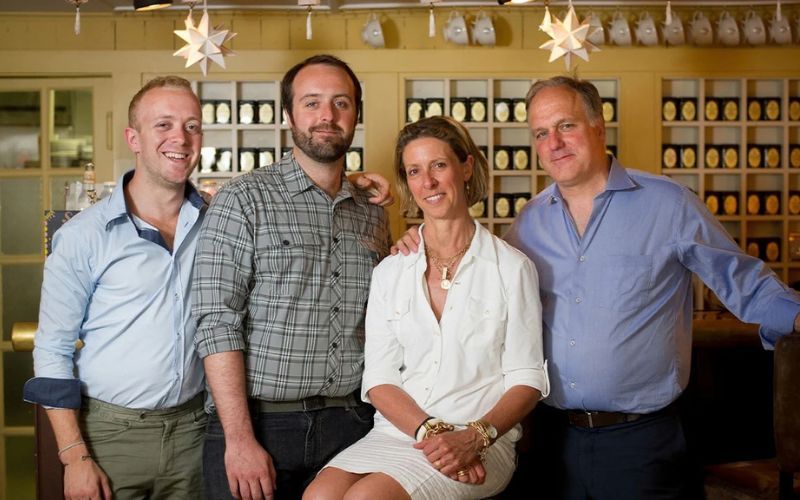
Mike (right) with his sons and wife, Brigette.
Brigitte now chooses the gifts and home goods for the Millerton shop. Their sons run the café, the photography, the SoHo store, and its marketing, each finding a distinct place within what Mike calls a family machine.
What has sustained Harney & Sons, in Mike's telling, is a willingness to widen its range without losing sight of the tea itself. Alongside the loose leaf and sachets, the company now bottles ready-to-drink iced teas, juices, and lemonades, a line that did not exist when his father was still working the phones from Salisbury. Mike's own days still revolve around tasting, be it a tea the company might buy, an incoming shipment, or the day's production before it ships. When we spoke, he was sampling a new holiday blend called "Lump of Coal" and turning his attention to matcha, chasing the drink's rising popularity beyond its traditional following.
Only teas that make you smile
A German tea broker once told him to buy only teas that make you smile, and Mike has carried that counsel ever since, borrowing it for the title of his forthcoming book, "Why Tea Makes You Smile," which he describes as "a science book disguised as fun." He is also at work on a chapter he calls "British legacy teas," covering varieties such as Assam and Darjeeling that took shape under British rule in India, a subject that leaves him with a certain wry gratitude. "I'm thankful to the British for their legacy teas," he says, "and I suppose, ironically, that they made the lives of my ancestors so miserable that they had to emigrate to America. Without that, I don't suppose I'd be where I am today."

The company's range still carries an Irish thread, one Mike speaks of with particular pride: the Irish Breakfast blend itself, Emerald Isles, Malachi McCormick, named for the Irish author and publisher, and the AOH Hibernian Blend, made for the Ancient Order of Hibernians. Irish drinkers raised on Lyons or Barry's can be particular about their cup, he admits, but he hopes that if Harney & Sons ever reaches Irish shelves, some will be curious enough to try something else.
John Harney died in 2014, having remained active in the business almost to the end; on his final day, Mike remembers, he bought strawberries and handed them out to employees, a small gesture from a man who believed that making people feel welcome mattered every bit as much as making a sale.
“He was a wonderful salesman and always had such perseverance. People would take his calls, would listen to him. As his son, I was always kind of surprised how people would get extremely excited to see him.”
“We miss him, but I think he’d be very proud of all that’s been achieved.”
The company has more than doubled in size since, carried forward by the family that once kept it running on faith alone. Mike's own measure of a good tea has not changed. Above all, he says, it should make someone smile.
Visit Harney & Sons at its Millerton shop and café or its SoHo shop in New York City.




Comments